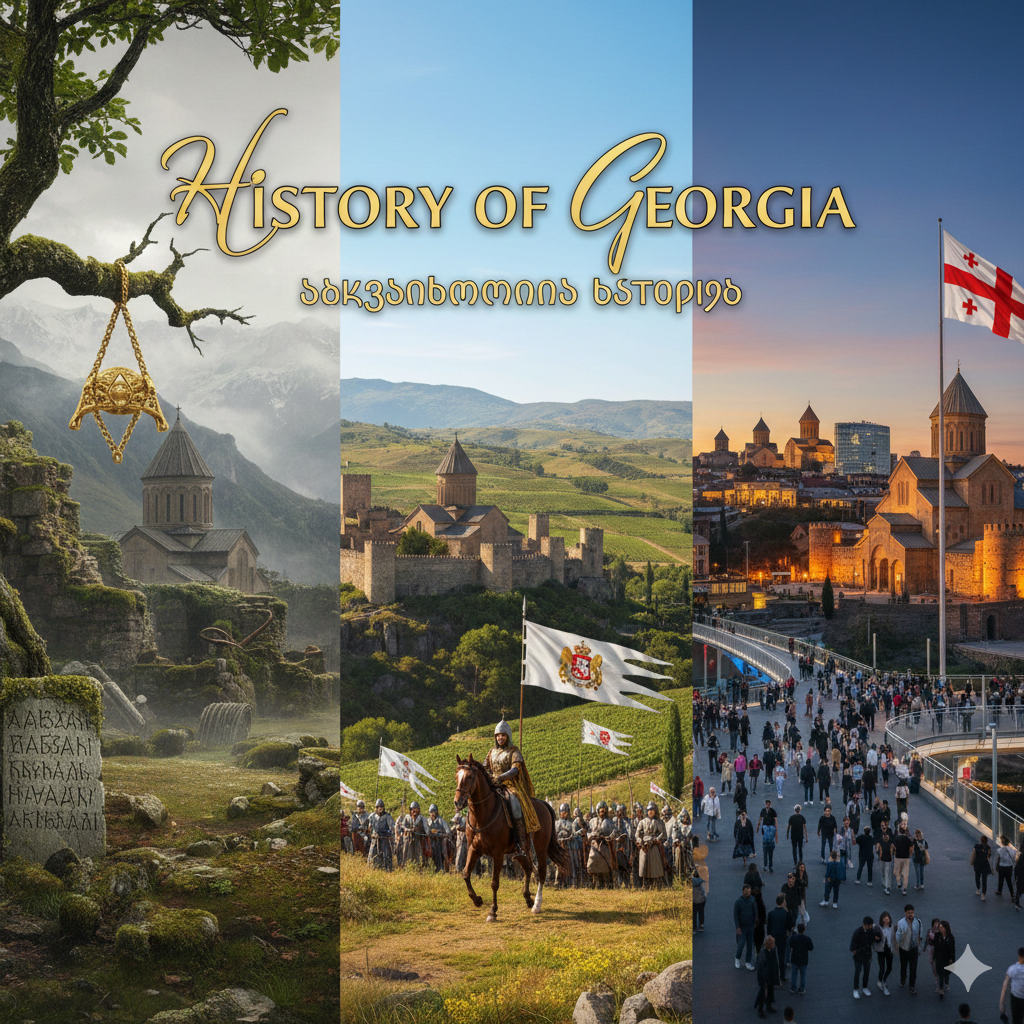
1. Prehistory and the Roots of Colchis
The History of Georgia is one of the oldest in the world. Dmanisi, in southern Georgia, is home to the 1.8 million-year-old remains of Homo erectus georgicus, the earliest evidence of hominids in Europe.
By the first millennium BCE, two distinct Georgian entities emerged:
-
- Colchis: Located on the Black Sea coast, famous in Greek mythology as the home of Medea and the destination of Jason and the Argonauts in search of the Golden Fleece.
-
- Iberia (Kartli): Located in the east, which would become the heart of the future unified Georgian state.
2. The Adoption of Christianity
One of the most defining moments in Georgian history occurred in 326 CE, when the Kingdom of Iberia officially adopted Christianity. This was largely due to the missionary work of Saint Nino of Cappadocia, who famously fashioned a cross from vine branches tied together with her own hair.
This conversion aligned Georgia culturally and politically with the Byzantine Empire and served as a crucial pillar of national identity, distinguishing Georgians from the surrounding Persian and, later, Islamic empires.
3. The Golden Age (11th – 13th Centuries)
Georgia reached its zenith under the Bagrationi dynasty. This era was characterized by a massive flourishing of architecture, philosophy, and poetry.
-
- King David IV (The Builder): Reigning from 1089 to 1125, David expelled the Seljuk Turks, reorganized the military, and founded the Gelati Academy. His victory at the Battle of Didgori (1121) is still celebrated as a “Miraculous Victory.”
-
- Queen Tamar the Great: David’s great-granddaughter, she presided over a period of immense cultural influence. It was during her reign that Shota Rustaveli wrote the national epic, The Knight in the Panther’s Skin.
4. Centuries of Invasion and Fragmentation
The Golden Age was shattered by the Mongol invasions in the 1220s. For the next 500 years, Georgia became a battlefield between the competing Ottoman Empire (to the west) and the Safavid/Qajar Persians (to the east). The country was frequently split into smaller kingdoms (Kartli, Kakheti, and Imereti) and principalities, struggling to maintain its Christian faith and language against overwhelming odds.
6. The Russian Era
Exhausted by Persian raids, King Erekle II signed the Treaty of Georgievsk in 1783, seeking protection from the Russian Empire. However, instead of a protectorate, Russia moved to fully annex Georgia in 1801, abolishing the Bagrationi monarchy and the independence of the Georgian Orthodox Church.
While this brought relative stability and Western European influence, it also sparked a century of revolts and the birth of modern Georgian nationalism led by figures like Ilia Chavchavadze.
7. Independence, Soviet Rule, and Modernity
With the collapse of the Russian Empire in 1917, Georgia declared independence as the Democratic Republic of Georgia (1918–1921). This brief experiment in social democracy was ended by the Red Army invasion in 1921, incorporating Georgia into the Soviet Union.
Notable events of the 20th century include:
-
- The Stalin Era: Despite being a native Georgian, Joseph Stalin oversaw brutal purges in his homeland.
-
- The 1989 April 9 Tragedy: A peaceful anti-Soviet demonstration in Tbilisi was violently suppressed, accelerating the push for independence.
-
- The Rose Revolution (2003): A peaceful revolution that ousted the old Soviet-style leadership and initiated rapid pro-Western reforms.
Summary Table: Key Milestones
| Era | Key Figures | Major Event |
| Antiquity | King Pharnavaz I | Creation of the Georgian script |
| Early Medieval | Saint Nino | Conversion to Christianity |
| The Golden Age | King David / Queen Tamar | Construction of Gelati & Vardzia |
| Russian Empire | Ilia Chavchavadze | Revival of Georgian national identity |
| Modern Era | Mikheil Saakashvili | The Rose Revolution |
Visit : www.dkbtech.com and www.allcircular.com