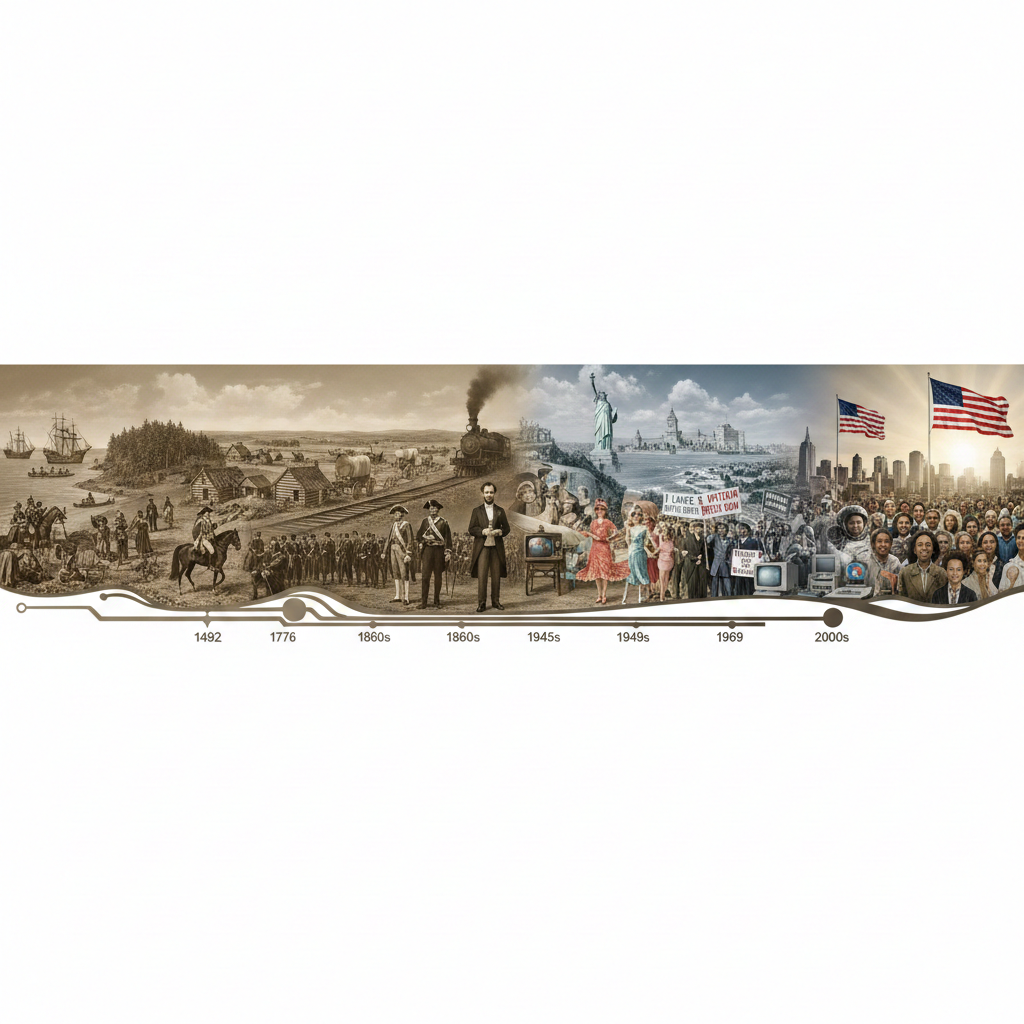
The history of America is a complex and multifaceted narrative spanning thousands of years, from the earliest Indigenous civilizations to the modern global superpower. This overview traces the major developments, conflicts, and transformations that have shaped the nation currently known as the United States of America.
Pre-Columbian America and Early Encounters (Pre-1492 – c. 1600)
Indigenous Civilizations
Long before European arrival, the American continents were home to diverse and sophisticated societies. Migration is believed to have begun approximately 15,000 years ago via the Bering Land Bridge (Beringia).
-
- Mesoamerica: Civilizations like the Olmec, Maya, and Aztec developed advanced mathematics, astronomy, writing systems, and massive urban centers.
-
- North America: Diverse groups formed complex cultures:
-
- Pueblo/Anasazi (Southwest): Known for cliff dwellings and irrigation.
-
- Mississippian Culture (Southeast/Midwest): Built large earthen mounds, such as those at Cahokia.
-
- Iroquois Confederacy (Northeast): A powerful political and military alliance of five (later six) nations.
-
- North America: Diverse groups formed complex cultures:
European Exploration
The “discovery” of the Americas by Europeans began with Christopher Columbus‘s voyage in 1492, initiating the Columbian Exchange—a widespread transfer of plants, animals, culture, human populations (including slaves), technology, and ideas between the Americas, West Africa, and the Old World.
-
- Spain: Established the earliest and most extensive empire, focusing on the Caribbean, Mesoamerica, and the American Southwest, seeking gold, silver, and to spread Christianity. Key figures include Hernán Cortés and Francisco Pizarro.
-
- France: Primarily focused on the fur trade and establishing outposts along the St. Lawrence River (New France) and the Mississippi River.
-
- England: Delayed entry but would eventually dominate the eastern seaboard.
Colonial America (c. 1600 – 1763)
The Thirteen Colonies
In history of America english colonization began in earnest in the early 17th century, resulting in the establishment of 13 distinct colonies along the Atlantic coast.
-
- Jamestown (1607): The first successful permanent English settlement, founded by the Virginia Company. Early survival depended on the leadership of John Smith and the introduction of tobacco as a cash crop by John Rolfe.
-
- Plymouth (1620): Founded by Pilgrims (Separatists) seeking religious freedom. They signed the Mayflower Compact, an early agreement for self-governance.
-
- Massachusetts Bay Colony (1630): Founded by Puritans led by John Winthrop, who envisioned a “City upon a Hill,” emphasizing strict moral and religious order.
Economic and Social Systems
The colonies developed distinct regional economies:
-
- New England: Based on fishing, shipbuilding, small farms, and trade. Characterized by strong community ties and Puritan influence.
-
- Middle Colonies (e.g., Pennsylvania, New York): The “Bread Basket” colonies, focused on farming (wheat) and trade. Known for ethnic and religious diversity (Quakers, Dutch, Germans).
-
- Southern Colonies (e.g., Virginia, Carolinas): Economy dominated by plantation agriculture (tobacco, rice, indigo) and heavily reliant on slavery. The transition from indentured servitude to chattel slavery was largely solidified by the late 17th century.
Imperial Conflicts and Native Relations
European powers frequently clashed, with North America often being a theater of war, culminating in the French and Indian War (Seven Years’ War, 1754–1763). The British victory expelled the French from North America, but the massive war debt led Parliament to seek revenue from the colonies, planting the seeds of revolution.
The American Revolution and Early Republic (1763 – 1800)
Road to Revolution
Following the French and Indian War, British policies shifted toward tighter control and taxation, provoking colonial resistance based on the principle of “no taxation without representation.”
-
- Acts of Parliament: The Stamp Act (1765), Townshend Acts (1767), and the Intolerable Acts (1774) were met with boycotts, protests (e.g., the Boston Tea Party, 1773), and the formation of political bodies like the Sons of Liberty and the First Continental Congress.
-
- Key Figures: Thomas Jefferson, John Adams, Benjamin Franklin, and George Washington emerged as leaders.
The War for Independence (1775–1783)
The fighting began at Lexington and Concord in April 1775.
-
- Declaration of Independence (July 4, 1776): Written primarily by Thomas Jefferson, it formally declared the colonies’ separation, asserting the rights to “Life, Liberty, and the pursuit of Happiness.”
-
- Victory: Led by General George Washington, the Continental Army, aided significantly by the French, defeated the British, culminating in the surrender at Yorktown (1781) and the Treaty of Paris (1783).
Forming a New Government
The initial governing document, the Articles of Confederation, proved too weak. A convention was called to revise them, resulting instead in the drafting of a new Constitution (1787).
-
- Federalist vs. Anti-Federalist: The Constitution’s ratification involved a major debate between Federalists (pro-strong central government, like Hamilton and Madison) and Anti-Federalists (pro-states’ rights).
-
- Bill of Rights (1791): The first ten amendments were added to protect individual liberties and ensure ratification.
-
- George Washington was inaugurated as the first President in 1789, establishing critical precedents for the executive branch.
Expansion, Division, and Conflict (1800 – 1877)
Westward Expansion and Manifest Destiny
The early 19th century saw massive territorial growth, fueled by the belief in Manifest Destiny—the idea that the U.S. was divinely ordained to expand across the continent.
-
- Louisiana Purchase (1803): President Thomas Jefferson bought a vast tract of land from France, doubling the size of the U.S.
-
- Conflict with Mexico: The Mexican-American War (1846–1848) resulted in the acquisition of the American Southwest (Mexican Cession).
-
- Trail of Tears: The forced relocation of thousands of Native Americans from their ancestral lands in the Southeast to territories west of the Mississippi River, following the Indian Removal Act of 1830.
The Crisis of Slavery
The expansion westward intensified the conflict over whether new territories would be free or slave, driving a wedge between the North and the South.
-
- Compromises: Efforts like the Missouri Compromise (1820) and the Compromise of 1850 temporarily held the nation together.
-
- Abolitionism: A growing movement, led by figures like Frederick Douglass and Harriet Tubman, demanded the end of slavery.
-
- Breakdown: The Kansas-Nebraska Act (1854), the Dred Scott Decision (1857), and the election of Abraham Lincoln (1860), a Republican opposed to the expansion of slavery, led directly to secession.
In History of America the Civil War (1861–1865)
Eleven Southern states seceded to form the Confederate States of America, triggering the deadliest conflict in American history.
-
- Key Issues: Preservation of the Union and the abolition of slavery.
-
- Turning Points: The Battle of Gettysburg (1863) and the fall of Vicksburg (1863).
-
- Emancipation Proclamation (1863): Lincoln declared enslaved people in Confederate states to be free, reframing the war as a moral struggle.
-
- Conclusion: The Union victory preserved the nation and legally ended slavery with the 13th Amendment (1865).
Reconstruction (1865–1877)
The period immediately following the war focused on integrating the formerly Confederate states and newly freed people (Freedmen) into the Union.
-
- Reconstruction Amendments:
-
- 14th Amendment (1868): Granted citizenship to all persons born or naturalized in the U.S. (including former slaves) and guaranteed equal protection under the law.
-
- 15th Amendment (1870): Granted voting rights regardless of race or previous condition of servitude.
-
- Reconstruction Amendments:
-
- Failure: Reconstruction efforts were largely undermined by Southern white resistance, violence (e.g., the Ku Klux Klan), and the Compromise of 1877, which withdrew federal troops and effectively ended federal protection of Black rights, leading to the era of Jim Crow laws and racial segregation.
The Gilded Age and Progressive Era (1877 – 1920)
The Gilded Age (1870s – 1900)
Marked by rapid industrialization, immigration, and urbanization. While the economy boomed, the era was characterized by severe wealth inequality and political corruption.
-
- Industrial Giants: Figures like Andrew Carnegie (steel), John D. Rockefeller (oil), and J.P. Morgan (finance) built massive corporations (trusts) that dominated the economy.
-
- Labor Movement: Harsh working conditions, low wages, and long hours led to the rise of labor unions (e.g., the American Federation of Labor), often clashing violently with management.
-
- Immigration: Millions of “New Immigrants” arrived from Southern and Eastern Europe, settling in crowded urban areas.
The Progressive Era (1890s – 1920s)
A period of widespread social activism and political reform aimed at combating the problems created by industrialization and the Gilded Age.
-
- Muckrakers: Journalists (e.g., Upton Sinclair, The Jungle) exposed corruption and social ills.
-
- Reforms: Efforts led to:
-
- Consumer Protection: The Pure Food and Drug Act (1906).
-
- Political Reforms: Direct election of Senators (17th Amendment), secret ballot.
-
- Women’s Suffrage: The movement culminated in the 19th Amendment (1920), granting women the right to vote.
-
- Reforms: Efforts led to:
-
- Presidents: Theodore Roosevelt, William Howard Taft, and Woodrow Wilson oversaw significant progressive legislation.
World Wars and The Great Depression (1914 – 1945)
World War I (1914–1918)
Initially neutral, the U.S. entered the war in 1917 under President Woodrow Wilson, tipping the balance in favor of the Allies. Wilson promoted his Fourteen Points, including the creation of a League of Nations, though the U.S. Senate ultimately rejected joining the League.
 The Roaring Twenties
An era of economic prosperity, cultural change, and social tension.
-
- Cultural Shifts: Mass consumerism, the rise of jazz, flapper culture, and new technologies like radio and film.
-
- Social Tensions: Conflicts over Prohibition (18th Amendment), anti-immigrant sentiment (e.g., the National Origins Act of 1924), and the rise of religious fundamentalism.
The Great Depression (1929 – c. 1939)
The Stock Market Crash of 1929 was followed by a decade-long economic catastrophe marked by mass unemployment, poverty, and bank failures.
-
- The New Deal: President Franklin D. Roosevelt (FDR) enacted a series of bold federal programs—the New Deal—aimed at Relief, Recovery, and Reform. Key programs included Social Security, the Civilian Conservation Corps (CCC), and the Tennessee Valley Authority (TVA), fundamentally expanding the role of the federal government in the economy.
World War II (1939–1945)
The U.S. entered the war after the Japanese attack on Pearl Harbor on December 7, 1941.
-
- The Arsenal of Democracy: American industrial power became the essential factor in the Allied victory.
-
- Key Events: The war mobilized every aspect of American society, including the internment of Japanese Americans. The U.S. played a decisive role in the European and Pacific theaters, culminating in the atomic bombings of Hiroshima and Nagasaki in August 1945, which ended the war but ushered in the nuclear age.
The Cold War and Civil Rights (1945 – 1980)
The Cold War (1947–1991)
The post-war era was defined by a geopolitical struggle between the U.S. (democracy/capitalism) and the Soviet Union (communism), conducted without direct large-scale fighting between the two powers.
-
- Containment: U.S. foreign policy, articulated in the Truman Doctrine, aimed to prevent the spread of communism.
-
- Crises: Included the Berlin Airlift, the Korean War, the Cuban Missile Crisis, and the Vietnam War.
-
- Domestic Fear: The Second Red Scare (McCarthyism) led to widespread fear of communist infiltration.
-
- Space Race: The competition with the USSR drove advancements in science and technology.
The Civil Rights Movement in History of America
A struggle for social justice that took place primarily during the 1950s and 1960s to end racial segregation and discrimination against African Americans.
-
- Key Events: The Montgomery Bus Boycott, the March on Washington (1963), and the Freedom Rides.
-
- Landmark Legislation:
-
- Brown v. Board of Education (1954): Declared state-sponsored segregation in public schools unconstitutional.
-
- Civil Rights Act of 1964: Outlawed discrimination based on race, color, religion, sex, or national origin.
-
- Voting Rights Act of 1965: Protected the right to vote for racial minorities.
-
- Landmark Legislation:
-
- Leaders: Martin Luther King Jr., Rosa Parks, and Malcolm X provided diverse leadership.
Shifting Politics (1960s – 1980)
The post-WWII consensus fractured due to the Vietnam War, social upheaval, and political scandals.
-
- Great Society: President Lyndon B. Johnson pursued ambitious domestic programs to end poverty and racial injustice, though overshadowed by Vietnam.
-
- Watergate: The scandal that forced President Richard Nixon to resign in 1974, leading to deep public cynicism toward government.
-
- The Reagan Revolution (1980): Ronald Reagan‘s election ushered in a new era of conservative politics, marked by tax cuts, deregulation, and a more aggressive stance toward the Soviet Union.
The Modern Era (1980 – Present)
The End of the Cold War and Globalization (1980 – 2001)
-
- Collapse of the USSR (1991): The Soviet Union dissolved, leaving the U.S. as the world’s sole superpower.
-
- The Digital Age: The development of the personal computer and the Internet fundamentally reshaped commerce, communication, and culture.
-
- The 1990s: An era of relative peace and economic growth under President Bill Clinton, though marked by political polarization and the rise of new foreign policy challenges.
Terrorism and the 21st Century
-
- September 11, 2001 (9/11): Attacks by Al-Qaeda prompted the War on Terror, leading to U.S. invasions of Afghanistan (2001) and Iraq (2003) and the creation of the Department of Homeland Security.
-
- The Great Recession (2007–2009): A severe global economic downturn triggered by the collapse of the U.S. housing market, leading to massive government interventions.
-
- The Obama Presidency (2009–2017): The election of the first African American President, focused on economic recovery and passing the Affordable Care Act (ACA).
-
- Modern Challenges: The current era is defined by deep political polarization, ongoing debates over immigration, racial justice (Black Lives Matter), climate change, and the increasing influence of social media.