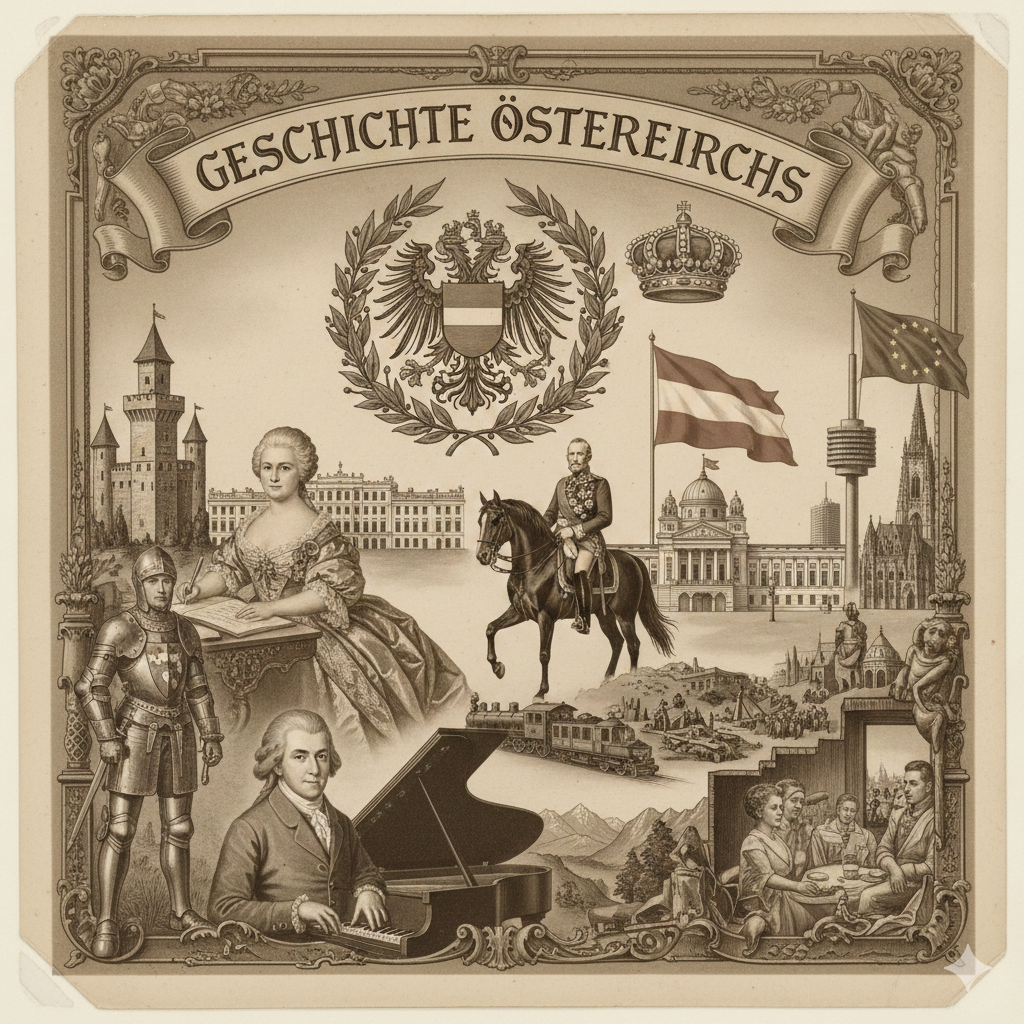
The History of Austria is a rich tapestry of Celtic kingdoms, Roman provinces, powerful dynasties, and the rise and fall of a great European empire, ultimately leading to the modern, neutral republic.
1. Prehistory and Antiquity (to c. 500 AD)
The fertile Danube Valley and the Alpine regions of modern Austria have been inhabited since the Paleolithic Age. The area became a key center during the Early Iron Age (c. 1100–450 BCE), giving its name to the Hallstatt Culture after a large prehistoric salt-mining area.
Around 400 BCE, Celtic tribes settled in the region, eventually establishing the kingdom of Noricum, a significant early “state” on Austrian soil. The Celts prospered due to rich mineral resources, particularly salt and iron, making them an important trading partner of the burgeoning Roman Empire.
The Romans gradually annexed the area, conquering Noricum by 15 BCE and incorporating the lands south of the Danube into the provinces of Raetia, Noricum, and Pannonia. Key Roman settlements included Carnuntum (capital of Pannonia in today’s Lower Austria) and Vindobona (modern-day Vienna). Roman rule lasted for nearly 500 years until the empire’s decline led to a withdrawal from the Danube region in the late 5th century.
2. Early Middle Ages: The Carolingians and the Ostarrichi (c. 500–1278)
Following the Roman withdrawal, the area became a crossroads for the Migration Period. Various Germanic tribes, including the Baiuvarii, moved into the western and central parts, while Slavic peoples settled in the south and east.
In the late 8th century, Charlemagne, King of the Franks and later Holy Roman Emperor, established the Carolingian East March (Marcha Orientalis) between the Enns and Raab rivers as a defensive buffer against the Avars. This territory later fell under renewed attacks, notably from the Magyars (ancestors of the Hungarians) in the early 10th century.
German King Otto I (the Great) defeated the Magyars in 955, allowing the Franks and Bavarians to re-establish control. In 976, Leopold von Babenberg was enfeoffed as Margrave of the new Bavarian Eastern March.
-
- The Babenbergs (976–1246): This Bavarian noble family steadily expanded their territory and influence. A key moment occurred in 996, when the territory was first referred to as Ostarrichi, a clear linguistic precursor to the modern German Österreich (Austria). In 1156, the Holy Roman Emperor elevated the March to a Duchy, granting it important privileges under the Privilegium Minus. Duke Henry II moved the Babenberg residence to Vienna, which has served as the capital ever since. The dynasty’s reign ended with the death of the last male Babenberg, Frederick II, in 1246, leading to a period of instability known as the Interregnum.
3. The Age of Habsburg (1278–1918)
The Habsburg dynasty would come to dominate History of Austrian and Central European politics for over six centuries.
The Rise of the Habsburgs: Following the Interregnum, Rudolf I of Habsburg, the newly elected German King, defeated the Bohemian King Ottokar II in 1278. In 1282, he installed his sons as Dukes of Austria, beginning the continuous rule of the House of Habsburg. They skillfully expanded their power, not primarily through military conquest but through strategic marriages and treaties (as famously summed up: “Bella gerant alii, tu felix Austria nube” – “Let others wage war, you, happy Austria, marry”). Through these means, they acquired Styria, Carinthia, Tyrol, and eventually the crowns of Bohemia and Hungary.
Imperial Status and Ottoman Wars: By the 15th century, the Habsburgs frequently held the title of Holy Roman Emperor (HRE). The early modern period was marked by existential threat from the Ottoman Empire, which besieged Vienna in 1529 and again in 1683. The Habsburgs successfully repelled both sieges, solidifying their status as the bulwark of Catholic Europe.
Reformation, Counter-Reformation, and the Thirty Years’ War: Protestantism made significant inroads in the Austrian lands. However, the Habsburgs remained staunchly Catholic and led a vigorous Counter-Reformation, eventually suppressing Protestantism in their hereditary lands. Austria was heavily involved in the devastating Thirty Years’ War (1618–1648), which established the modern state system in Europe.
The Pragmatic Sanction and Maria Theresa (1740–1780): Following the extinction of the male Habsburg line, Emperor Charles VI issued the Pragmatic Sanction to ensure his daughter, Maria Theresa, could inherit the diverse Habsburg monarchy. Her reign began with the War of the Austrian Succession, in which she lost Silesia to Prussia, but ultimately secured her throne. She implemented far-reaching administrative, military, and educational reforms, modernizing the state.
The Napoleonic Wars and the Austrian Empire: In response to Napoleon’s declaration of the French Empire, the Habsburg ruler, Francis II, proclaimed the Austrian Empire (Kaisertum Österreich) in 1804. When Napoleon dissolved the Holy Roman Empire in 1806, Francis I (formerly II) gave up the HRE title, but remained Emperor of Austria. After Napoleon’s defeat, the Congress of Vienna (1814–1815), led by Austrian Chancellor Prince Klemens von Metternich, restored the old order and established the Concert of Europe, placing Austria at the heart of the conservative European system.
4. The Decline of the Empire (1848–1918)
The Revolutions of 1848: Nationalist and liberal fervor swept across the empire, forcing Metternich’s resignation. While the revolutions were ultimately suppressed, they highlighted the deep-seated ethnic and constitutional tensions within the multinational state.
Loss of Dominance: Austria suffered two major military defeats: by France and Piedmont-Sardinia in 1859 and by Prussia in the Austro-Prussian War of 1866. The loss to Prussia ended Austria’s role as the dominant German power, paving the way for a Prussian-led unified German state (excluding Austria).
The Austro-Hungarian Empire(1867–1918): To pacify Hungarian nationalism after the 1866 defeat, Emperor Franz Joseph I enacted the Ausgleich (Compromise) of 1867, transforming the Empire into the Dual Monarchy of Austria-Hungary. This gave Hungary equal status and autonomy within the Empire, though it failed to satisfy other ethnic groups (Czechs, Slavs, Romanians, etc.), whose demands for self-rule continued to destabilize the state.
World War I and Dissolution: The assassination of Archduke Franz Ferdinand, the heir to the throne, in Sarajevo in June 1914, triggered World War I. Austria-Hungary, allied with Germany, suffered catastrophic losses. By October 1918, the Empire began to disintegrate as various national groups declared independence. On November 11, 1918, Emperor Karl I abdicated, and on November 12, 1918, the Republic of German-Austria was proclaimed.
5. The First Republic and Anschluss (1918–1945)
The First Republic History of Austria (1919–1938): The new state, officially the Republic of Austria, was significantly smaller, landlocked, and economically vulnerable. The Treaty of Saint-Germain-en-Laye (1919) forbade the union of Austria with Germany (Anschluss) and resulted in border changes. The 1920s saw economic recovery, but political life was marred by intense conflict between the socialist and conservative camps.
Austrofascism: The instability deepened during the Great Depression. In 1933-1934, Chancellor Engelbert Dollfuss gradually dismantled the democratic system, establishing an authoritarian regime known as Austrofascism or the Federal State of Austria. Dollfuss was assassinated by Austrian Nazis in an attempted coup in 1934, though the coup failed.
The Anschluss (1938): Adolf Hitler, born in Austria, was determined to achieve the union forbidden by the 1919 treaty. Under extreme pressure and internal threat, Chancellor Kurt Schuschnigg was forced to resign. On March 12, 1938, German troops marched into Austria, and the country was annexed into the Nazi German Reich—the Anschluss.
In History of Austria World War II: Austria was fully integrated into the Nazi war machine as the Ostmark (Eastern March). The country and its people were active participants in the war and the Holocaust, though the Allies later adopted the Moscow Declaration (1943), which stated their intention to restore an independent Austria after the war.
6. The Second Republic (1945–Present)
Allied Occupation: Following the surrender of Nazi Germany in 1945, Austria was liberated and divided into four zones of occupation (American, British, French, and Soviet), similar to Germany, but with a central provisional government in Vienna.
Restoration of Sovereignty: After years of negotiation, the Austrian State Treaty was signed in May 1955. The treaty formally re-established Austria as a sovereign, independent, and democratic republic. Immediately following the treaty, the Austrian Parliament declared the country’s permanent neutrality in perpetuity, legally banning it from entering into military alliances or allowing foreign military bases on its soil.
Modern Austria: The late 20th century saw Austria enjoy an extended period of peace, prosperity, and economic growth, becoming one of Europe’s most prosperous nations. In 1995, Austria joined the European Union (EU), and adopted the euro currency in 2002. Today, Austria is recognized globally for its strong commitment to neutrality, its rich cultural heritage, and its high quality of life.
Visit : www.dkbtech.com and www.allcircular.com