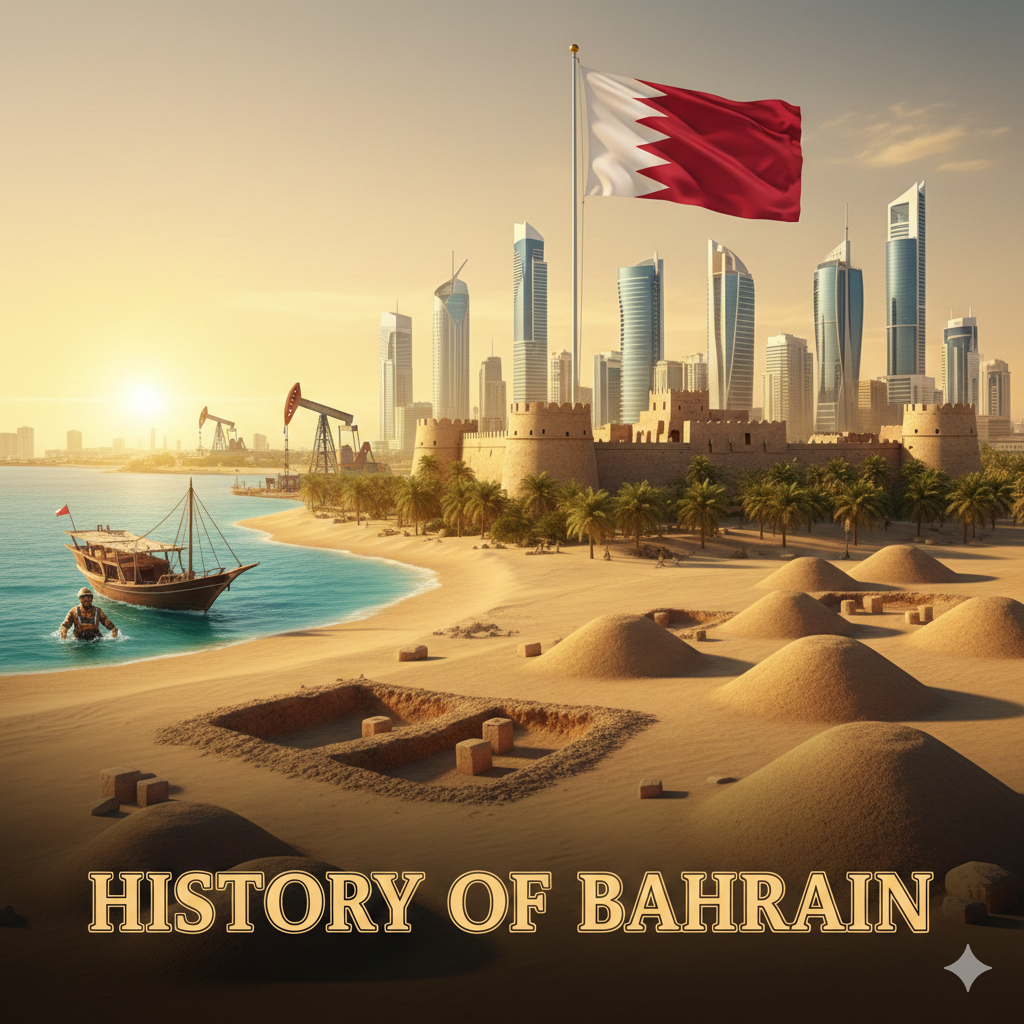
The Kingdom of Bahrain, an archipelago nestled in the Arabian Gulf, possesses a history disproportionately rich for its small geographical size. Often dubbed the “Pearl of the Gulf,” Bahrain has served for millennia as a vital trade link, a pearl diving hub, and a strategic military and commercial outpost, attracting numerous conquerors, traders, and empires. Its history is a fascinating tapestry woven with threads of Dilmun’s ancient greatness, Islamic expansion, Portuguese occupation, Persian influence, and a modern trajectory shaped by oil wealth and British protection.
1. The Prehistoric and Ancient Era: Dilmun (c. 3200 BCE – 538 BCE)
History of Bahrain’s earliest is dominated by the legendary Dilmun civilization, one of the most important, yet often overlooked, ancient trading powers. Archaeological evidence, most notably the colossal burial mounds of A’ali, firmly places the heart of Dilmun in present-day Bahrain.
The Land of the Living
Dilmun features prominently in Sumerian cuneiform texts, where it is often mythologized as a pristine, holy, and paradisiacal place—the land where the sun rises and the dwelling of the hero Ziusudra (the Sumerian equivalent of Noah). This mythical reputation suggests it was a deeply respected and significant entity in the ancient Near East.
The Great Trading Emporium
Dilmun’s true importance lay in its function as a pivotal entrepôt—a central staging post—for the lucrative trade routes connecting Mesopotamia (Sumer and later Babylonia and Assyria) with the Indus Valley Civilization (Meluhha, modern-day Pakistan/India).
-
- Goods Traded: Dilmun controlled the trade of essential materials, including copper (from Magan, likely modern Oman), timber, carnelian, lapis lazuli, and, critically, fresh water, which was abundant in Bahrain’s artesian springs.
-
- Significance: All goods travelling between the two great civilizations of the third millennium BCE passed through Dilmun, granting its rulers immense wealth and political leverage.
Decline of Dilmun
The civilization flourished for over 2,000 years. However, by the late second and early first millennium BCE, shifts in global trade routes, the rise of powerful empires, and perhaps environmental changes began to diminish Dilmun’s dominance.
-
- Assyrian and Babylonian Control: By the 7th century BCE, Dilmun was reduced to a vassal state, paying tribute to the Neo-Assyrian and Neo-Babylonian Empires, its name changing to Tilmun.
2. The Hellenistic and Pre-Islamic Era (c. 300 BCE – 628 CE)
Following the conquests of Alexander the Great in the 4th century BCE, the Gulf region entered the Hellenistic sphere of influence.
Tylos: The Greek Influence
Bahrain became known as Tylos to the Greeks. Alexander’s admiral, Nearchus, is credited with exploring the island. The Hellenistic presence, marked by Greek cultural influence and administrative structures, lasted for several centuries.
Arados and the Era of Trade
Under the control of the Seleucid Empire and later the Parthian and Sassanid Persian Empires, Tylos remained a key location, particularly for the pearl trade, which had been a staple industry since Dilmun times.
-
- Pearl Center: Greek writers noted the islands’ unparalleled fresh water springs and their famous pearl fisheries.
-
- Sassanid Rule: By the 3rd century CE, the Sassanid Empire of Persia had firmly established its control over the region, maintaining a powerful presence until the arrival of Islam.
3. History of Bahrain the Islamic Era (628 CE – 1521 CE)
The arrival of Islam fundamentally transformed the history, culture, and political landscape of Bahrain.
Conversion and Early Caliphates (7th Century CE)
-
- 628 CE: The Prophet Muhammad sent an envoy to Mundhir ibn Sawa al-Tamimi, the Sassanid governor of the Bahrain region (which at the time encompassed a much larger area of eastern Arabia, including Al-Hasa). Mundhir converted to Islam, and the islanders soon followed, making Bahrain one of the earliest areas outside the Hijaz to embrace the new faith.
-
- Umayyad and Abbasid Periods: Bahrain was administered by the successive Caliphates. Its strategic position meant it played a role in the maritime commerce and naval power of the Islamic empires.
The Qarmatian State (899 CE – 1076 CE)
This was one of the most tumultuous and distinctive periods in Bahrain’s history. The Qarmatians, a radical Ismaili Shia sect, established an independent state centered in Al-Hasa, with Bahrain as a key territory.
-
- Revolutionary Ideology: They rejected orthodox Islamic law, established a communal society, and levied heavy tolls on pilgrims.
-
- Attack on Mecca: In 930 CE, they famously sacked Mecca, carrying off the sacred Black Stone of the Kaaba, which they held for over two decades.
-
- End of the State: Their power waned due to internal conflicts and external pressures from the Abbasids and local Arab tribes.
Local Dynasties and Shifting Control
After the Qarmatians, Bahrain fell under the rule of various local and regional powers, often contested between Persia and different Arab tribes.
-
- Uyunid Dynasty (1076–1235): An Arab dynasty that established its power after defeating the Qarmatians.
-
- Usfurid Dynasty (1253–1383): Another local Arab dynasty.
-
- Jabrids (15th Century): The strongest pre-colonial power in the region, establishing control over eastern Arabia and challenging the regional influence of the Persian Gulf powers.
The Colonial Period and Foreign Influence (1521 CE – 1861 CE)
The arrival of European maritime powers, seeking to control the spice trade, dramatically altered the political geometry of the Gulf.
The Portuguese Occupation (1521 CE – 1602 CE)
-
- Seizure of Control: Following Vasco da Gama’s establishment of the sea route to India, the Portuguese began to dominate the Indian Ocean. Bahrain, with its strategic location and access to fresh water and pearl fisheries, was captured in 1521 from the Jabrids.
-
- Fortification: They fortified the island, using the existing fort (now Bahrain Fort or Qal’at al-Bahrain) and turning it into a crucial outpost for defending their commercial empire.
-
- End of Rule: The Portuguese were expelled in 1602 by a Persian army under Shah Abbas I of the Safavid Empire, assisted by local forces.
Persian and Omani Rivalry (1602 CE – 1783 CE)
For over a century and a half, Bahrain was either directly governed by Persian Safavid governors or was a contested territory, often changing hands between the powerful Persian Empire and the burgeoning maritime power of the Yaruba Imams of Oman. This period of instability saw various local rulers attempt to establish independence.
5. The Al Khalifa Dynasty and British Protection (1783 CE – 1971 CE)
The modern History of Bahrain begins definitively with the arrival of the Al Khalifa family, who have ruled the islands continuously ever since.
The Conquest of Bahrain (1783 CE)
-
- The Utub Tribes: The Al Khalifa, a branch of the Utub (or Utubi) tribal confederation, were based in Zubarah on the Qatar peninsula. They were already a powerful force in Gulf trade and shipbuilding.
-
- The Battle: In 1783, following a punitive expedition by the Persian governor against the Utub, the Al Khalifa, led by Sheikh Ahmed bin Muhammad Al Khalifa, successfully captured Bahrain from the local Persian representative.
Early Rule and Succession
The early years of Al Khalifa rule were marked by ongoing conflict, primarily with the Persians and the Al Saud forces (Wahhabis) from the Arabian mainland. Despite these challenges, the Al Khalifa managed to consolidate their control.
-
- Pearl Trade: The dynasty established its wealth and stability on the burgeoning, and highly lucrative, pearl diving industry, which was the mainstay of Bahrain’s economy until the 1930s.
The British Ascendancy (19th Century)
As the Ottoman, Persian, and Egyptian powers vied for influence in the Gulf, the British East India Company (and later the British Government) increasingly sought to secure the maritime trade routes to India.
-
- General Treaty of Peace (1820): The first of many treaties signed between the British and the Gulf rulers, aimed at suppressing piracy, a move that effectively established British authority over the seas.
-
- The Perpetual Truce (1861): This treaty, signed between Sheikh Muhammad bin Khalifa Al Khalifa and the British, marked a turning point. In exchange for British military protection against external aggressors (specifically Persia and the Ottomans), the Al Khalifa agreed not to dispose of any of their territories or enter into agreements with other foreign powers without British consent. This established the Protectorate Status of Bahrain, ending its long history as a prize in regional power struggles.
Internal Reform and External Pressure (Early 20th Century)
The early 20th century saw the beginnings of modernization and significant internal tension.
-
- British Influence: Under the guidance of British political agents, Bahrain began to implement administrative reforms.
-
- Reform and Opposition:Sheikh Isa bin Ali Al Khalifa (r. 1869–1923) faced pressure from the British for reform, which led to his abdication. The most significant reforms came under his successor, Sheikh Hamad bin Isa Al Khalifa (r. 1932–1942), and the British Political Agent, Charles Belgrave (adviser to the rulers from 1926 to 1957).
-
- Establishment of modern legal systems.
-
- Introduction of formal education (Al-Hidaya Al-Khalifia Boys School in 1919 was the first in the Gulf).
-
- Modernization of the police and customs.
-
- The Bahrain Reform Movement emerged, a non-violent political movement demanding constitutional government and an end to British influence.
-
- Reform and Opposition:Sheikh Isa bin Ali Al Khalifa (r. 1869–1923) faced pressure from the British for reform, which led to his abdication. The most significant reforms came under his successor, Sheikh Hamad bin Isa Al Khalifa (r. 1932–1942), and the British Political Agent, Charles Belgrave (adviser to the rulers from 1926 to 1957).
The Discovery of Oil (1932)
The single most pivotal event in Bahrain’s modern history was the discovery of oil.
-
- First Discovery: Oil was struck in 1932 at the Jabal Dukhan field, making Bahrain the first Gulf state to discover oil.
-
- Economic Transformation: Though Bahrain’s oil reserves were comparatively modest, the revenue generated was enough to fundamentally transform the economy, funding the social and infrastructural modernization that had begun with the British-backed reforms. It led to the decline of the pearl industry.
-
- BAPCO: The Bahrain Petroleum Company (BAPCO), established in 1929, played a central role in this transformation.
The Road to Independence and Modern Statehood (1971 – Present)
Independence (1971)
-
- British Withdrawal: In 1968, Britain announced its intention to withdraw its military forces from “East of Suez” by 1971. This prompted the Gulf states to determine their future.
-
- Failure of Federation: Bahrain initially attempted to join a federation with Qatar and the Trucial States (now the UAE), but negotiations failed.
-
- Sovereignty: On August 14, 1971, Bahrain declared its full independence as the State of Bahrain. Sheikh Isa bin Salman Al Khalifa (r. 1961–1999) became the first Amir (Emir).
-
- UN Recognition: The question of Bahrain’s sovereignty, long claimed by Iran, was finally settled by a United Nations survey in 1970, which confirmed that the vast majority of Bahrainis wished to remain fully independent.
The Constitutional and Political Experiment (1970s)
-
- First Constitution (1973): Bahrain adopted a constitution and established a bicameral National Assembly. This was the Gulf’s first experiment with a popularly elected legislature.
-
- Dissolution of the Assembly: Political tensions between the government and the left-leaning, nationalist, and conservative members led to the dissolution of the National Assembly by the Amir in 1975. The constitution was suspended, and Bahrain was ruled by decree for the next quarter-century.
Political and Social Dynamics
Bahrain is unique in the Gulf for its sectarian and political complexity, mainly due to a large Shia population being governed by a Sunni ruling family (the Al Khalifa).
-
- The 1990s Uprising (Intifada): Discontent over unemployment, lack of political representation, and the status of the suspended constitution led to a period of civil unrest and riots in the mid-1990s.
The Golden Era of Reform (2000s)
The accession of Sheikh Hamad bin Isa Al Khalifa (the current King) in 1999 ushered in a period of unprecedented reform and liberalization.
-
- The National Action Charter (2001): This charter, which proposed a transition to a constitutional monarchy and an elected parliament, was approved by over 98% of the public in a national referendum.
-
- Kingdom Status (2002): Bahrain became the Kingdom of Bahrain, and Hamad bin Isa Al Khalifa became the first King.
-
- Restoration of Parliament: A new constitution was adopted, establishing a bicameral parliament:
-
- Council of Representatives (Lower House): Fully elected.
-
- Shura Council (Upper House): Appointed by the King.
-
- The first parliamentary elections in three decades were held in 2002.
-
- Restoration of Parliament: A new constitution was adopted, establishing a bicameral parliament:
The Arab Spring and Aftermath (2011 – Present)
-
- The February 14th Protests: Inspired by the regional “Arab Spring,” Bahrain experienced massive protests, primarily by the Shia community, demanding greater political freedom, an end to perceived sectarian discrimination, and a genuine constitutional monarchy.
-
- Pearl Roundabout: Protesters occupied the Pearl Roundabout in Manama, which became the focal point of the movement.
-
- Intervention: The protests were eventually suppressed with military and security assistance from the Gulf Cooperation Council (GCC), particularly Saudi Arabia and the UAE, which viewed the uprising as a threat to regional stability and a potential opening for Iranian influence.
-
- BICI Report: The government commissioned the Bahrain Independent Commission of Inquiry (BICI), which documented government misconduct and human rights abuses during the crackdown. The government pledged to implement the BICI recommendations.
Contemporary Bahrain
Today, the Kingdom of Bahrain continues to navigate its complex history.
-
- Economic Diversification: With dwindling oil reserves, Bahrain has successfully diversified its economy, becoming a major regional financial services hub, a center for Islamic banking, and a burgeoning tourism destination.
-
- Strategic Alliance: It remains a key Western ally, notably hosting the United States Naval Forces Central Command (NAVCENT) and the U.S. Fifth Fleet, underscoring its enduring strategic importance in the Gulf.
-
- Political Future: The King and the government continue to pursue economic and administrative reforms while maintaining a tight control on political dissent, balancing demands for greater democratic representation with the imperative for stability in a geopolitically sensitive region.
Conclusion
The History of Bahrain is a compelling narrative of survival, trade, and transformation. From the ancient grandeur of Dilmun, the pearling wealth of the Islamic era, the brief but formative Portuguese occupation, and the establishing force of the Al Khalifa dynasty, Bahrain has always been more than just a cluster of islands. The discovery of oil and the subsequent transition from a British protectorate to an independent constitutional monarchy have forged a modern state that is financially dynamic, culturally rich, and strategically vital, continually shaping its identity at the crossroads of East and West.
Visit : www.dkbtech.com and www.allcircular.com