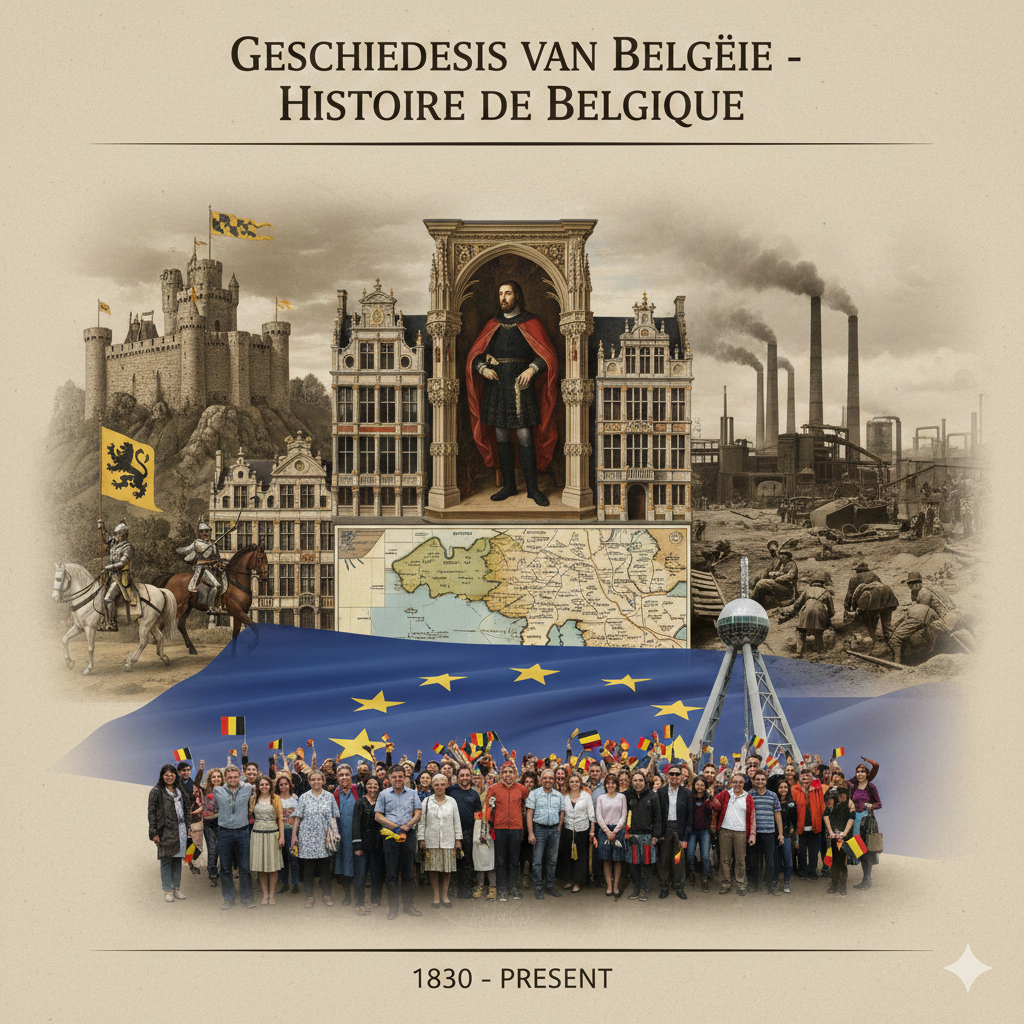
The History of the territory that makes up modern-day Belgium is a complex tapestry, largely defined by its location at the crossroads of powerful European cultures—Germanic and Romance—and its role as a strategic “battleground of Europe.” For most of its existence, it was not an independent state but a collection of principalities under foreign rule, leading to a deep-seated tradition of regional autonomy and cultural duality that defines the nation today
I. Prehistory and Roman Era (c. 57 BC – 5th Century AD)
The Belgae and Roman Conquest
The name “Belgium” is derived from the Belgae, a collection of mixed Celtic and Germanic tribes that inhabited the northern part of Gaul. Julius Caesar, in his Commentarii de Bello Gallico (Commentaries on the Gallic War), famously referred to them as the “bravest of all the Gauls.”
-
- 57 BC: Caesar conquered the region, and it was incorporated into the Roman Empire, eventually becoming the province of Gallia Belgica.
-
- The Romans established settlements like Tournai and Tongeren, introduced a road network, and brought Roman law and administration.
-
- The region was deeply affected by the linguistic divide: the south was heavily Romanized (developing into Wallonia), while the northern, less densely populated areas (Flanders) saw greater settlement by Germanic tribes.
II. The Early Middle Ages and Fragmentation (5th – 14th Centuries)
The Frankish and Carolingian Empires
Following the collapse of the Western Roman Empire in the 5th century, the region fell under the control of the Salian Franks.
-
- Merovingians: The first Frankish dynasty, the Merovingians, established their power base in the region, with the first capital at Tournai.
-
- Carolingians: The later Carolingian dynasty, which produced Charlemagne, hailed from the Meuse Valley (Herstal). In 843, the Treaty of Verdun split the vast Carolingian Empire, placing the future Belgian lands mainly in Middle Francia (Lotharingia), and later largely under the influence of the East Frankish Kingdom (the Holy Roman Empire).
The Rise of Feudal Principalities
As central authority waned, the territory fragmented into powerful feudal states that maintained significant autonomy from both France (in the west) and the Holy Roman Empire (in the east). The most important of these were:
-
- The County of Flanders: Subject to the French crown, it became one of the richest and most urbanized regions in Europe due to its thriving wool and cloth industry (cities like Ghent, Bruges, and Ypres).
-
- The Duchy of Brabant: With major centers like Brussels, Leuven, and Antwerp, it became the economic and political center of the Low Countries.
-
- The Prince-Bishopric of Liège: A large, powerful, and effectively independent ecclesiastical state within the Holy Roman Empire.
A key event showcasing the power of the cities was the Battle of the Golden Spurs in 1302, where an army of Flemish militias defeated the French royal knights.
III. Burgundian and Habsburg Rule (14th – 18th Centuries)
The Burgundian Netherlands
From the late 14th century, through a clever series of marriages and purchases, the Dukes of Burgundy gradually unified the collection of principalities into a single political entity known as the Burgundian Netherlands (1384–1482).
-
- This was a golden age of culture, art (the Flemish Primitives like Jan van Eyck), and economic prosperity, centered in cities like Bruges and later Antwerp.
-
- Central institutions, such as the States General and the Great Council of Mechelen, were created, fostering a collective identity for the Low Countries.
Spanish Habsburg Rule and the Eighty Years’ War
In 1477, the Burgundian inheritance passed to the Habsburg dynasty through the marriage of Mary of Burgundy to Maximilian of Austria. The territories became part of a vast empire, later inherited by Charles V and then his son, Philip II of Spain.
-
- Religious and Political Conflict: The rise of Protestantism and Philip II’s centralizing policies and staunch Catholicism led to the Dutch Revolt (1568–1648).
-
- The Division: The conflict ultimately split the Low Countries. The northern provinces formed the Union of Utrecht and declared independence as the Dutch Republic. The southern, predominantly Catholic provinces (roughly modern Belgium and Luxembourg) formed the Union of Arras and remained loyal to the Spanish Crown, becoming the Spanish Netherlands. This split, formalized by the Treaty of Westphalia (1648), is a foundational moment in Belgian identity.
Austrian Netherlands
Following the War of the Spanish Succession, the Treaty of Utrecht (1713) transferred the Spanish Netherlands to the Austrian branch of the Habsburgs, creating the Austrian Netherlands. The 18th century was relatively peaceful but marked by occasional local resistance to Austrian centralizing reforms.
-
- 1789: Inspired by the American and French Revolutions, a local uprising known as the Brabant Revolution briefly expelled the Austrians and proclaimed the independent United States of Belgium, but internal division led to the swift return of Austrian rule.
IV. French and Dutch Rule (1795 – 1830)
French Annexation
The French Revolutionary armies conquered the Austrian Netherlands in 1794, and in 1795, the territory was officially annexed to the French Republic.
-
- This period abolished the old feudal and ecclesiastical structures, introduced the Napoleonic Code, and forcibly reunited the territory with the independent Prince-Bishopric of Liège.
The United Kingdom of the Netherlands
After Napoleon’s defeat at Waterloo in 1815, the Congress of Vienna decided to create a strong buffer state on France’s northern border. The former Austrian Netherlands was united with the Dutch Republic to form the United Kingdom of the Netherlands, ruled by King William I of Orange-Nassau.
-
- Growing Discontent: This union proved unstable. The southern, Catholic population resented the Protestant king’s attempts to control education and the Church, while the liberal elite disliked his authoritarian style. The Walloon (French-speaking) elite also resisted William I’s policy of promoting the Dutch language. A coalition of Catholic conservatives and liberal opposition forces coalesced against the Dutch king.
V. The Revolution and Independence History of Belgium (1830 – 1914)
The Revolution of 1830
The spark for revolution came in Brussels in August 1830, ignited by a performance of the opera La Muette de Portici, which tells the story of an oppressed people’s revolt.
-
- Riots quickly escalated into a full-scale revolution. Dutch troops were expelled from Brussels, and a Provisional Government declared Belgian Independence on October 4, 1830.
-
- The London Conference of 1830 of European Great Powers recognized Belgium’s independence in 1831, establishing it as a perpetually neutral and independent state under a constitutional monarchy.
The Foundation of the Modern State
-
- 1831 Constitution: The new Belgian Constitution was exceptionally liberal for its time, establishing a constitutional monarchy and guaranteeing fundamental rights and civil liberties.
-
- Leopold I: Leopold of Saxe-Coburg-Gotha was inaugurated as the first King of the Belgians on July 21, 1831, a date celebrated as the National Holiday.
-
- The Ten Days’ Campaign: King William I attempted to reconquer the territory in 1831 but was only halted by the intervention of a French army. Full international recognition by the Netherlands was only formalized in the Treaty of London in 1839.
The Industrial Powerhouse and the Congo
Belgium became the second most industrialized nation in the world (after Great Britain) due to its vast coal and iron resources, particularly in the Walloon region (Sillon industriel). This created a wealthy industrial and financial class but also a large, poor working class.
-
- King Leopold II (1865-1909): In a deeply controversial move, Leopold II personally acquired a massive territory in Central Africa, establishing the Congo Free State in 1885. This was ruled as the King’s private property and became notorious for brutal exploitation of the local population for rubber and ivory, resulting in millions of deaths.
-
- 1908: Due to immense international pressure over the atrocities, the Congo Free State was transferred to the Belgian state and renamed the Belgian Congo.
The Flemish Movement and Language Conflict
The ruling class and the state apparatus initially favored the French language, creating linguistic and socio-economic tension, particularly in Dutch-speaking Flanders.
-
- The Flemish Movement arose in the mid-19th century to demand cultural and linguistic equality for Dutch-speakers, a struggle that would shape Belgian domestic politics for over a century. Early successes included the passing of laws on language use in judicial and public administration.
VI. The World Wars (1914 – 1945)
In History of Belgium World War I (1914-1918)
Belgium’s guaranteed neutrality was violated when Germany invaded in August 1914 as part of the Schlieffen Plan to bypass French defenses.
-
- Belgian Resistance: The small Belgian army, led by King Albert I, offered fierce resistance, notably at the Battle of Liège, which crucially slowed the German advance.
-
- The “Rape of Belgium”: German troops, frustrated by resistance from soldiers and civilians, committed widespread atrocities against the population, destroying cities (like Leuven) and executing thousands, leading to international condemnation.
-
- The Yser Front: The Belgian army held a small sliver of un-occupied territory along the Yser River for the duration of the war.
Interwar Period and World War II (1940-1945)
In the interwar period, Belgium abandoned its perpetual neutrality for a policy of independent neutrality. This proved futile when Germany invaded again on May 10, 1940.
-
- 18-Day Campaign: The ill-equipped Belgian army was quickly defeated. King Leopold III made the controversial decision to surrender and remain in German-occupied Belgium, breaking with the government, which fled to London.
-
- German Occupation: Belgium endured four years of harsh Nazi occupation, marked by economic exploitation and the persecution of Jews. A strong Resistance Movement emerged, conducting sabotage and intelligence gathering.
-
- Liberation: Allied forces liberated Belgium in September 1944. The Battle of the Bulge over the winter of 1944-45 briefly threatened to push the Allies back but was ultimately defeated in the Ardennes.
VII. Post-War to Modern Federalism (1945 – Present)
The Royal Question and Decolonization
The immediate post-war era was dominated by the Royal Question—the controversy over King Leopold III’s decision to surrender in 1940.
-
- 1950: A national referendum narrowly approved his return, but massive unrest in Wallonia forced him to abdicate in favor of his son, Baudouin I, in 1951.
-
- 1960: The Belgian Congo gained independence, resulting in the abrupt and chaotic Congo Crisis, which severely damaged Belgium’s international reputation and had significant domestic repercussions.
European Integration and Economic Shift
Belgium was a founding member of the Benelux Union (with the Netherlands and Luxembourg) and a key proponent of European integration.
-
- Brussels became the de facto capital of Europe, hosting the headquarters of the European Economic Community (EEC), the precursor to the European Union (EU), and the North Atlantic Treaty Organization (NATO).
-
- Economic Shift: The Walloon heavy industry (coal, steel) went into steep decline from the 1960s, while the economy of Flanders diversified and boomed (Antwerp’s port, light manufacturing). This reversal of economic fortunes exacerbated the existing linguistic-political tensions.
The Path to Federalism
The post-war period saw the definitive institutionalization of the linguistic divide, with growing autonomy for the regions and communities. From the 1970s onward, Belgium underwent six major State Reforms to transform the country from a unitary state into a complex federal state.
-
- 1970: Creation of three Cultural Communities (Dutch, French, German).
-
- 1980: Creation of three Regions (Flanders, Wallonia, and Brussels-Capital) and two additional Communities (Flemish and French), beginning the transfer of legislative power.
-
- 1993: The Constitution was revised, formally establishing Belgium as a Federal State with four linguistic areas (the three regions plus the small German-speaking Community).
-
- Later Reforms: Further reforms have transferred significant powers—including economic policy, infrastructure, and parts of social security—to the Regions and Communities.
Today, the Belgian state is a unique structure built on consensus and compromise, where power is divided between the Federal Government and the governments of the three Communities (based on language/culture) and three Regions (based on geography/economy). This complex balance reflects the country’s long history as a diverse crossroads of Europe, managing its internal linguistic and cultural divisions while remaining a central pillar of the European project.
Visit : www.dkbtech.com. and www.allcircular.com