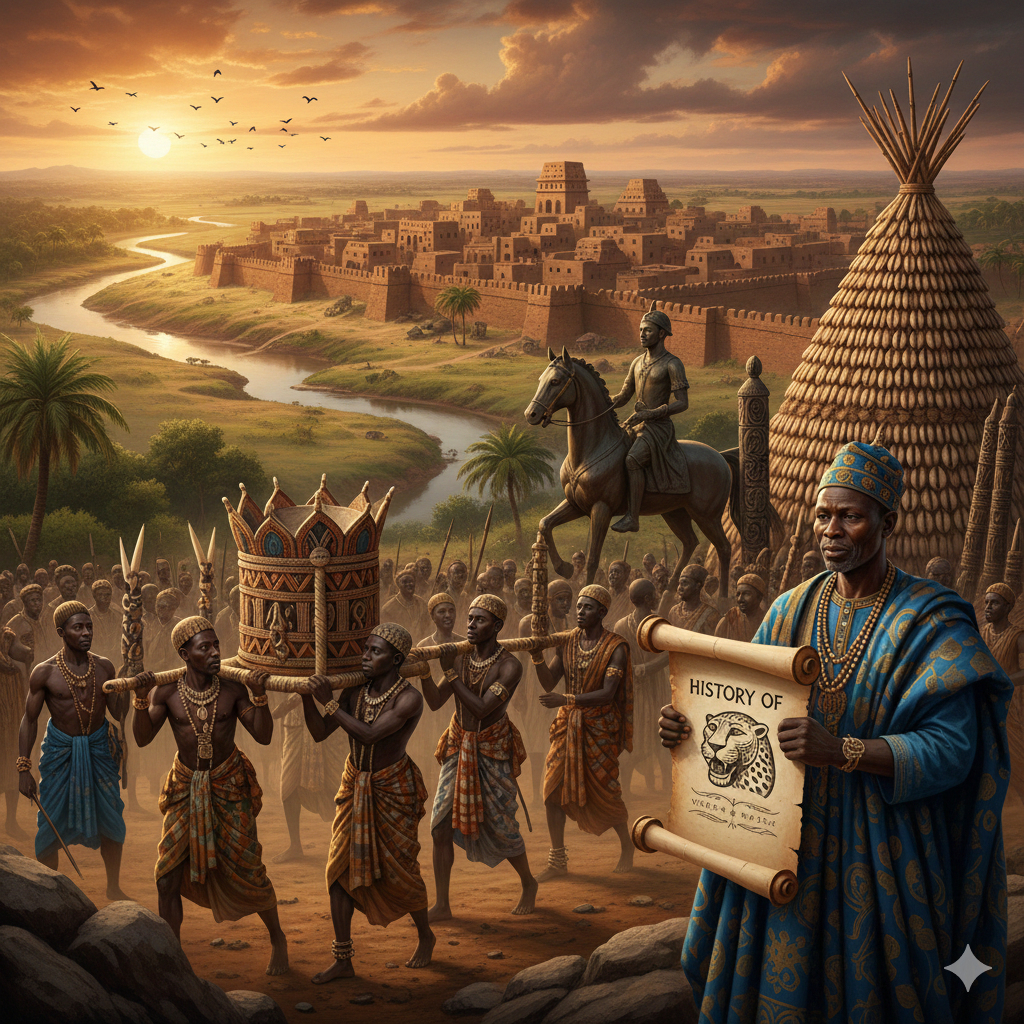
The history of the region now known as the Republic of Benin is rich and complex, encompassing two distinct major historical entities: the ancient and influential Kingdom of Benin (located in modern-day Nigeria) and the kingdoms of the region that became the French colony of Dahomey (the precursor to the modern Republic of Benin).
 The Kingdom of Benin (Nigeria)
It is crucial to first distinguish the Kingdom of Benin (or Benin Empire), a powerful pre-colonial state in West Africa, from the modern Republic of Benin. The historical kingdom was centered in what is now Benin City, Edo State, Nigeria.
Early History: Igodomigodo and the Ogiso DynastyThe earliest organized polity in the region was Igodomigodo, which coalesced from autonomous communities in the late 1st millennium CE.
-
- Early Settlement: By the 1st century BC, the territory was partially agricultural, becoming primarily agricultural around 500 AD, though hunting and gathering remained important. Iron use was established by 500 AD.
-
- The Ogiso Rulers: The ruler of Igodomigodo was titled Ogiso (“ruler of the sky” or “God-King”). This dynasty is credited with establishing many of the cultural and social traditions that shaped Benin. The capital, Edo (later Benin City), sprang up around 1000 AD.
The Rise of the Obas (c. 13th Century)
Tradition holds that the Edo people grew dissatisfied with the rule of the Ogisos.
-
- The Ife Connection: In the 13th century, they are said to have invited Prince Oranmiyan of Ife (a Yoruba kingdom to the west) to rule them.
-
- The First Oba: Oranmiyan eventually returned to Ife, but he left a son, Eweka I, who is regarded as the first Oba (king) of Benin, establishing the current dynasty. However, royal authority initially remained with a hereditary order of local chiefs.
-
- Consolidation of Power: Royal power began to assert itself under Oba Ewedo in the late 13th century.
The Golden Age (15th – 16th Centuries)
The Kingdom of Benin reached the height of its prosperity, power, and artistic brilliance during this period.
-
- Ewuare the Great (c. 1440–80): He is considered the most famous Oba, known as a great warrior and magician. He established a hereditary succession and vastly expanded the territory of the kingdom, which, by the mid-16th century, stretched from the Niger River delta to present-day Lagos.
-
- Highly Organized State: Under Obas like Ozolua the Conqueror (c. 1481–c. 1504) and Esigie (early to mid-16th century), Benin became a highly centralized and organized state with a strong bureaucracy.
-
- Artistic Legacy: Benin became renowned for its craft guilds, which worked exclusively for the Oba and the court. The kingdom produced exquisite art, including:
-
- The Benin Bronzes: Sculptures (mostly cast in brass/copper alloys) of naturalistic heads, commemorative plaques, and figures. These documented the court’s history, rituals, and military achievements.
-
- Works in ivory, iron, and wood.
-
- Artistic Legacy: Benin became renowned for its craft guilds, which worked exclusively for the Oba and the court. The kingdom produced exquisite art, including:
-
- European Contact and Trade: Benin first made contact with Portuguese merchant adventurers on the coast. It engaged in active trade with Portuguese and later Dutch traders, exchanging ivory, pepper, and palm oil for European and Indian cloth, coral beads, and brass currency. Benin also profited from the transatlantic slave trade.
Decline and British Conquest
The prosperity of Benin began to decline with the international suppression of the slave trade.
-
- Internal Strife: In the latter half of the 19th century, the kingdom was weakened by conflicts over succession and a loss of military and economic power.
-
- British Imperial Ambition: British interest in controlling West African markets intensified, putting pressure on the Oba to open the kingdom to ‘free trade.’
-
- The Punitive Expedition (1897): A British expedition, initially traveling under the guise of an unarmed trade mission, was attacked and massacred by Benin forces. The British responded with a full-scale “punitive expedition.”
-
- Benin City was captured, looted, and burned.
-
- Oba Ovonramwen was removed and exiled.
-
- Thousands of the royal art treasures, the Benin Bronzes, were confiscated and taken to auction in London to pay for the expedition’s costs (many are still held in Western museums today).
-
- The Punitive Expedition (1897): A British expedition, initially traveling under the guise of an unarmed trade mission, was attacked and massacred by Benin forces. The British responded with a full-scale “punitive expedition.”
-
- Incorporation into Nigeria: The depopulated and debilitated kingdom was incorporated into British Nigeria. The monarchy was later restored with limited powers under Oba Eweka II in 1914, and the traditional rulers continue to hold cultural significance in Nigeria today.
 The Republic of Benin (Formerly Dahomey)
The modern Republic of Benin is a country in West Africa, bordered by Togo, Nigeria, Burkina Faso, and Niger. Its history stems from the political entities in the area that was known as the “Slave Coast.”
Pre-Colonial Kingdoms
Prior to the 17th century, the territory was a mosaic of different political systems and ethnicities.
-
- Coastal City-States: City-states like Allada and Whydah (Ouidah), primarily of Aja, Yoruba, and Gbe ethnic groups, flourished along the coast, growing wealthy from the slave trade.
-
- The Oyo Empire: The powerful Oyo Empire, based to the east (in modern Nigeria), exerted influence through raids and by exacting tribute from the coastal kingdoms.
The Kingdom of Dahomey (c. 1625–1894)
The most influential kingdom in the area was the Kingdom of Dahomey, which was founded by the Fon people on the Abomey plateau.
-
- Establishment: Dahomey was established around the beginning of the 17th century.
-
- Expansion: By the 18th century, Dahomey began to expand, conquering the coastal cities of Allada and Whydah.
-
- The Slave Trade: Dahomey became a major center for the transatlantic slave trade, which led the area to be named the “Slave Coast.” The kings of Dahomey sold war captives, earning vast wealth.
-
- Centralized Rule: Dahomey was characterized by a rigidly stratified society and a centralized bureaucracy that served the king.
-
- The Dahomey Amazons: The kingdom was famous for its elite all-female military unit, known to Europeans as the Amazons, who served as royal bodyguards and frontline soldiers.
-
- The Transition: After 1840, when Britain successfully suppressed the overseas slave trade, King Gezu (1818–1858) managed a difficult transition to exporting palm oil, though this was far less lucrative than slavery.
French Colonial Rule (French Dahomey)
The kingdom’s power waned as France began its colonial push into West Africa.
-
- Conflict with France: Hostilities arose under King Behanzin (1889–94).
-
- French Conquest: In 1892, a French expedition defeated the Dahomeyans, and the French established a protectorate. Behanzin was deported.
-
- French Dahomey: The territory was absorbed into the French colony of French West Africa as the colony of Dahomey, with its capital at Porto-Novo.
Post-Colonial Era: The Republic of Benin
The territory of Dahomey gained full independence from France on August 1, 1960.
Post-Colonial Era: The Republic of Benin
The territory of Dahomey gained full independence from France on August 1, 1960.
-
- Political Instability: The newly independent country was plagued by political instability, experiencing a succession of military coups between 1960 and 1972.
-
- Military Rule and Name Change: The last of these coups brought Major Mathieu Kérékou to power.
-
- In 1975, the country changed its name from the Republic of Dahomey to the People’s Republic of Benin, after the Bight of Benin that borders the country. The name Dahomey was associated too exclusively with the Fon people of the south.
-
- Kérékou’s regime professed strict Marxist-Leninist principles until the beginning of the 1990s.
-
- Military Rule and Name Change: The last of these coups brought Major Mathieu Kérékou to power.
-
- Democratic Transition: In 1990, Kérékou convened a national conference that ushered in a new democratic constitution, making Benin the first African country to successfully transition from a dictatorship to a pluralistic political system.
-
- Modern Republic: The country became the Republic of Benin in 1991. Kérékou later stood for and won democratic elections in 1996 and 2001, demonstrating a remarkable political transformation.
The legacy of the Kingdom of Benin remains a vital part of African history, particularly through its world-renowned art and sophisticated statecraft, while the modern Republic of Benin continues its development as a multi-party democratic state.
Visit : www.dkbtech.com and www.allcircular.com