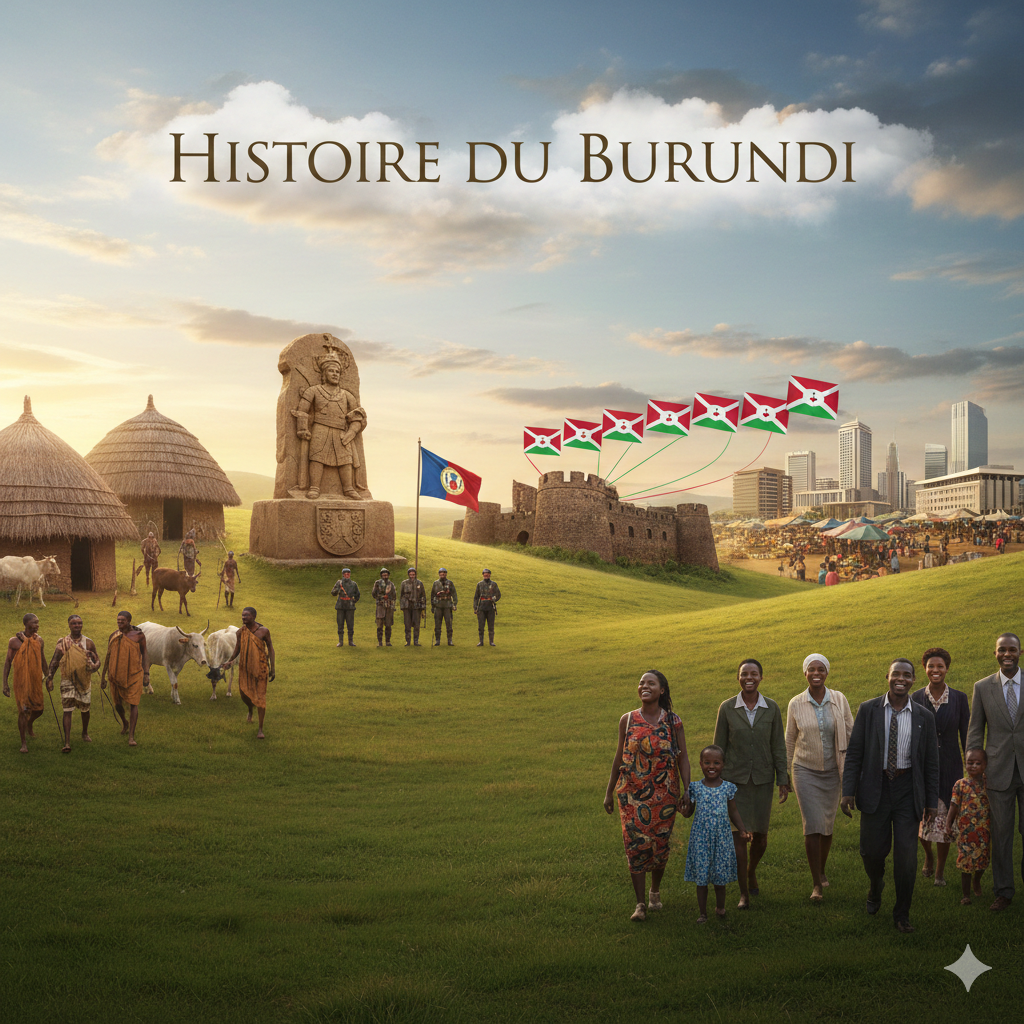
The History of Burundi is a narrative of remarkable resilience, shifting from a centralized and powerful ancient monarchy to a territory shaped by colonial intervention, and finally to a modern republic defined by its struggle for ethnic reconciliation and democratic stability.
1. The Pre-Colonial Era: The Kingdom of Burundi
Burundi is one of the few African nations whose modern borders align closely with its pre-colonial state. Established in the 16th century, the Kingdom of Burundi (also known as Urundi) was a highly organized and stratified society.
-
- Foundation and Expansion: Legend credits Ntare Rushatsi as the first Mwami (King). Under subsequent rulers like Ntare Rugamba in the 18th century, the kingdom expanded significantly, doubling its size through conquest and diplomacy.
-
- The Mwami and the Ganwa: The Mwami held absolute authority, but he ruled through a princely class known as the Ganwa. These princes were the king’s sons and grandsons, and they served as governors of various provinces.
-
- Social Fluidity: Traditional Burundian society was divided into three groups: the Hutu (mostly farmers), Tutsi (mostly cattle herders), and Twa (indigenous hunter-gatherers). Crucially, in this era, these categories were more socio-economic than strictly “ethnic.” Success in cattle rearing could allow a Hutu to move up in status, a process known as kwihutura.
2. The Colonial Encounter (1890–1962)
European contact began late in the 19th century. Explorers like Richard Burton and John Speke visited in 1858, but formal colonization did not begin until the 1890s.
German East Africa (1890–1916)
Burundi was incorporated into German East Africa. Unlike many other kingdoms, King Mwezi Gisabo fiercely resisted German encroachment. It took years of military campaigns for the Germans to force a treaty, but even then, they opted for indirect rule, leaving the Mwami’s administrative structures largely intact.
Belgian Mandate and Trust Territory (1916–1962)
After World War I, the League of Nations handed the territory (joined with Rwanda as Ruanda-Urundi) to Belgium. This period introduced fundamental changes:
-
- Ethnic Rigidification: The Belgians issued identity cards that fixed ethnic categories. They heavily favored the Tutsi minority for administrative roles, based on pseudoscientific racial theories of the time. This created a deep-seated sense of inequality and resentment.
-
- Economic Shifts: The introduction of coffee as a mandatory cash crop transformed the economy but placed a heavy burden on Hutu peasantry.
-
- The Church: Roman Catholic missions became the primary providers of education and healthcare, deeply embedding Western values and the French language into Burundian life.
3. Independence and the Rise of the Republic (1962–1993)
The path to independence was paved by Prince Louis Rwagasore, the son of the King and a charismatic nationalist who founded the UPRONA party. He successfully united Hutu and Tutsi under a common banner of independence.
-
- The Assassination of Rwagasore: In October 1961, just months before independence, Rwagasore was assassinated. His death deprived the nation of its most unifying figure.
-
- Independence (1962): Burundi gained independence as a constitutional monarchy on July 1, 1962.
-
- The End of the Monarchy: In 1966, Captain Michel Micombero overthrew the king, abolished the monarchy, and declared Burundi a Republic. This began a decades-long period of military rule by Tutsi-dominated regimes.
-
- The 1972 Ikiza: Following a Hutu uprising, the military government launched a systematic campaign of violence. An estimated 100,000 to 200,000 Hutu, particularly the educated elite, were killed. This event, known as the Ikiza (the Scourge), remains one of the darkest chapters in the nation’s history.
4. The Civil War and the Arusha Peace Process
In the early 1990s, international pressure led to democratic reforms. In 1993, Melchior Ndadaye, a Hutu, was elected as the first democratic president.
-
- The Assassination of Ndadaye: Only 100 days into his term, Ndadaye was assassinated by Tutsi paratroopers. This sparked a brutal Civil War that lasted from 1993 to 2005, claiming over 300,000 lives.
-
- The Arusha Accords (2000): Mediated by Julius Nyerere and Nelson Mandela, these peace agreements created a power-sharing system. It mandated ethnic quotas (60% Hutu / 40% Tutsi in government; 50/50 in the military) to ensure no single group could dominate the other.
5. Modern Burundi: 2005 to Present
The post-war era began with the election of Pierre Nkurunziza (a former rebel leader) in 2005.29 His presidency was marked by relative stability in the first decade, followed by a severe political crisis in 2015 when he sought a controversial third term.
| Period | Key Leadership | Major Focus |
| 2005–2015 | Pierre Nkurunziza | Reconstruction and rebel integration. |
| 2015–2020 | Pierre Nkurunziza | Political unrest, ICC withdrawal, and capital move to Gitega. |
| 2020–Present | Évariste Ndayishimiye | Economic recovery and international re-engageme |
Today, Burundi continues to navigate its transition toward lasting peace. The country is re-engaging with the international community and focusing on economic development within the East African Community.
Visit: www.dkbtech.com and www.allcircular.com