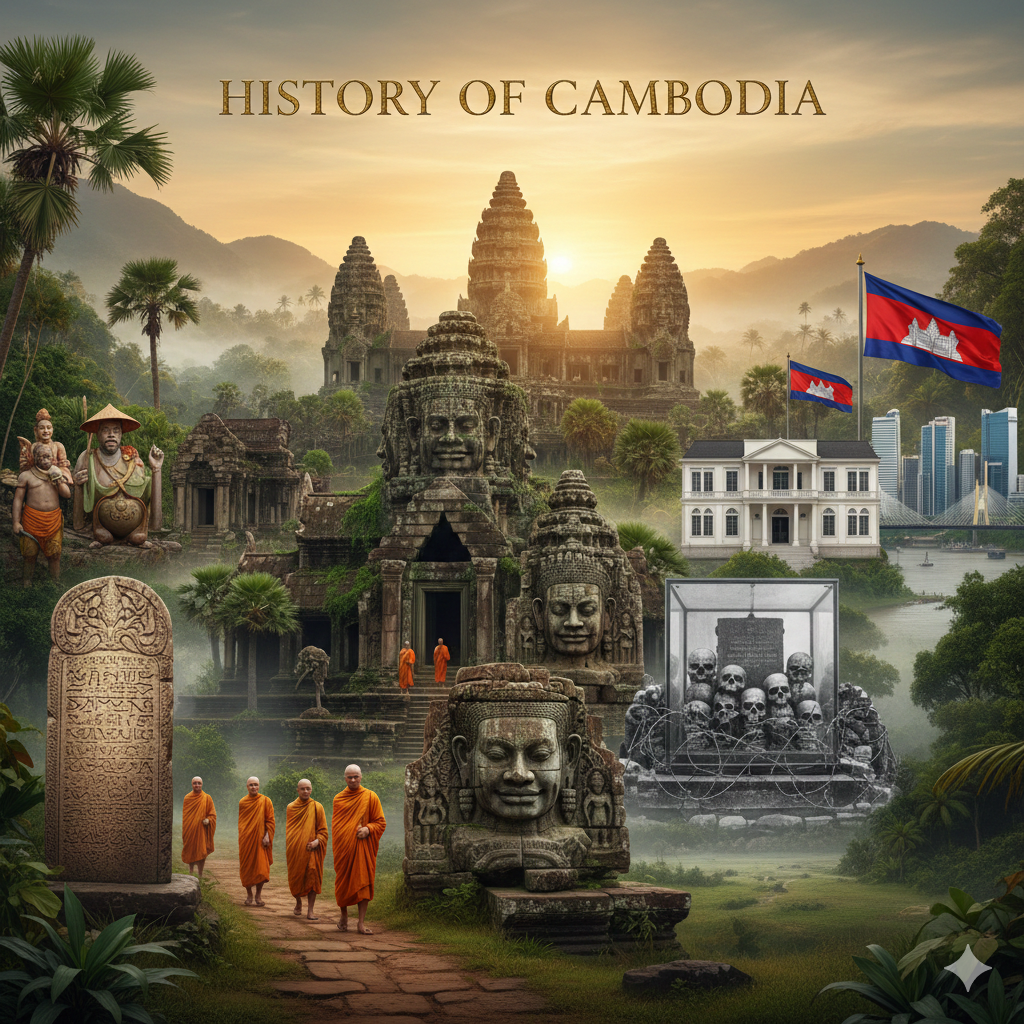
1. The Dawn: Funan and Chenla (1st – 8th Century)
The History of Cambodia begins not with a single event, but with a process called Indianization. Around the 1st century CE, the Kingdom of Funan emerged in the Mekong Delta. It was a maritime powerhouse, serving as a vital link in the trade routes between China and India.
-
- Funan (1st–6th Century): The Funanese were master hydraulic engineers, creating vast canal systems that turned swamps into fertile rice paddies. They adopted Hinduism and Sanskrit, laying the cultural bedrock of Khmer society.
-
- Chenla (6th–8th Century): As Funan declined, the inland “proto-Khmer” state of Chenla rose to power. This era was marked by political fragmentation—eventually splitting into “Land Chenla” and “Water Chenla”—but it saw the first distinctly Khmer stone inscriptions and the development of early temple architecture.
2. The Golden Age: The Khmer Empire (802 – 1431)
In 802 CE, Jayavarman II performed a ritual on Mount Kulen, declaring himself a Chakravartin (Universal Monarch) and a Devaraja (God-King). This birthed the Khmer Empire, the most powerful entity in Southeast Asian history.
The Builders of Angkor
The empire’s greatness was etched in stone through its massive temple-mountains:
-
- Suryavarman II: In the early 12th century, he commissioned Angkor Wat, the largest religious monument in the world. Originally a Hindu temple dedicated to Vishnu, its architecture reflected the cosmic Mount Meru.
-
- Jayavarman VII: After the Cham (from modern Vietnam) sacked the capital in 1177, this Buddhist king reclaimed the throne. He built Angkor Thom and the Bayon, famous for the massive stone faces looking out in four directions. He also established a network of hospitals and rest houses throughout the empire.
The Decline
By the 13th century, the empire began to wane. Factors included the exhaustion of the workforce, the shift from Mahayana to Theravada Buddhism (which emphasized individual merit over royal monuments), and catastrophic failures in the complex irrigation systems. In 1431, the Thai kingdom of Ayutthaya sacked Angkor, leading the Khmer court to abandon the city and move south toward modern-day Phnom Penh.
3. The Dark Ages and Colonialism (1432 – 1953)
The four centuries following the fall of Angkor are often called the “Dark Ages.” Cambodia became a “buffer state,” squeezed between the expanding empires of Siam (Thailand) to the west and Vietnam to the east.
The French Protectorate
Facing total erasure as a sovereign state, King Norodom signed a treaty with France in 1863.
-
- Stability at a Price: France protected Cambodia from its neighbors but gradually stripped the King of his power.
-
- Colonial Legacy: The French modernised Phnom Penh, mapped the ruins of Angkor, and introduced rubber plantations. However, they also imposed heavy taxes, leading to major peasant uprisings in 1916.
4. The 20th Century: Independence and Nightmare
Cambodia gained independence in 1953 under the charismatic Prince Norodom Sihanouk. However, the country was soon sucked into the vortex of the Vietnam War.
The Khmer Rouge (1975–1979) On April 17, 1975, the radical communist Khmer Rouge, led by Pol Pot, seized Phnom Penh. They declared “Year Zero” and attempted to turn Cambodia into an agrarian utopia.
-
- The Genocide: Cities were emptied. Money, religion, and schools were abolished. In less than four years, an estimated 1.7 to 2.2 million people (nearly a quarter of the population) died from execution, starvation, and disease in the “Killing Fields.”
5. Modern Cambodia: Recovery and Challenges
In 1979, Vietnamese forces invaded and overthrew the Khmer Rouge, installing a new government. After a decade of civil war and international isolation, the 1991 Paris Peace Accords paved the way for UN-sponsored elections in 1993.
Today, Cambodia is a nation defined by its resilience. While it faces challenges regarding political freedom and economic disparity, it has experienced rapid development. The spirit of the Angkorian era remains a central pillar of the national identity, seen in the flag which proudly bears the silhouette of Angkor Wat.
Visit: www.dkbtech.com and www.allcircular.com