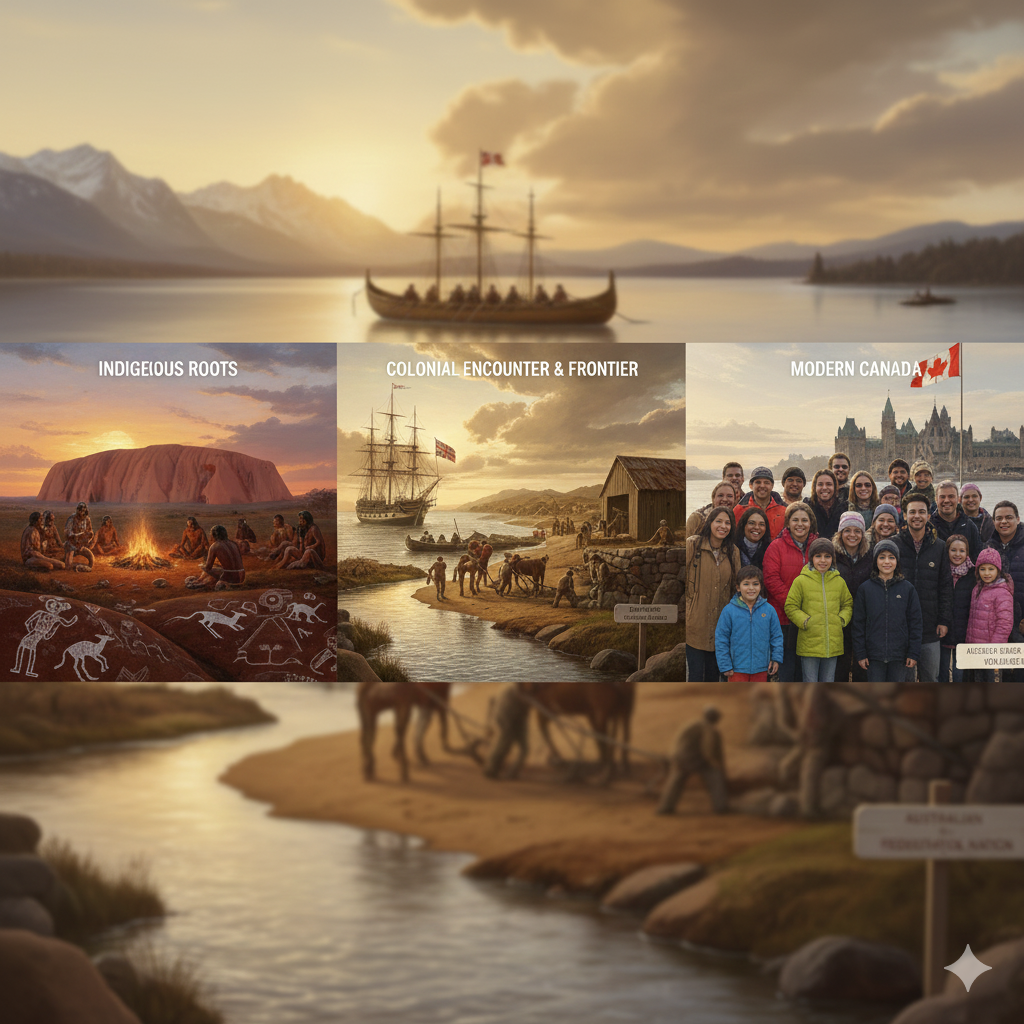
In History of Canada, I will focus on the below points:
Indigenous History (Pre-Contact to 1500s)
New France (1534–1763)
British North America (1763–1867)
Confederation and Nation Building (1867–1914)
World Wars and Interwar Years (1914–1945)
Post-War Canada and Modern Identity (1945–Present)
Deep Roots: Indigenous History (Pre-Contact to 1500s) 
The history of the land now known as Canada begins not with European arrival, but with the Indigenous Peoples who have inhabited the territory for thousands of years, having migrated across the Bering Strait land bridge (Beringia) and other routes.
Diverse Nations and Societies -History of Canada
By the time of European contact, the continent was home to hundreds of diverse and distinct nations with complex political, economic, and social structures. Historians categorize these groups largely by geographic and cultural areas:
-
- East/Woodland: Groups like the Mi’kmaq, Innu, and Algonquin were primarily nomadic hunters, fishers, and gatherers, often assembling in the summer for trade and ceremonies.
-
- Iroquoian: Nations like the Haudenosaunee (Iroquois Confederacy) and Huron-Wendat were sophisticated agriculturalists who lived in large, permanent, fortified villages with complex, consensus-based democratic systems. Their diet was centered on the “Three Sisters”: corn, beans, and squash.
-
- Plains: Nations such as the Blackfoot, Cree, and Assiniboine were nomadic, relying heavily on the seasonal migration of the bison for food, clothing, and shelter (tipis).
-
- Pacific Coast: Groups like the Haida, Tsimshian, and Kwakwaka’wakw developed highly elaborate, non-agricultural societies thanks to the abundance of marine life. They were known for their sophisticated wood carving, large communal longhouses, and the Potlatch ceremonies which demonstrated status and wealth.
-
- The North (Inuit): The Inuit of the Arctic developed specialized knowledge and technology (like the kayak and dog sled) to survive in a harsh environment, relying on marine mammals like seals, whales, and caribou.
These nations were not isolated; they engaged in extensive trade networks, complex alliances, and periods of warfare long before European arrival. The subsequent transfer of European diseases (for which Indigenous peoples had no immunity) and the disruption of these societal structures due to colonial expansion were catastrophic.
Rival Empires: New France (1534–1763) 
The European chapter of Canadian history officially began with the French claim on the land.
Exploration and Settlement
Though Norse Vikings briefly settled at L’Anse aux Meadows around 1000 AD, permanent European exploration began much later:
-
- 1497: John Cabot claimed the Atlantic coast for England.
-
- 1534: Jacques Cartier explored the Gulf of St. Lawrence, claiming the territory for King Francis I of France and naming it New France.
-
- 1605: Samuel de Champlain helped found Port Royal (Acadia), and in 1608, he founded Québec City, establishing the first permanent settlements and the heart of the future colony.
The Fur Trade and Alliances
The economy of New France was dominated by the fur trade, particularly beaver pelts used for hats in Europe. This reliance on the fur trade defined the nature of French-Indigenous relations:
-
- The French, needing guides, trappers, and access to interior waterways, established extensive trade alliances, most famously with the Huron-Wendat and later the Algonquin and Cree.
-
- This relationship led to the French becoming enemies of the powerful Haudenosaunee (Iroquois Confederacy), often resulting in conflict known as the Beaver Wars.
-
- The French population grew slowly compared to the English colonies to the south, prioritizing trade over mass agricultural settlement. The society was hierarchical, governed directly by the French Crown through a Governor and an Intendant.
The Conquest (1759–1763)
Growing imperial rivalry between Britain and France in the 18th century culminated in the Seven Years’ War (1756–1763), known in North America as the French and Indian War.
-
- 1759: The decisive Battle of the Plains of Abraham saw British General James Wolfe defeat French General Louis-Joseph de Montcalm, resulting in the surrender of Québec City.
-
- 1760: Montréal fell, ending French military control.
-
- 1763: The Treaty of Paris formally ceded nearly all of New France (except for fishing islands and claims) to Great Britain, fundamentally changing the cultural and political destiny of the continent.
The Shaping of a Nation: British North America (1763–1867) 
Following the conquest, Britain had to manage a vast new territory containing a large, established French-speaking, Catholic population (Canadiens).
Maintaining French Society
The British initially struggled to govern the territory, but two key acts solidified the cultural divide that persists today:
-
- The Royal Proclamation of 1763: Established guidelines for British settlement and governance, importantly setting aside lands west of the Appalachian Mountains for Indigenous peoples, an early foundation for later treaties.
-
- The Quebec Act of 1774: This was a pragmatic move designed to secure the loyalty of the Canadiens ahead of the impending American Revolution. It officially recognized French civil law, guaranteed religious freedom for Catholics, and reinstated the seigneurial system of land tenure. This act ensured the survival of a distinct French Canadian culture.
The American Influence and Division
The American Revolution (1775–1783) had a massive impact, bringing over 40,000 refugees known as United Empire Loyalists to the remaining British colonies.
-
- To accommodate the Loyalists (primarily English-speaking Protestants), the Constitutional Act of 1791 divided the Province of Quebec into two colonies:
-
- Upper Canada (mostly English-speaking, west of the Ottawa River, future Ontario).
-
- Lower Canada (mostly French-speaking, along the St. Lawrence, future Quebec).
-
- To accommodate the Loyalists (primarily English-speaking Protestants), the Constitutional Act of 1791 divided the Province of Quebec into two colonies:
-
- The War of 1812: This conflict, fought largely on Canadian soil between the British North American colonies and the United States, cemented a sense of shared identity and loyalty to the Crown among both English and French Canadians who fought together.
The Path to Responsible Government
Political tensions grew throughout the 1830s, as colonial governments were controlled by small, appointed elites (the Family Compact in Upper Canada and the Château Clique in Lower Canada), denying power to elected assemblies.
-
- The Rebellions of 1837–1838: Armed uprisings occurred in both Upper and Lower Canada, led by William Lyon Mackenzie and Louis-Joseph Papineau, respectively, pushing for democratic reform.
-
- Lord Durham’s Report (1839): Sent from Britain to investigate the rebellions, Lord Durham famously recommended two things:
-
- Reuniting Upper and Lower Canada to assimilate the French.
-
- Granting Responsible Government—where the executive council (Cabinet) is accountable to the elected legislative assembly, not the appointed Governor.
-
- Lord Durham’s Report (1839): Sent from Britain to investigate the rebellions, Lord Durham famously recommended two things:
-
- Act of Union (1840): The Canadas were united into the Province of Canada. While assimilation failed, the decades that followed saw the gradual, hard-won achievement of Responsible Government in the 1840s, culminating in the Lafontaine-Baldwin ministry.
Building the Dominion: Confederation and Expansion (1867–1914) 
The deadlock in the Province of Canada’s government, fear of American annexation, and the need for economic growth spurred a movement for a larger union.
The Birth of Canada
Key conferences in the 1860s (Charlottetown, Quebec, and London) led to a set of resolutions, championed by leaders known as the Fathers of Confederation, including John A. Macdonald and George-Étienne Cartier.
-
- July 1, 1867: The British North America Act (BNA Act) was passed by the British Parliament, creating the Dominion of Canada, a federal union of four provinces: Ontario, Quebec, Nova Scotia, and New Brunswick.
-
- Macdonald became the first Prime Minister, committed to his “National Policy” of nation-building.
The National Policy and Western Expansion
Macdonald’s vision rested on three pillars:
-
- The Canadian Pacific Railway (CPR): A massive project promised to British Columbia as a condition of its joining Confederation (1871), the railway was completed in 1885, physically uniting the country from east to west.
-
- Immigration and Settlement: The Dominion Lands Act (1872) offered free homesteads (160 acres) to settlers, driving mass immigration to the Prairies, a necessary precondition for the railway’s profitability.
-
- Protective Tariffs: Tariffs were imposed on foreign goods to protect Canadian manufacturing and create a national market for goods to be shipped via the CPR.
Treaties and Resistance
The expansionist project came at a devastating cost to the Indigenous peoples of the West.
-
- The Numbered Treaties (1871–1921): The government negotiated a series of eleven treaties with First Nations across the Prairies, often under duress and with profound misunderstandings of the terms. The goal was to clear the way for settlement and place Indigenous peoples on reserves.
-
- Red River Resistance (1869–1870): Led by Louis Riel, the Métis people of the Red River Settlement (modern Manitoba) resisted the Canadian government’s acquisition of Rupert’s Land without consultation. The resistance resulted in the creation of the province of Manitoba (1870), with constitutional guarantees for Métis land and French-language rights.
-
- North-West Resistance (1885): Faced with starvation and failed promises, Riel again led a resistance in modern Saskatchewan. The CPR was used to quickly deploy troops, and the uprising was crushed. Riel was executed for treason, an act that deeply divided French and English Canada.
-
- Residential Schools: Beginning in the 1880s, the government implemented the Residential School System, designed to assimilate Indigenous children by removing them from their families and cultures. This system would last for over a century, inflicting intergenerational trauma that continues to be a central issue in modern Canada.
Coming of Age: World Wars and Interwar Years (1914–1945) 
The 20th century saw Canada emerge from Britain’s shadow and forge its own international identity.
World War I (1914–1918)
As a self-governing Dominion, Canada was automatically at war when Britain declared war on Germany.
-
- Military Contributions: Canadian forces played a vital and distinct role, particularly in hard-fought victories at the Battle of Vimy Ridge (1917) and Passchendaele. These victories came at a tremendous cost, solidifying a national sense of military capability and sacrifice.
-
- The Conscription Crisis (1917): Prime Minister Robert Borden introduced mandatory military service, leading to a profound political and cultural split between English Canada (largely supportive) and French Canada (vehemently opposed), echoing the Riel crisis.
-
- Autonomy: Canada signed the Treaty of Versailles as an independent nation, and the Statute of Westminster (1931) formally recognized the Dominions as autonomous entities equal in status to the United Kingdom.
The Great Depression and World War II
The Great Depression (1929–c. 1939) caused widespread suffering, high unemployment, and the rise of new political parties (like the Cooperative Commonwealth Federation, CCF, the precursor to the NDP).
-
- World War II (1939–1945): Under Prime Minister William Lyon Mackenzie King, Canada declared war on Germany on its own authority one week after Britain.
-
- Canadian troops were instrumental in key operations, including the disastrous Dieppe Raid (1942), the Italian Campaign (1943–1945), and most famously, the landing on Juno Beach during D-Day (1944).
-
- Canada also ran the crucial British Commonwealth Air Training Plan and contributed heavily to the Battle of the Atlantic.
-
- World War II (1939–1945): Under Prime Minister William Lyon Mackenzie King, Canada declared war on Germany on its own authority one week after Britain.
-
- Home Front: The war effort stimulated massive industrial and economic growth, cementing Canada’s status as a major industrial power.
Modern Canada: Prosperity and Identity (1945–Present) 
The post-war era brought economic prosperity, the expansion of the welfare state, and a continuous debate over national unity.
Prosperity, Welfare, and Diplomacy
-
- Post-War Boom: Canada experienced rapid economic growth, spurred by resource development (like the discovery of oil in Alberta) and trade, particularly with the United States.
-
- The Welfare State: The post-war era saw the expansion of key social programs, including Universal Healthcare (pioneered in Saskatchewan by Tommy Douglas and later implemented federally under Lester B. Pearson).
-
- International Role: Canada was a founding member of the United Nations (UN) and the North Atlantic Treaty Organization (NATO). Lester B. Pearson won the Nobel Peace Prize for his role in resolving the Suez Crisis (1956) by proposing the first UN peacekeeping force, defining Canada’s reputation as a middle power and peacekeeper.
-
- Newfoundland joined Confederation in 1949, completing the current configuration of ten provinces.
The Quebec Question
The most persistent political challenge has been the status of Quebec.
-
- The Quiet Revolution (1960s): A period of rapid modernization in Quebec society, characterized by secularization, educational reform, and a heightened sense of Francophone nationalism.
-
- Bilingualism and Biculturalism: In response to growing tensions, Prime Minister Pearson introduced the Official Languages Act (1969), making Canada officially bilingual.
-
- Separatism: The political movement for an independent Quebec gained momentum, culminating in two provincial referendums on sovereignty:
-
- 1980: Defeated with 59.5% voting ‘No’.
-
- 1995: Narrowly defeated with 50.58% voting ‘No’, leading to a major re-evaluation of national unity.
-
- Separatism: The political movement for an independent Quebec gained momentum, culminating in two provincial referendums on sovereignty:
The Constitution and Contemporary Issues
Prime Minister Pierre Elliott Trudeau sought to cement Canadian identity and national unity.
-
- Patriation of the Constitution (1982): Trudeau brought the BNA Act home from the UK, making it fully a Canadian document. Crucially, it included the Canadian Charter of Rights and Freedoms, which enshrined fundamental rights and freedoms, dramatically changing the role of the judiciary and individual rights in Canadian society. Quebec, however, did not sign the 1982 Constitution.
-
- Multiculturalism: Canada adopted an official policy of multiculturalism in 1971, embracing a “cultural mosaic” rather than a “melting pot” model.
-
- Indigenous Reconciliation: Since the late 20th century, the legacy of colonization, particularly the Residential Schools, has become the central moral and political challenge. The Truth and Reconciliation Commission (TRC), which concluded its work in 2015, brought the devastating history to the national forefront. The process of fulfilling the Calls to Action and addressing land claims, treaty rights, and economic inequality remains a defining feature of contemporary Canada.
In summary, the history of Canada is one of evolving identity, shifting from a collection of Indigenous nations and a French colony, to a self-governing British Dominion, and finally to an independent, multicultural, and bilingual federal state grappling with its colonial past and its place in the modern world.
Visit : www.dkbtech.com