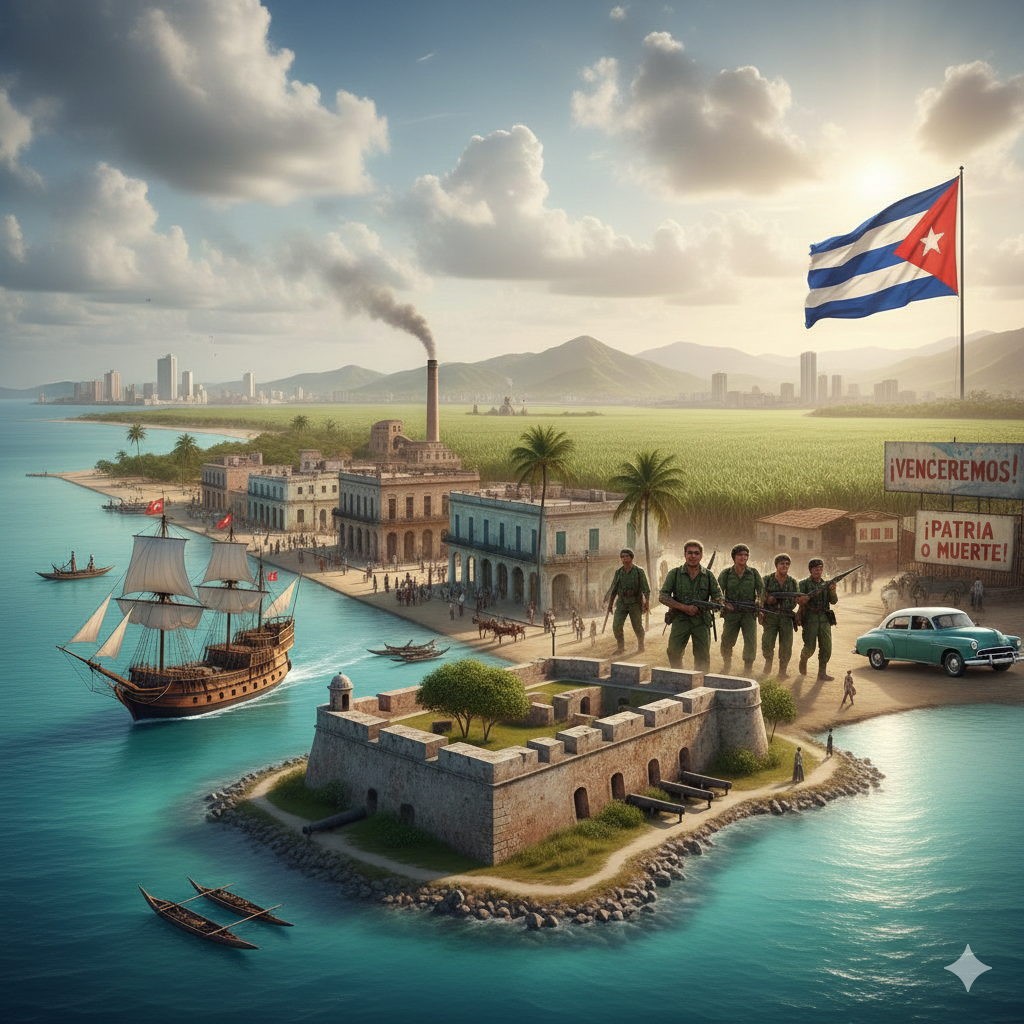
1. Pre-Columbian Roots and the Spanish “Encounter”
Before the arrival of Europeans, Cuba was inhabited by the Taíno, Ciboney, and Guanahatabey peoples. They lived in organized cacicazgos (chiefdoms) and were skilled in agriculture, particularly tobacco and yuca.
Everything changed in 1492 when Christopher Columbus landed. By 1511, Diego Velázquez de Cuéllar began the formal conquest. Within decades, the indigenous population was decimated by disease and forced labor (the encomienda system), leading the Spanish to begin the forced importation of enslaved people from Africa—a move that would permanently define Cuban culture, religion, and music.
2. The Pearl of the Antilles (1700s–1800s)
Cuba became the crown jewel of the Spanish Empire. Its strategic location made Havana the “Key to the New World.”
-
- The Sugar Boom: By the 19th century, Cuba was the world’s leading sugar producer.
-
- Independence Movements: While most of Latin America broke free from Spain in the 1820s, Cuba remained loyal (“The Ever-Faithful Isle”) until the late 1800s.
-
- The Ten Years’ War (1868–1878): The first major attempt at independence, led by Carlos Manuel de Céspedes. It ended in a stalemate but planted the seeds of rebellion.
3. José Martí and the Spanish-American War
In 1895, the poet-revolutionary José Martí launched the final War of Independence. Martí died early in battle, becoming Cuba’s greatest national hero.
The conflict took a global turn in 1898 when the USS Maine exploded in Havana Harbor. The United States intervened, defeating Spain in weeks. However, the resulting Platt Amendment gave the U.S. the right to intervene in Cuban affairs, creating a period of “limited sovereignty” and establishing the naval base at Guantánamo Bay.
4. The Republic and the Rise of Batista
The early 20th century was marked by economic growth (tourism, gambling, and sugar) and deep corruption.
-
- Fulgencio Batista: Originally a hero of the “Sergeants’ Revolt” in 1933, Batista eventually became a dictator. By the 1950s, his regime was characterized by brutal repression and a close alliance with the American Mafia, making Havana a playground for the wealthy while rural poverty surged.
5. The History of Cuba 1959 Revolution
On January 1, 1959, Fidel Castro, his brother Raúl, and Che Guevara successfully overthrew Batista after a multi-year guerrilla campaign in the Sierra Maestra mountains.
-
- The Shift to Socialism: Initially, the revolution promised democracy, but it quickly pivoted toward Marxism-Leninism as relations with the U.S. soured.
-
- Cold War Flashpoints: This era saw the failed Bay of Pigs invasion (1961) and the Cuban Missile Crisis (1962), which brought the world to the brink of nuclear war.
6. The “Special Period” and Modern Cuba
The collapse of the Soviet Union in 1991 was a catastrophe for Cuba, losing its main subsidies. This led to the “Special Period,” a time of extreme austerity and hunger.
In the 21st century, Cuba has undergone slow shifts:
-
- Transition of Power: From Fidel to Raúl Castro, and now to Miguel Díaz-Canel.
-
- Normalization: The 2014 “Thaw” under President Obama saw a brief diplomatic opening, though many restrictions were later reinstated.
-
- July 11, 2021: Largest protests in decades broke out over economic hardships and lack of freedoms, signaling a new chapter of civil unrest and digital activism.
Summary Table: Key Eras
| Era | Key Figures | Defining Characteristic |
| Colonial | Velázquez / De las Casas | Conquest and the rise of the Sugar trade. |
| Independence | José Martí / Maceo | Struggle against Spanish rule and U.S. intervention. |
| Revolutionary | Fidel Castro / Che Guevara | Overthrow of Batista; adoption of Communism. |
| Post-Soviet | Raúl Castro | Economic survival and gradual opening to tourism. |
Visit : www.dkbtech.com and www.allcircular.com