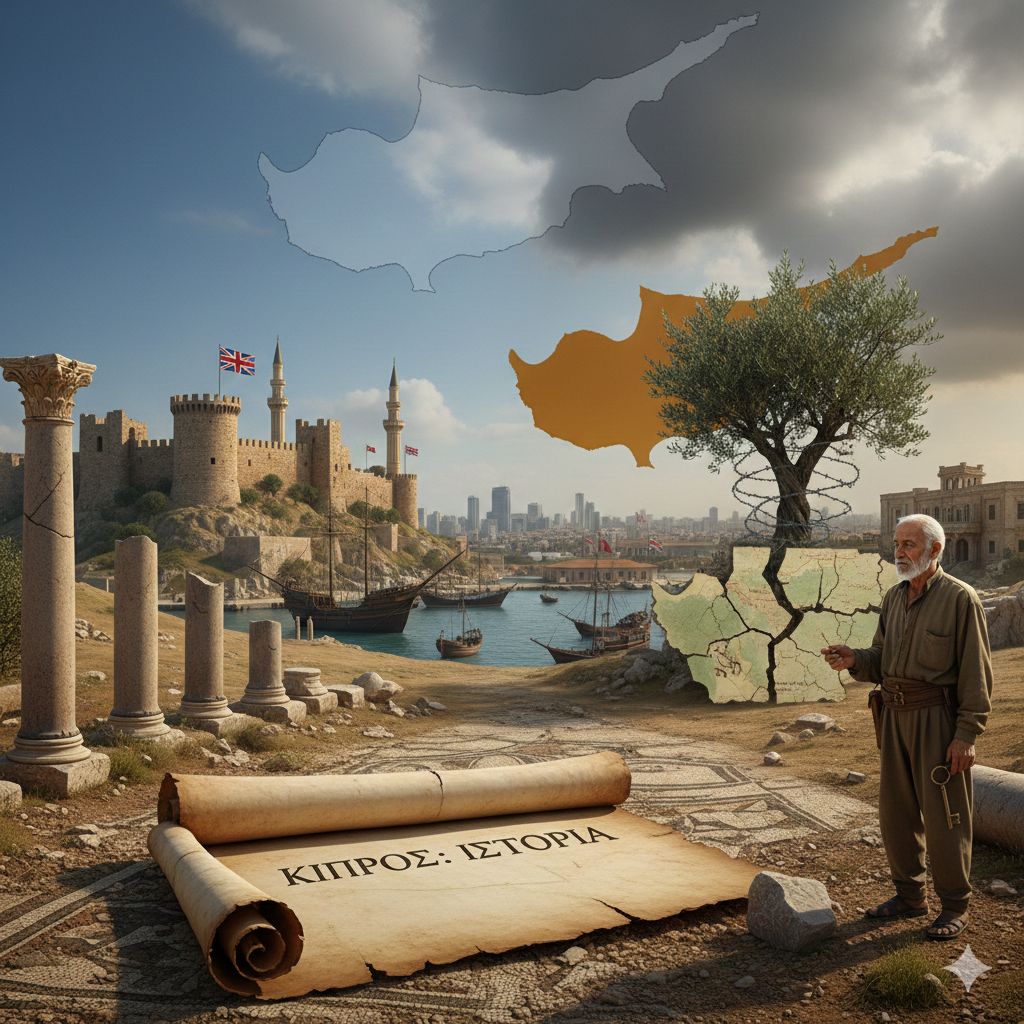
The History of Cyprus is a vast tapestry of human ambition, strategic conflict, and cultural synthesis. Spanning over 12,000 years, the island’s story is inextricably linked to its geography—a literal stepping stone between Europe, Asia, and Africa. Because of its abundant copper deposits and its position as a maritime hub, Cyprus has rarely been left to its own devices. Instead, it has been a sought-after prize for every major empire in the Mediterranean basin.
1. The Prehistoric Foundation (c. 10,000 BC – 1050 BC)
The human story of Cyprus begins in the Aceramic Neolithic period. Early hunter-gatherers arrived as early as 10,000 BC, coexisting for a time with endemic species like the pygmy elephant and pygmy hippopotamus. By 8,200 BC, the settlement of Choirokoitia (a UNESCO World Heritage Site) displayed a sophisticated society of circular stone houses, revealing that Cyprus was one of the earliest sites of permanent settlement in the Mediterranean.
The Bronze Age and the Birth of “Kypros”
The discovery of copper around 3000 BC changed Cyprus forever. The island’s name itself is believed to be derived from the Greek word for copper, kypros. During the Late Bronze Age, Cyprus—known in ancient Hittite and Egyptian texts as Alashiya—became the Mediterranean’s primary copper supplier.
This period also saw the arrival of Mycenaean Greeks around 1400 BC. Following the collapse of the Mycenaean palaces in Greece (c. 1200 BC), waves of Greek settlers integrated with the local population, establishing the Greek language and culture that remain the island’s foundation today.
2. Antiquity: The Age of City-Kingdoms (1050 BC – 330 AD)
For centuries, Cyprus was organized into ten to twelve autonomous city-kingdoms, such as Salamis, Paphos, and Kourion. These kingdoms were masters of diplomacy, often paying tribute to larger empires to maintain internal autonomy.
-
- Persian and Egyptian Rule: The island fell under the Neo-Assyrians, then the Egyptians, and finally the Persian Empire in 545 BC. Despite Persian rule, the city-kingdoms remained culturally Greek, even participating in the Ionian Revolt against the Persians.
-
- Hellenistic Cyprus: In 333 BC, Alexander the Great liberated Cyprus from the Persians. After his death, the island became a jewel of the Ptolemaic Kingdom of Egypt. During this era, Cyprus was fully Hellenized, and Paphos became its thriving capital.
-
- The Roman Province: Rome annexed Cyprus in 58 BC. This era brought stability and the famous visit of the Apostles Paul and Barnabas in 45 AD, who converted the Roman Proconsul Sergius Paulus, making Cyprus the first country in the world to be governed by a Christian.
3. The Byzantine and Medieval Eras (330 AD – 1571 AD)
With the division of the Roman Empire, Cyprus became part of the Byzantine Empire. This was a golden age for the Church of Cyprus, which was granted “autocephalous” (self-governing) status in 488 AD.
The Crusader Interlude
In 1191, during the Third Crusade, King Richard the Lionheart of England captured Cyprus after the local governor insulted his fiancé. Richard eventually sold the island to the Knights Templar, who then passed it to Guy de Lusignan, the dispossessed King of Jerusalem.
The Lusignan Dynasty (1192–1489) turned Cyprus into a vibrant feudal kingdom. Magnificent Gothic cathedrals and castles, like Bellapais Abbey and Saint Hilarion, were built during this time. Eventually, the Venetians took control in 1489, viewing the island primarily as a military fortress to guard against the rising Ottoman Empire.
4. Ottoman Rule and the British Period (1571 – 1960)
The Ottomans conquered Cyprus in 1571. This marked the arrival of the first Turkish settlers, creating the Turkish Cypriot community. The Ottomans abolished the feudal system and restored the Greek Orthodox Church’s power, using the Archbishop as a representative of the Greek population.
The British Administration
In 1878, the British took over administration of Cyprus via a secret deal with the Ottomans to protect the Suez Canal. Britain formally annexed the island in 1914. During the 1950s, the EOKA movement began a guerrilla war against British rule, seeking Enosis (union with Greece). This conflict eventually led to a compromise.
5. Independence and Modern Division (1960 – Present)
Cyprus gained independence in 1960, with Archbishop Makarios III as its first President. However, the power-sharing constitution between Greek and Turkish Cypriots proved fragile.
-
- 1974 Coup and Invasion: In July 1974, the military junta in Greece backed a coup to overthrow Makarios. In response, Turkey invaded, citing its right as a guarantor power to protect the Turkish Cypriot minority.
-
- The Divided Island: The island has remained divided ever since. A UN-monitored “Green Line” separates the Republic of Cyprus (south) from the “Turkish Republic of Northern Cyprus” (recognized only by Turkey).
In 2004, the Republic of Cyprus joined the European Union. Today, while the “Cyprus Problem” remains a focus of international diplomacy, the island thrives as a modern democratic state and a major Mediterranean tourist destination, still guarded by the ruins of the many empires that once called it home.
Visit: www.dkbtech.com and www.allcircular.com