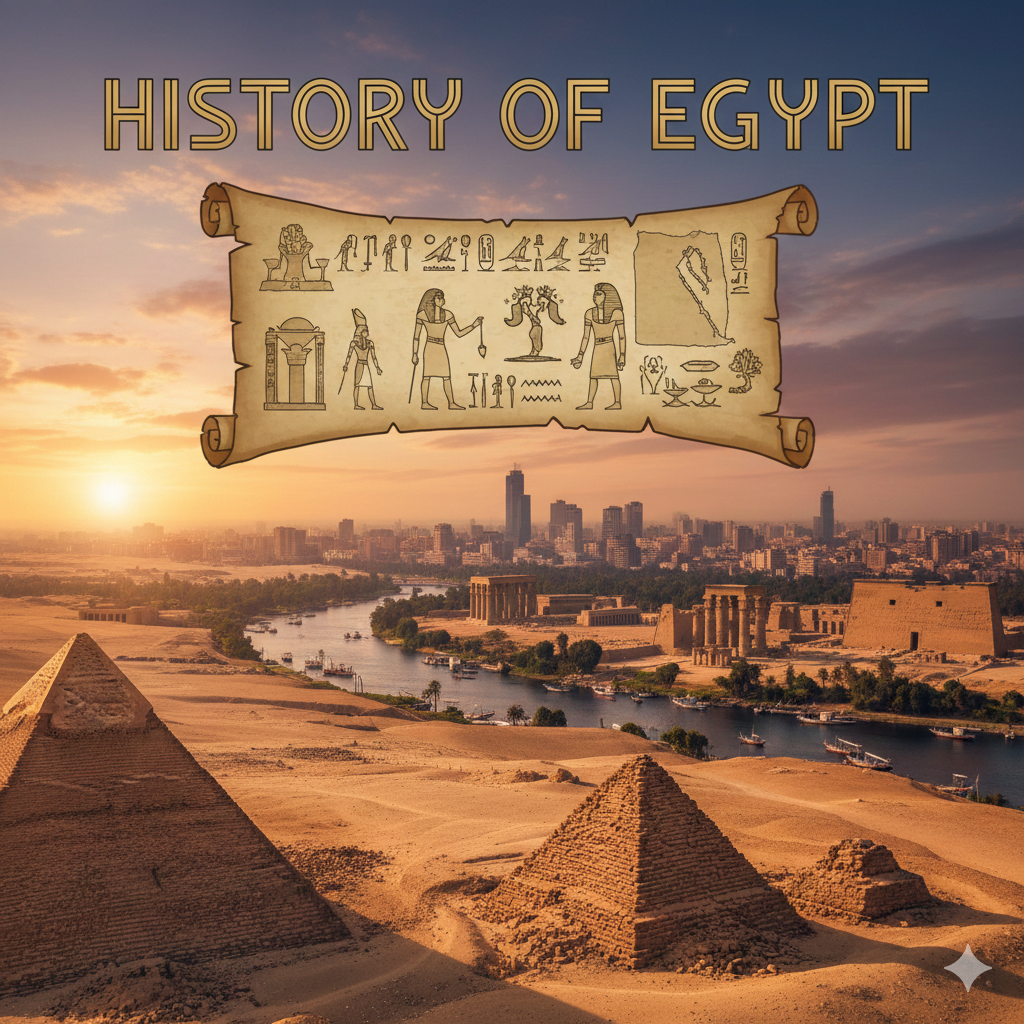
History of Egypt is a sprawling narrative of continuity and transformation, stretching from the first settlements along the Nile nearly 6,000 years ago to the modern, bustling republic of today. It is a story not just of stone and sand, but of the human spirit’s capacity for endurance.
I. The Dawn of the Pharaohs: The Dynastic Age
The history of Egypt effectively begins with the Nile River. Around 3100 BCE, a legendary figure known as Narmer (or Menes) unified the warring kingdoms of Upper and Lower Egypt. This act of unification birthed the Early Dynastic Period, establishing the first of 31 dynasties.
The Old Kingdom (c. 2686–2181 BCE)
Often called the “Age of the Pyramids,” this era saw the absolute power of the Pharaohs reach its peak. It was during the Fourth Dynasty that Khufu commissioned the Great Pyramid of Giza, a feat of engineering that remained the tallest man-made structure for nearly 4,000 years.
The Middle and New Kingdoms
After a period of chaos (the First Intermediate Period), the Middle Kingdom (c. 2055–1650 BCE) restored order and focused on art, literature, and regional trade. However, it was the New Kingdom (c. 1550–1070 BCE) that saw Egypt become a true empire. This was the age of:
-
- Hatshepsut: One of the most successful female pharaohs.
-
- Akhenaten: The “heretic” king who introduced monotheism.
-
- Ramesses II (The Great): A warrior-king who signed the world’s first recorded peace treaty with the Hittites.
II. The Greco-Roman and Islamic Eras
The decline of the New Kingdom led to centuries of foreign rule. In 332 BCE, Alexander the Great conquered Egypt, founding the city of Alexandria. His general, Ptolemy I, started a Greek dynasty that ended with the death of Cleopatra VII in 30 BCE, after which Egypt became a province of the Roman Empire.
The Islamic Conquest (641 CE)The most significant cultural shift occurred in the 7th century when Arab forces under Amr ibn al-As brought Islam to the Nile. Egypt transitioned from a Christian, Coptic-speaking Byzantine province to a central hub of the Islamic world. Under the Fatimid and Mamluk dynasties, Cairo became a global center for scholarship and trade.
III. Modern Egypt: From Monarchy to Republic
The modern era began in 1805 with Muhammad Ali Pasha, an Albanian commander who is considered the “Founder of Modern Egypt.” He modernized the military and bureaucracy, though his successors eventually fell under British colonial influence due to debts incurred building the Suez Canal (opened in 1869).
The 1952 Revolution and Beyond
In 1952, a group of “Free Officers” led by Gamal Abdel Nasser overthrew the monarchy, establishing a republic. Egypt’s 20th-century history was defined by:
-
- Nasserism: A period of Arab nationalism and the nationalization of the Suez Canal.
-
- The Camp David Accords: Under Anwar Sadat, Egypt became the first Arab nation to sign a peace treaty with Israel.
-
- The 25th of January Revolution (2011): A massive uprising that ended the 30-year rule of Hosni Mubarak.
Today, Egypt remains a pivotal regional power, balancing its ancient heritage with the demands of a 21st-century global economy.
Visit : www.dkbtech.com and www.allcircular.com