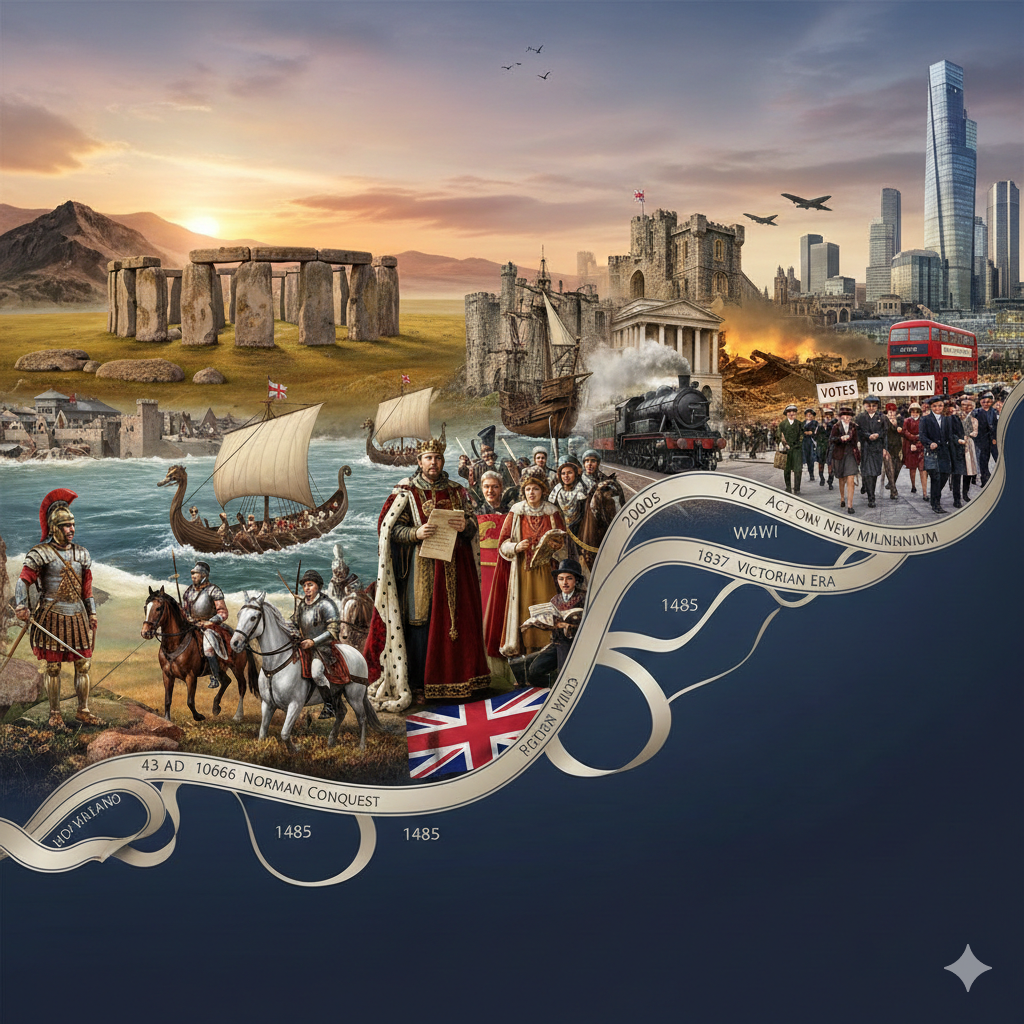
The history of England is not merely the story of a nation, but a compelling narrative of conquest, cultural fusion, and transformation that ultimately shaped a global empire and a modern democracy. Positioned strategically on the edge of the European continent, the island nation has served as a crucible where successive waves of invaders—Celts, Romans, Angles, Saxons, Vikings, and Normans—intermingled to create a distinct language, legal system, and political structure. From the ancient stones of Stonehenge to the financial skyscrapers of the City of London, England’s path has been one of continual revolution: religious, political, industrial, and social. The resulting narrative is one of resilient identity, maritime dominance, and a lasting influence on global culture, commerce, and governance.
1. Foundations: Roman and Anglo-Saxon Britain (c. 800 BC – 1066 AD)
Pre-Roman and the Celtic World
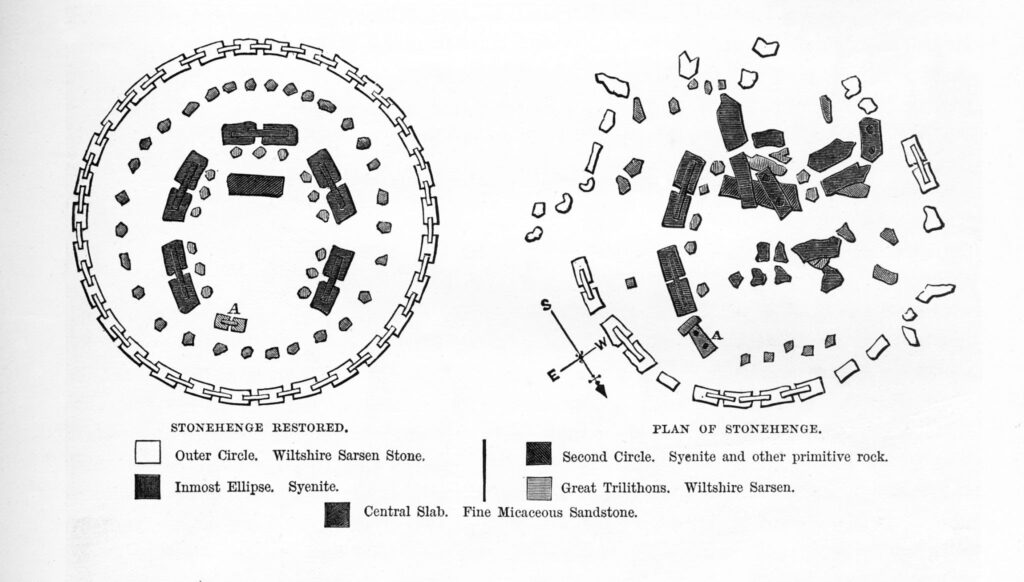
The earliest inhabitants of Britain left monumental structures like Stonehenge, a complex astronomical marker dating back to 3000 BC
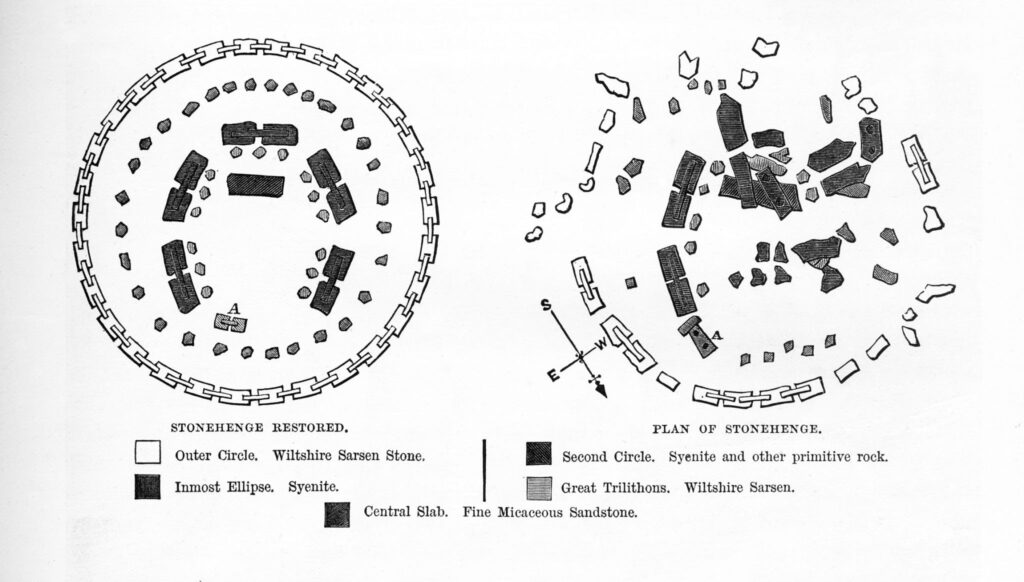
By the Iron Age, the land was settled by Celtic tribes, who developed a sophisticated agricultural society, distinct languages, and an intricate, decentralized political structure. These tribes, such as the Brigantes and Iceni, resisted foreign incursions until the arrival of the Roman Empire.
In History of england Roman Occupation (43 AD – c. 410 AD)
The definitive change began in 43 AD with the Emperor Claudius’s successful invasion. The Romans subdued the southern tribes, establishing the province of Britannia. They introduced urban centers like Londinium (London) and Eboracum (York), built extensive road networks, and brought Latin language and culture. To defend the northern frontier from the Picts, they erected Hadrian’s Wall, a defining symbol of the empire’s farthest reach. The Roman legacy was profound in infrastructure and administration, but less so in language, as the native Celtic tongues and local societal structures persisted outside the military and administrative centers. By the early 5th century, internal pressures and the need to defend the core of the empire forced Rome to withdraw its legions, leaving Britannia vulnerable and fragmented.
The Age of the Anglo-Saxons (c. 450 AD – 1066 AD)
The vacuum left by the Romans was filled by Germanic tribes—the Angles, Saxons, and Jutes—migrating from northern Germany and Denmark. This period, known as the Anglo-Saxon or Early Medieval period, saw the gradual establishment of a number of competing kingdoms, collectively known as the Heptarchy (including Wessex, Mercia, and Northumbria). Over time, these kingdoms were converted to Christianity, starting with the mission of St. Augustine in 597 AD. This conversion linked England culturally to continental Europe and brought literacy and monastic learning.
The 9th and 10th centuries were defined by the relentless onslaught of the Vikings (or Danes). The resistance organized by Alfred the Great of Wessex (r. 871–899) marked a turning point. Alfred successfully defended his kingdom, established the Danelaw (a territory where Danish law prevailed), and initiated the process of unifying the Anglo-Saxon kingdoms under a single crown, promoting the use of Old English and laying the foundation for a single English identity. By the early 11th century, the country briefly fell under Danish rule (Canute the Great), but the line of Alfred was restored in 1042 with Edward the Confessor.
2. Medieval Transformation (1066 AD – 1485 AD)
The Norman Conquest and Feudalism
The pivotal year in English history is 1066. Following the death of Edward the Confessor, William, Duke of Normandy, defeated the English forces led by Harold Godwinson at the Battle of Hastings. The Norman Conquest radically transformed England. William replaced the Anglo-Saxon nobility with a new French-speaking elite, establishing a rigid feudal system where land ownership was dependent on homage and military service to the king. The Normans introduced new architectural styles (e.g., stone castles and cathedrals), French vocabulary that permanently altered the English language, and a sophisticated central administration, famously catalogued in the Domesday Book (1086).
Plantagenets, Law, and Limits on Royal Power
The Plantagenet dynasty began with Henry II (r. 1154–1189), who established the Common Law system, relying on judicial precedent and traveling judges to create a unified body of law across the kingdom. This legal system remains the foundation of law in many nations today. The growing power of the monarchy was first formally checked in 1215 when King John was forced by rebellious barons to sign the Magna Carta. This document established that the King was not above the law and guaranteed certain rights, notably stating that no free man could be imprisoned or dispossessed of property except by “the lawful judgment of his equals or by the law of the land.” This moment is universally recognized as a foundational step toward parliamentary democracy.
The 14th century was marked by the Hundred Years’ War against France and the devastating arrival of the Black Death, which killed up to half the population. This demographic catastrophe fundamentally altered the feudal system, as the scarcity of labor empowered peasants, eventually leading to the Peasants’ Revolt of 1381.
The Wars of the Roses
The Medieval period culminated in the dynastic conflict known as the Wars of the Roses (1455–1485), a struggle for the throne between the House of Lancaster (represented by a red rose) and the House of York (represented by a white rose). The conflict destabilized the realm and decimated the old nobility. It ended at the Battle of Bosworth Field, where Henry Tudor (a Lancastrian claimant) defeated Richard III (the last Yorkist king). Henry was crowned Henry VII, inaugurating the Tudor dynasty and a new era of powerful, centralized monarchy.
3. The Reformation and Global Ambition (1485 AD – 1603 AD)
The Tudor Dynasty and the English Reformation
The Tudor period marked England’s emergence as a major European power. The most transformative event was the English Reformation, driven not by theological conviction initially, but by the marital politics of Henry VIII (r. 1509–1547).
Frustrated by the Pope’s refusal to annul his marriage to Catherine of Aragon, Henry passed the Acts of Supremacy (1534), declaring himself the Supreme Head of the Church of England. This dramatic break with Rome led to the dissolution of the monasteries, centralizing vast wealth and land in the crown, and fundamentally altering the religious and political landscape of the country.
The subsequent reigns of Henry’s children saw violent religious swings: Edward VI promoted Protestantism; Mary I (Bloody Mary) temporarily restored Catholicism; and finally, Elizabeth I (r. 1558–1603) established the “Elizabethan Religious Settlement,” forging a moderate Protestant Church that retained many Catholic rituals, thus securing internal peace.
The Elizabethan Golden Age
Elizabeth I’s reign is often regarded as a Golden Age. It was a period of flourishing culture (William Shakespeare, Christopher Marlowe), maritime exploration, and the beginnings of overseas colonization. England successfully resisted Catholic threats, notably defeating the Spanish Armada in 1588, a victory that cemented England’s reputation as a burgeoning naval power and fostered a powerful sense of national pride. This era firmly set England’s trajectory toward global influence.
4. From Civil War to Empire (1603 AD – 1837 AD)
The Stuarts, Civil War, and the Commonwealth
When Elizabeth died childless, the crown passed to James I (r. 1603–1625) of Scotland, uniting the crowns of England and Scotland. The Stuart period was dominated by conflict between the monarchy, which asserted the Divine Right of Kings, and Parliament, which defended its ancient rights and control over taxation. This tension exploded into the English Civil War (1642–1651). The Parliamentarian forces, led by Oliver Cromwell, defeated the Royalists, leading to the execution of Charles I in 1649 and the establishment of the Commonwealth, a republic lasting from 1649 to 1660. This was the only time in English history that the monarchy was abolished.
The monarchy was restored in 1660 under Charles II, but the fundamental issues remained unresolved.
The Glorious Revolution and Parliamentary Supremacy
The final triumph of Parliament came with the Glorious Revolution of 1688, when James II (a Catholic) was deposed in favor of the Protestant monarchs William and Mary. Critically, William and Mary accepted the 1689 Bill of Rights, which established constitutional monarchy, confirmed Parliament’s supremacy, and laid down fundamental individual rights. This revolution affirmed that power resided not in the person of the king, but in the constitutional relationship between the monarch and Parliament.
Union, Enlightenment, and Industrial Revolution
In 1707, the Acts of Union formally joined the Kingdom of England and the Kingdom of Scotland, creating the Kingdom of Great Britain. The subsequent Georgian era saw Great Britain become the preeminent global commercial and naval power, especially after defeating France in the Seven Years’ War (1756–1763).
The 18th century was also the age of the Industrial Revolution, a period of rapid technological advancement, starting with innovations in textiles, iron-making, and steam power. This revolution irrevocably transformed the English economy from an agrarian one to an industrial powerhouse. New inventions and factory systems led to massive rural-to-urban migration, the growth of factory towns, and the creation of a vast working class. This economic supremacy funded the expansion of the British Empire, which by the end of the century was a global network of territories and trading posts.
5. Victorian Zenith and Global Conflict (1837 AD – Present)
The Victorian Age (1837 AD – 1901 AD)
The long reign of Queen Victoria epitomizes Britain’s 19th-century zenith. It was an era of unprecedented industrial, economic, and imperial expansion. Britain was the “workshop of the world,” and the Empire covered a quarter of the globe. Internally, the era was defined by social reform and moral certainty. Key political changes included the extension of the franchise through Reform Acts (1832, 1867, 1884), which slowly moved the nation toward universal male suffrage. The period was marked by massive urban growth, driven by the factory system, which also necessitated public health reforms to tackle poverty and disease. Great cultural confidence was displayed in achievements like the Great Exhibition of 1851.
The Two World Wars and Social Change (1901 AD – 1945 AD)
The early 20th century was characterized by increasing social demands (e.g., the Suffragette movement achieving votes for women) and rising international tensions. Britain was dragged into the catastrophic First World War (1914–1918), which shattered the illusions of Edwardian society, cost an immense generation of lives, and plunged the country into severe economic difficulty despite being on the winning side.
The interwar years were fraught with economic depression and the rise of totalitarian regimes in Europe. The Second World War (1939–1945), particularly the Battle of Britain and the Blitz, tested the nation’s resolve. Led by Winston Churchill, Britain played a pivotal role in the Allied victory, though the conflict exhausted its national resources and accelerated the decline of its imperial dominance.
Post-War Reconstruction and Decolonization
The immediate post-war era saw the election of a Labour government committed to radical social change. This government implemented the Beveridge Report, establishing the modern Welfare State, including the National Health Service (NHS) in 1948—a cornerstone of modern British identity.
The latter half of the 20th century was dominated by the rapid decolonization of the British Empire, transforming it into the modern Commonwealth. Economically, the country struggled with cycles of high inflation and industrial unrest, leading to significant political shifts under leaders like Margaret Thatcher in the 1980s, who introduced free-market reforms that fundamentally reshaped the British economy.
Modern England
The turn of the millennium has seen England navigating issues of globalization, devolution (the granting of self-governance to Scotland, Wales, and Northern Ireland), and its complex relationship with Europe. The most recent defining event was the 2016 referendum decision to leave the European Union (Brexit), which ushered in a new era of global and economic repositioning.
Today, England remains a political, financial, and cultural powerhouse within the United Kingdom. Its historical legacy, rooted in the Magna Carta, the supremacy of Parliament, the Common Law, and the enduring influence of the English language, continues to shape the world. The history is a story of continuous adaptation, where ancient foundations meet the challenges of a constantly changing modern global environment.
Conclusion
The history of England is a cycle of integration, resistance, and redefinition. From the unification under Anglo-Saxon kings, to the Norman imposition of a new legal and social order, to the religious and political revolutions of the Tudors and Stuarts, the island has continually reinvented itself. The centuries of industrial and imperial dominance gave way to a modern state focused on social welfare and navigating a post-imperial world. This long, complex history is the source of the nation’s enduring institutions, its distinct character, and its lasting impact on the global stage.
Visit : www.dkbtech.com