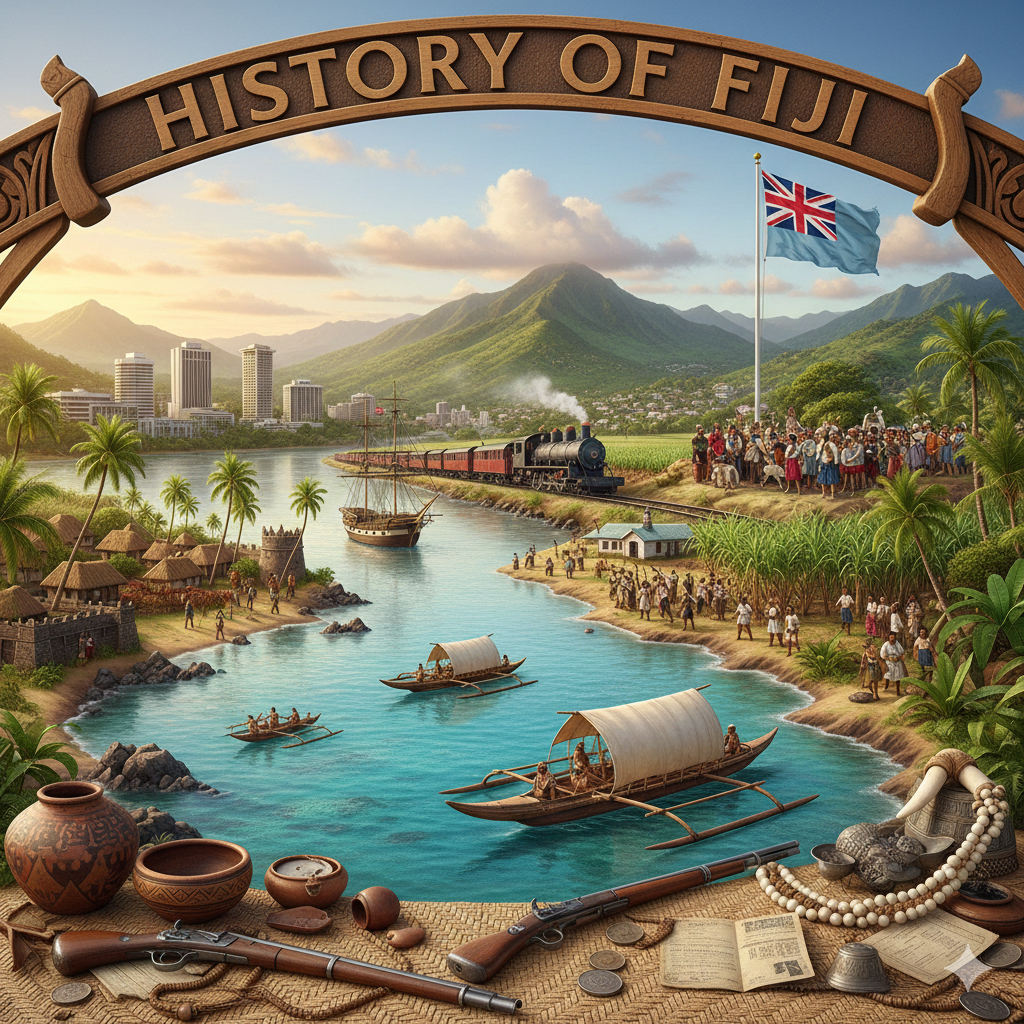
1. The Dawn of the Islands (1500 BC – 1800 AD)
The History of Fiji began approximately 3,500 years ago. The first settlers were the Lapita people, named after their distinctive stamped pottery. These seafaring voyagers traveled from Southeast Asia through Melanesia, navigating by the stars and ocean currents.
The Lapita Heritage
The Lapita settled primarily on the coasts, living off the sea and small-scale agriculture. Over centuries, they evolved into the distinct iTaukei (Indigenous Fijian) culture. By 1000 AD, the societal structure had shifted from small coastal settlements to complex, fortified inland villages as populations grew and competition for land increased.
A Culture of Warriors and Chiefs
Fijian society became highly stratified, governed by a hierarchy of chiefs (Turaga). This era was defined by:
-
- The Rise of Chiefdoms: Large confederacies like Bau, Rewa, and Verata emerged.
-
- Warfare: Ritualized warfare was common, and the construction of massive war canoes (Drua) allowed chiefs to project power across the archipelago.
-
- Spiritual Beliefs: Life was governed by a complex system of tabu (taboos) and the worship of ancestral gods (Kalou-vu).
2. The Era of First Contact (1643 – 1860)
The Western world’s first recorded glimpse of Fiji came from Dutch explorer Abel Tasman in 1643. However, it was not until the 19th century that European influence began to reshape the islands.
Beachcombers and Traders
In the early 1800s, Fiji became a hub for the Sandalwood trade. This brought “beachcombers”—shipwrecked sailors and deserters—who introduced muskets to the local chiefs. This technological shift escalated traditional warfare, leading to the rise of powerful warlords, most notably Ratu Seru Cakobau.
The Arrival of Christianity
Missionaries from the London Missionary Society and later the Methodists arrived in the 1830s. Their influence was gradual until the conversion of Cakobau in 1854, which signaled a massive shift in Fijian social and moral life, effectively ending the practice of cannibalism and tribal warfare in many regions.
3. Cession and the Colonial Period (1874 – 1970)
By the 1860s, Fiji was in turmoil. Debt, internal strife, and the threat of foreign intervention led Ratu Cakobau to offer the islands to Great Britain.
The Deed of Cession
On October 10, 1874, Fiji was formally ceded to the British Crown. The first governor, Sir Arthur Gordon, implemented a policy of “indirect rule.” He sought to protect the iTaukei way of life by:
-
- Prohibiting the sale of native land.
-
- Codifying the chiefly system through the Great Council of Chiefs.
The Girmitya Era
To fuel the burgeoning sugar industry without exploiting Indigenous labor, the British initiated the indentured labor system. Between 1879 and 1916, over 60,000 people from India were brought to Fiji. Known as Girmityas, these laborers endured harsh conditions but eventually settled, forever changing Fiji’s demographic and cultural landscape.
4. Independence and the Coup Cycles (1970 – 2006)
Fiji gained independence from Britain on October 10, 1970, exactly 96 years after Cession. Ratu Sir Kamisese Mara became the nation’s first Prime Minister, championing the “Pacific Way” of consensus.
The Struggle for Identity
Independence brought the challenge of balancing the political rights of the Indo-Fijian population with the “paramountcy of Fijian interests.” This tension led to several political upheavals:
-
- 1987 Coups: Led by Sitiveni Rabuka after an Indo-Fijian-dominated coalition won the election.
-
- 2000 Coup: Led by George Speight, which saw the first Indo-Fijian PM, Mahendra Chaudhry, taken hostage.
-
- 2006 Coup: Led by Commodore Voreqe (Frank) Bainimarama, who argued that the government was promoting racial division.
5. Modern Fiji: The Path to Stability (2014 – Present)
Following years of interim rule, Fiji returned to democracy in 2014 under a new constitution that removed ethnic-based voting.
Key Milestones:
-
- 2013 Constitution: Introduced a “one person, one vote” system and declared all citizens “Fijians,” regardless of ethnicity.
-
- Global Leadership: Fiji has become a leading voice in global climate change advocacy, presiding over COP23.
-
- Economic Shift: Transitioning from a sugar-based economy to a tourism powerhouse, though the nation remains vulnerable to natural disasters.
Summary Table: Key Eras in Fijian History
| Period | Key Event | Significance |
| 1500 BC | Arrival of Lapita | First human settlement and start of iTaukei culture. |
| 1835 | Missionary Arrival | Introduction of Christianity and Western education. |
| 1874 | Deed of Cession | Fiji becomes a British Colony; land rights are protected. |
| 1879 | First Girmit Ship | Arrival of Indian laborers; birth of multi-ethnic Fiji. |
| 1970 | Independence | Fiji becomes a sovereign nation. |
| 1987-2006 | The Coup Years | Period of political instability and constitutional debate. |
| 2014 | Democratic Elections | Return to parliamentary democracy under a common roll. |
Fiji’s history is a story of resilience—from the courageous navigators of the Pacific to the modern struggle to create a unified, multi-ethnic democracy.
Visit: www.dkbtech.com and www.allcircular.com