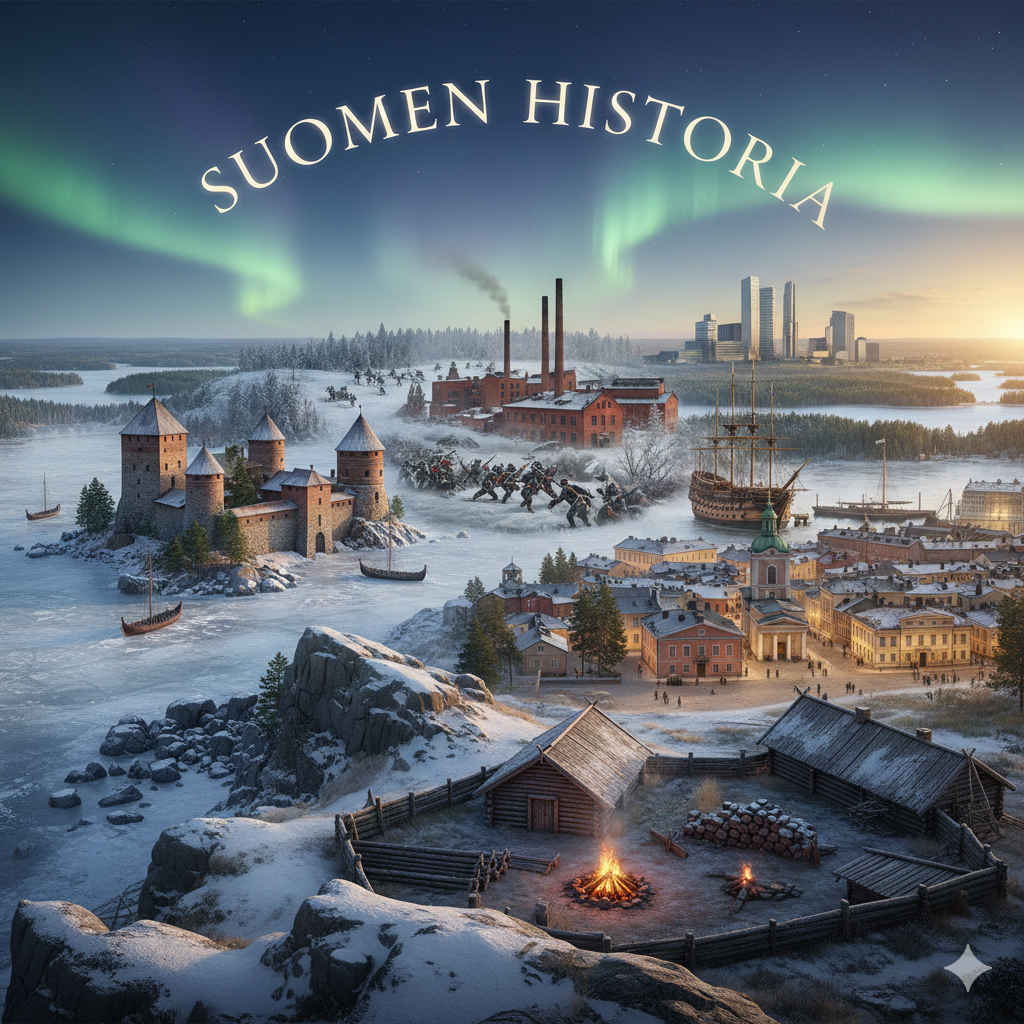
1. The Prehistoric Dawn (9000 BCE – 1150 CE)
The history of Finland begins with the retreating ice sheets of the last Ice Age. Around 9000 BCE, the first nomadic hunters and gatherers followed the reindeer and elk into the newly exposed land.
-
- The Suomusjärvi Culture: These early inhabitants used stone tools and lived primarily on coastal fishing and hunting.
-
- The Arrival of Finno-Ugric Peoples: Around 3000–2000 BCE, the “Comb Ceramic” culture emerged, marking a shift toward more permanent settlements and a linguistic foundation that would eventually become the Finnish and Sámi languages.
-
- The Bronze and Iron Ages: Finland remained largely outside the direct control of the Roman Empire, but trade routes brought metals and luxury goods. By the Viking Age (800–1050 CE), Finland was a crossroads between the seafaring Vikings of the west and the Novgorodians of the east.
2. The Swedish Era (1150 – 1809)
For nearly 700 years, Finland was an integral part of the Swedish Kingdom. This was not a colonial relationship in the traditional sense; Finns were Swedish subjects with the same rights as those living in Stockholm.
The Crusades and Christianity
Sweden’s influence began with the “Northern Crusades.” Legend tells of King Erik and Bishop Henry arriving in 1155 to baptize the Finns. Over the next century, three crusades consolidated Swedish power and established the Catholic Church (later Lutheran) as a pillar of society.
The Border with Russia
In 1323, the Treaty of Nöteborg established the first official border between Sweden and the Republic of Novgorod (Russia). This line would shift many times over the centuries, turning Finland into a perennial battlefield between Eastern and Western powers.
The Rise of Turku and the Reformation
Turku (Åbo) became the administrative and ecclesiastical heart of Finland. In the 16th century, the Reformation reached Finland via Mikael Agricola, the “Father of Finnish Literature,” who translated the New Testament into Finnish, effectively creating the written language.
3. The Grand Duchy Under Russia (1809 – 1917)
The Napoleonic Wars shifted the European map. In the Finnish War (1808–1809), Russia defeated Sweden, and Finland was ceded to Tsar Alexander I.
Autonomous Finland
Surprisingly, the Tsar granted Finland autonomy as a Grand Duchy. Finland kept its Swedish laws, its Lutheran religion, and eventually gained its own currency (the Markka) and postal service. This period was the “Golden Age” of Finnish nationalism:
-
- Elias Lönnrot compiled the Kalevala, the national epic.
-
- Johan Vilhelm Snellman pushed for Finnish to become an official language of administration.
-
- Jean Sibelius composed music that gave a voice to the Finnish spirit.
Russification and Resistance
In the late 19th century, the Russian Empire attempted to strip Finland of its autonomy (the “Years of Oppression”). This backfired, strengthening the Finnish resolve for full independence. In 1906, Finland became the first country in Europe to grant women full political rights, including the right to vote and stand for election.
4. Independence and Civil War (1917 – 1918)
The Russian Revolution of 1917 provided the window of opportunity. On December 6, 1917, the Finnish Parliament declared independence.
However, the joy was short-lived. A bitter Civil War broke out in 1918 between the “Reds” (working class, supported by Bolshevik Russia) and the “Whites” (bourgeoisie/farmers, supported by Imperial Germany). The Whites won, but the conflict left deep scars in Finnish society that took decades to heal.
5. The Crucible of World War II
Finland’s survival as a sovereign nation was tested during three distinct conflicts:
-
- The Winter War (1939–1940): The Soviet Union invaded. Despite being vastly outnumbered, the Finnish “Sisu” (stoic determination) and superior winter tactics held the Red Army back, though Finland eventually lost 10% of its territory.
-
- The Continuation War (1941–1944): Seeking to regain lost lands, Finland fought alongside Germany against the USSR.
-
- The Lapland War (1944–1945): Under the terms of the peace treaty with the Soviets, Finland had to forcibly expel German troops from its northern regions.
6. The Modern Era: Neutrality and Tech
Post-war Finland walked a diplomatic tightrope called “Finlandization”—maintaining neutrality to appease the Soviet Union while integrating economically with the West.
-
- The Economic Miracle: Finland transformed from an agrarian society to a high-tech powerhouse. The rise of Nokia in the 1990s symbolized this shift.
-
- EU and Beyond: In 1995, Finland joined the European Union. In 2023, following the invasion of Ukraine by Russia, Finland fundamentally shifted its security policy by joining NATO, marking the end of its era of military non-alignment.
Key Historical Comparison
| Era | Ruler/Power | Status of the Finnish Language |
| Swedish | Swedish Crown | Peasant dialect; Swedish was the elite language. |
| Russian | Russian Tsar | Emerged as a language of culture and administration. |
| Independent | Finnish Republic | National language; global leader in education. |
Visit : www.dkbtech.com and. www.allcircular.com