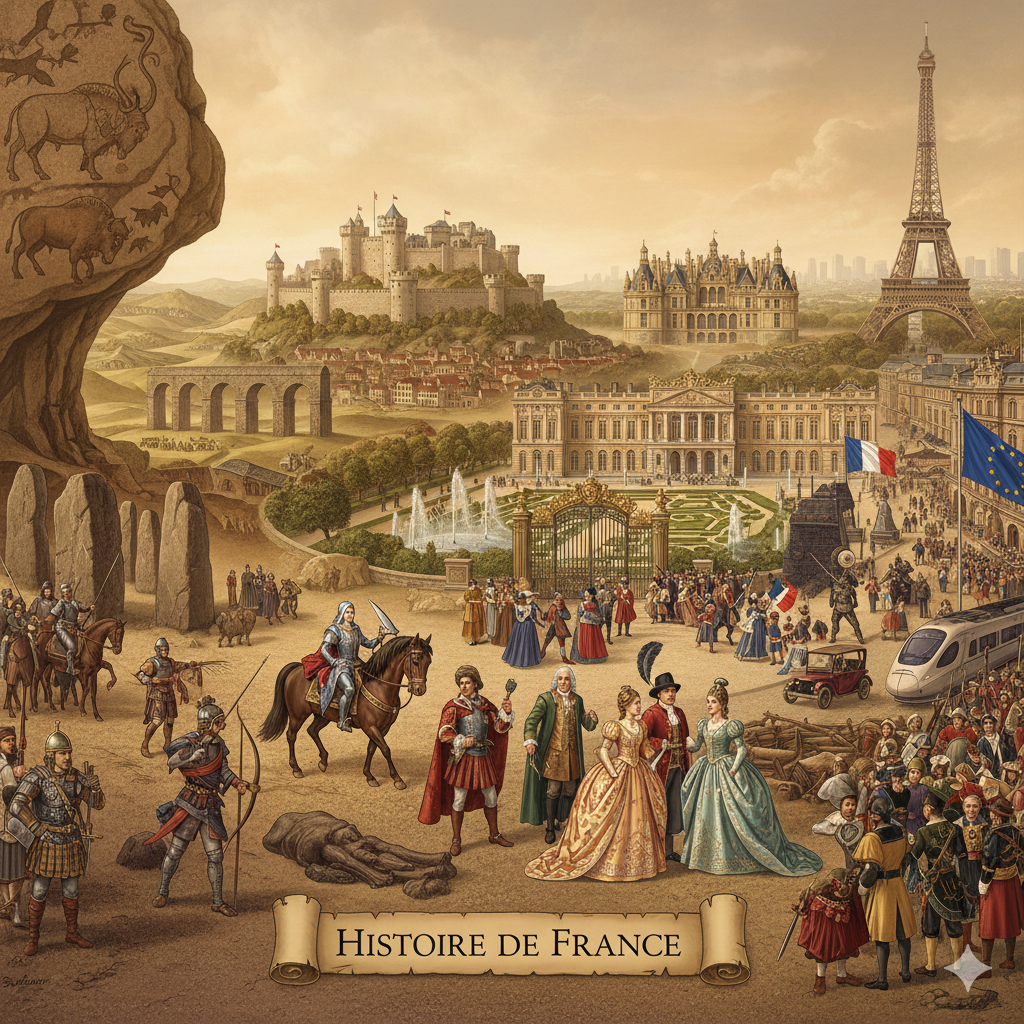
The History of France is a continuous, fascinating narrative of human development, from prehistoric cave dwellers to the establishment of one of the world’s most influential modern republics. It is a story of Gaulish tribes, Roman conquest, Frankish kingdoms, feudal struggle, revolution, empire, and two world wars, all contributing to the distinct cultural, political, and social identity that is modern France.
I. Prehistory and Roman Gaul (to 5th Century AD)
The territory that is now France was first settled by early hominids. The most famous evidence of prehistoric human activity is found in the painted caves of Lascaux , dating back approximately 17,000 years.
A. The Gauls (The Celts)
Around the 8th century BC, Celtic tribes, collectively known as the Gauls by the Romans, began migrating into the region. They formed powerful, decentralized tribes (such as the Arverni and Aedui) and established trade links across Europe. Despite their lack of unified political structure, they were fierce warriors, famously sacking Rome in 390 BC under the chieftain Brennus.
B. Roman Conquest and Pax Romana
The pivotal moment came in the 1st century BC when Julius Caesar undertook the conquest of Gaul (58–52 BC). The final and most significant resistance was led by the Arvernian chieftain, Vercingetorix, who was defeated at the Battle of Alesia in 52 BC.
Gaul was then integrated into the Roman Empire as the province of Gallia. This Romanization was profound:
-
- Infrastructure: Cities like Lugdunum (Lyon), Lutetia (Paris), and Narbo Martius (Narbonne) were founded or expanded, connected by a vast network of Roman roads.
-
- Culture: Latin became the dominant language, forming the basis for the later development of the French language. Roman law, architecture (aqueducts, arenas, baths ), and administration were established.
-
- Religion: Christianity began to spread through Gaul in the 2nd and 3rd centuries AD.
II. The Merovingians and Carolingians (481–987 AD)
As the Western Roman Empire declined in the 5th century, various Germanic tribes migrated across the Rhine. The Franks emerged as the most successful and enduring group.
A. The Merovingian Dynasty
In 481, Clovis I united the various Frankish tribes and established the Merovingian Dynasty. His conversion to Catholic Christianity around 496 was a critical moment. It secured the allegiance of the Gallo-Roman population and the powerful Catholic Church, setting the stage for a lasting alliance between the French monarchy and the Papacy. Upon Clovis’s death, the kingdom was often divided among his heirs, leading to centuries of internal strife known as the period of the “Do-Nothing Kings” (rois fainéants).
B. The Rise of the Carolingians
Real power shifted to the Mayors of the Palace (chief ministers). One of these, Charles Martel, famously defeated a massive invading Muslim army at the Battle of Tours in 732, an event often credited with halting the Muslim advance into Western Europe.
His son, Pepin the Short, deposed the last Merovingian king with papal approval, establishing the Carolingian Dynasty in 751.
C. Charlemagne (768–814)
The zenith of the Frankish kingdom was reached under Pepin’s son, Charlemagne (Charles the Great).
-
- Expansion: He waged campaigns that expanded the Frankish domain to include much of modern France, Germany, and Northern Italy.
-
- Imperial Crown: On Christmas Day, 800 AD, Pope Leo III crowned Charlemagne as Emperor of the Romans , symbolizing the rebirth of a Western Roman Empire and formalizing the union of Germanic power and Roman tradition.
-
- Carolingian Renaissance: He fostered a cultural and intellectual revival, standardizing monastic life, promoting literacy, and preserving classical texts.
After Charlemagne’s death, the empire was divided by the Treaty of Verdun in 843, which created three realms: West Francia (Francia Occidentalis) is the territory that directly evolves into France.
III. The Capetians and the Consolidation of Royal Power (987–1498)
The Carolingian line weakened due to Viking invasions and the rise of local feudal lords. In 987, the powerful nobles elected Hugh Capet, Duke of France, as king, establishing the Capetian Dynasty.
A. Feudal Monarchy and the Crusades
Initially, the Capetian kings controlled only the Île-de-France (the region around Paris). For centuries, their main challenge was to assert authority over powerful vassals (Dukes of Normandy, Brittany, Burgundy, etc.). The Crusades, launched at the end of the 11th century, provided an external focus and strengthened royal prestige.
B. The Angevin Empire and Philip Augustus
The great rivalry of the period was with the Kings of England, particularly the Angevin Empire established by Henry II of England, who controlled more territory in France than the French king himself. King Philip II (Augustus) (reigned 1180–1223) was a shrewd ruler who capitalized on internal English strife. His decisive victory at the Battle of Bouvines in 1214 allowed him to recover Normandy, Maine, Anjou, and Touraine, greatly expanding the royal domain and establishing France as the dominant European power.
C. Louis IX (Saint Louis) and Institutional Reform
Louis IX (1226–1270) was an immensely respected king known for his piety and justice. He reformed the judicial system, establishing royal courts and laying the foundation for the French legal tradition. The magnificent Sainte-Chapelle in Paris was built during his reign.
D. The Hundred Years’ War (1337–1453)
This prolonged conflict began when the English King Edward III claimed the French throne upon the extinction of the direct Capetian line in 1328.
-
- English Dominance: Early French defeats at Crécy (1346) and Poitiers (1356) and the catastrophic Black Death (which arrived in 1347) devastated France.
-
- Joan of Arc: The war turned decisively with the emergence of Joan of Arc in 1429. Her divine inspiration rallied the French army, leading to the lifting of the Siege of Orléans and the coronation of Charles VII at Reims . Though captured and executed by the English in 1431, her legacy solidified the French sense of national identity.
-
- Outcome: By 1453, the English were expelled from all French territory except Calais, marking the end of the war and the emergence of a unified, centrally governed French kingdom.
IV. The Ancien Régime (16th–18th Centuries)
This period, known as the Ancien Régime (Old Rule), saw the rise of an absolute monarchy and intense cultural flowering.
A. The Renaissance and Religious Wars
The early 16th century saw the French Renaissance under Francis I, who embraced Italian art and culture (e.g., inviting Leonardo da Vinci to France). However, the spread of the Protestant Reformation led to decades of internal conflict. The French Wars of Religion (1562–1598) pitted Catholics against Protestants (Huguenots). The most infamous episode was the St. Bartholomew’s Day Massacre in 1572.
The conflict was ended by Henry IV (the first Bourbon king) who converted to Catholicism to secure his throne (“Paris is worth a mass”) and issued the Edict of Nantes in 1598, granting substantial rights to Huguenots and establishing religious toleration.
B. The Age of Absolutism
The 17th century was the era of French absolutism.
-
- Richelieu and Mazarin: Under Louis XIII, Chief Ministers Cardinal Richelieu and, later, Cardinal Mazarin systematically curtailed the power of the nobility and regional parliaments, centralizing all authority in the Crown.
-
- Louis XIV, the “Sun King” (1643–1715): Louis XIV famously declared, “L’État, c’est moi” (I am the State). He built the Palace of Versailles , which served as a dazzling symbol of royal power and a mechanism to control the nobility by keeping them close. His reign saw French culture, language, and military power dominate Europe. However, his costly wars and the revocation of the Edict of Nantes (1685), which led to the emigration of hundreds of thousands of Huguenots, sowed seeds of future instability.
C. The Enlightenment and the Crisis of the Monarchy
The 18th century, under Louis XV and Louis XVI, was the Age of Enlightenment. Philosophers like Rousseau, Voltaire, and Montesquieu questioned the very foundations of absolute monarchy, hereditary privilege, and the feudal structure. Their ideas promoting liberty, equality, and rational government spread rapidly among the educated elite.
Concurrently, the French monarchy faced a severe financial crisis, exacerbated by costly foreign wars (like the Seven Years’ War and the American Revolutionary War) and a highly unequal system of taxation that burdened the peasantry and the burgeoning middle class (the Third Estate).
V. The French Revolution and Napoleon (1789–1815)
The combination of intellectual ferment, social inequality, and fiscal crisis led to the dramatic rupture of the French Revolution.
A. The Revolution (1789–1799)
-
- 1789: Unable to solve the financial crisis, Louis XVI summoned the Estates-General for the first time since 1614. The Third Estate broke away, forming the National Assembly, and took the Tennis Court Oath (vowing not to disband until a constitution was established). The storming of the Bastille on July 14, 1789, symbolized the end of royal tyranny.
-
- Reforms: The National Assembly abolished feudalism and passed the Declaration of the Rights of Man and of the Citizen , proclaiming the sovereignty of the people and the fundamental rights of all citizens.
-
- The Republic and the Terror: The monarchy was abolished, and the First French Republic was proclaimed in 1792. Fear of counter-revolution and foreign invasion led to the Reign of Terror (1793–1794), led by the radical Maximilien Robespierre, during which tens of thousands were executed. The Terror ended with Robespierre’s own execution, and the Directory (1795–1799) took power.
B. The Napoleonic Era
In 1799, a young, successful general named Napoleon Bonaparte staged a coup d’état, ending the Directory and establishing the Consulate.
-
- Emperor: In 1804, Napoleon crowned himself Emperor of the French , ending the First Republic.
-
- Reforms: He instituted major, lasting reforms, most notably the Napoleonic Code (or Civil Code), which codified French law and influenced legal systems worldwide. He also centralized administration and established the Lycée education system.
-
- Wars of Conquest: Napoleon’s ambition plunged Europe into two decades of war. At its height, the French Empire controlled most of continental Europe. The disastrous invasion of Russia in 1812 and the final defeat at the Battle of Waterloo in 1815 led to his final exile and the end of the First Empire.
VI. The 19th Century: Instability and the Rise of the Republic (1815–1914)
The century following Napoleon was marked by a constant struggle between republican, monarchist, and imperial ideals.
-
- The Restoration (1814–1830): The Bourbon monarchy was restored with Louis XVIII.
-
- The July Monarchy (1830–1848): Louis-Philippe, the “Citizen King,” ruled under a constitutional monarchy.
-
- The Second Republic (1848–1852): A brief democratic republic established after the Revolutions of 1848, which introduced universal male suffrage.
-
- The Second Empire (1852–1870): Louis-Napoleon Bonaparte (Napoleon’s nephew) staged a coup and crowned himself Emperor Napoleon III. His reign saw industrial modernization and the ambitious renovation of Paris by Baron Haussmann. It ended disastrously with the defeat in the Franco-Prussian War of 1870–1871.
A. The Third Republic (1870–1940)
The defeat against Prussia and the subsequent establishment of the Paris Commune (a short-lived revolutionary government in Paris) led to the founding of the Third Republic. This proved to be the longest-lasting democratic regime up to that point.
-
- Achievements: The Third Republic established free, secular, and compulsory education (Jules Ferry Laws), legalized trade unions, and developed a vast colonial empire (especially in Africa and Indochina).
-
- Challenges: It faced major political crises, such as the Dreyfus Affair (a Jewish army officer falsely accused of treason), which polarized the country between pro-army conservatives and pro-republican liberals and cemented the division between Church and State.
VII. The 20th Century and Contemporary France (1914–Present)
The 20th century was one of survival, recovery, and the creation of modern European integration.
A. The World Wars
-
- World War I (1914–1918): France was a principal battleground of the Western Front. The nation suffered immense casualties (nearly 1.4 million military deaths). The war, fought largely in the trenches, crippled a generation and was a profound psychological trauma. The Treaty of Versailles (1919) restored Alsace-Lorraine to France.
-
- The Interwar Period: France struggled to recover economically and politically.
-
- World War II (1939–1945): In 1940, the French army was quickly defeated by the German Blitzkrieg. The country was split: the northern zone was occupied by Germany, and the southern zone was governed by the collaborationist Vichy Regime led by Marshal Philippe Pétain. General Charles de Gaulle , refusing to surrender, fled to London and led the Free French Forces, organizing the Resistance (la Résistance). France was liberated by the Allies in 1944.
B. The Fourth and Fifth Republics
-
- The Fourth Republic (1946–1958): A parliamentary system that oversaw post-war reconstruction (aided by the Marshall Plan) and the early stages of European integration. However, it was destabilized by the wars of decolonization, particularly in Indochina and the increasingly bitter Algerian War.
-
- The Fifth Republic (1958–Present): The crisis over Algeria led to the return of Charles de Gaulle, who oversaw the creation of a new constitution, establishing the Fifth Republic. This constitution gave the President much greater executive power. De Gaulle successfully ended the war in Algeria (1962), established France’s independent nuclear deterrent (Force de Frappe), and adopted a foreign policy independent of both the US and the Soviet Union.
C. Contemporary France
Since de Gaulle, French politics has oscillated between center-right and center-left parties, but the core institutions of the Fifth Republic have endured.
-
- Social Change: The May 1968 student and worker protests were a profound challenge to traditional French society and led to significant social and educational reforms.
-
- European Union: France has been a founding and leading member of the European Union (EU) and the Eurozone, viewing it as crucial for peace and prosperity.
-
- Challenges: Contemporary France faces ongoing economic challenges, including unemployment and integrating diverse immigrant populations, alongside the threat of terrorism and internal political polarization.
The history of France is a powerful testament to the resilience of a nation that has continually reinvented itself—from Roman colony to medieval kingdom, from absolute monarchy to a powerful modern republic, its culture and ideas forever shaping the course of Western Civilization.
Visit : www.dkbtech.com and allcircular.com