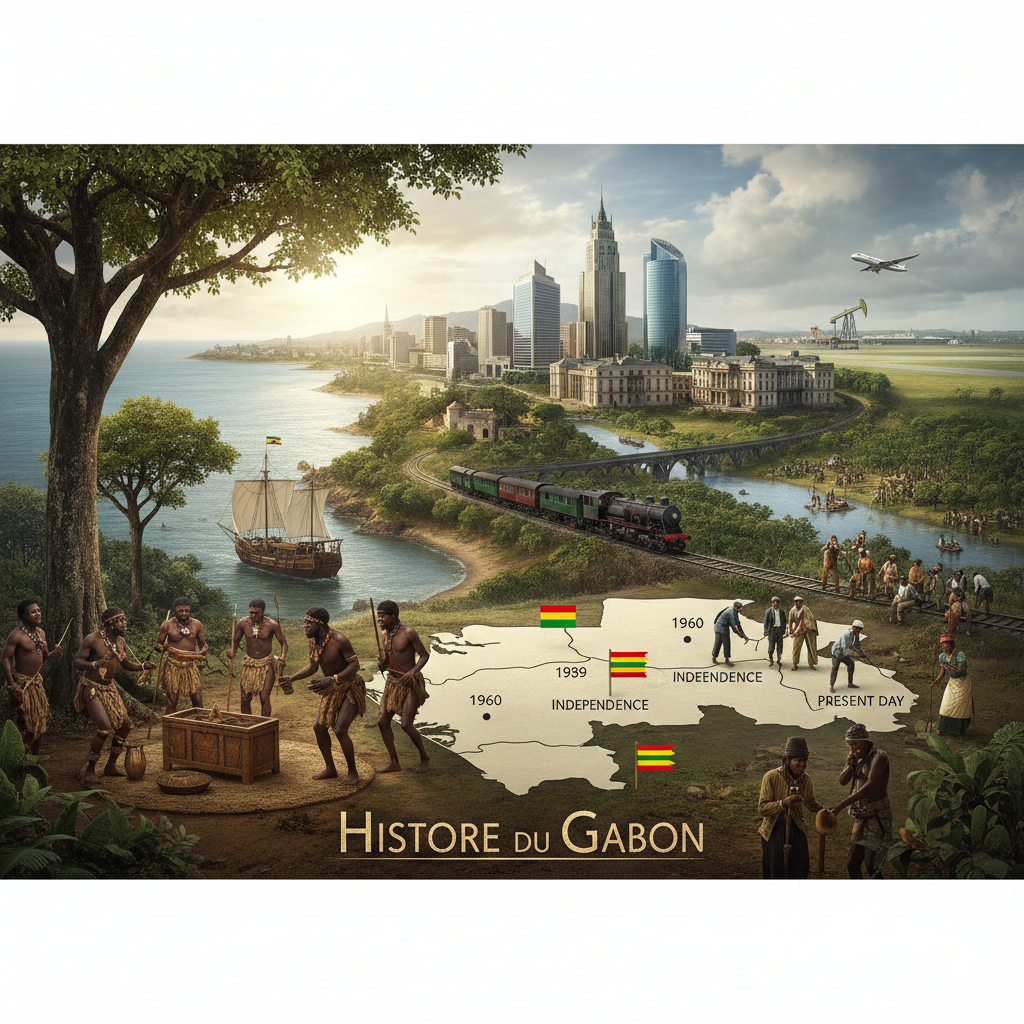
The History of Gabon is a narrative of profound transformation—from the ancient migrations of hunter-gatherers and Bantu-speaking farmers through the turbulent centuries of the Atlantic slave trade, to the complexities of French colonial rule and the modern “dynastic republic.” Situated on the equator in West Central Africa, Gabon’s history is inextricably linked to its dense rainforests, its strategic coastline, and, more recently, its vast natural resources.
1. Prehistoric Origins and the Bantu Migration
Human habitation in Gabon dates back tens of thousands of years. Archaeological evidence, including stone tools discovered in the Ogooué River valley, suggests that humans inhabited the region as early as 400,000 BC.
The Pygmy Peoples
The earliest known inhabitants were the Bambenga (ancestors of the modern-day Babongo and Baka peoples). These hunter-gatherer communities lived in deep symbiosis with the rainforest. Genetics and archaeology suggest they flourished in the region for millennia, developing sophisticated knowledge of the forest’s medicinal plants and wildlife.
Beginning around the 8th century BC, Bantu-speaking groups began migrating into the region from the north and east. This “Bantu Expansion” brought significant technological shifts:
-
- Iron Metallurgy: The introduction of iron-working allowed for more efficient clearing of forests and better hunting tools.
-
- Agriculture: Migrants introduced crops like yams and oil palms.
-
- Social Organization: Bantu groups organized into clan-based village-states. Over centuries, these groups (including the Myene, Punu, and Nzebi) established diverse cultural identities, though they shared a common linguistic root.
The Fang people, today the largest ethnic group in Gabon, were among the last to arrive, moving southward into the territory as recently as the 18th and 19th centuries.
2. European Contact and the Slave Trade
The course of Gabonese history changed in 1472, when Portuguese navigators Lopo Gonçalves and Rui de Sequeira arrived at the Komo River estuary. They named the region Rio de Gabão (River of Gabon) because the estuary’s shape resembled a gabão, a hooded cloak worn by Portuguese sailors.
The Era of Extraction
By the 16th century, Dutch, English, and French traders followed. Initial trade focused on ivory and hardwoods, but the focus soon shifted to the transatlantic slave trade.
-
- Coastal Kingdoms: Powerful coastal groups, such as the Kingdom of Orungu (centered at Cape Lopez), acted as intermediaries, capturing people from the interior to trade for European goods, firearms, and alcohol.
-
- Social Disruption: The slave trade devastated many interior communities, leading to mass migrations and the fortification of villages as people sought safety from slave raiders.
3. The French Colonial Era (1839–1960)
France’s formal involvement began in 1839, when Captain Édouard Bouët-Willaumez signed a treaty with the Mpongwe ruler, King Denis (Rapontchombo). In exchange for protection, King Denis ceded sovereignty over the southern bank of the estuary.
The Founding of Libreville
In 1849, the French intercepted a slave ship, the Ilizia, and freed the captives. These freed slaves were settled at a site on the northern shore, which was named Libreville (Freetown)—mirroring the founding of Freetown in Sierra Leone. Libreville eventually became the colonial capital.
Exploration and Exploitation
During the late 19th century, explorers like Pierre Savorgnan de Brazza used Gabon as a base to explore the Congo Basin. By 1910, Gabon was incorporated into French Equatorial Africa (AEF), a federation that also included present-day Chad, the Central African Republic, and the Republic of the Congo.
The colonial period was marked by the “concessionary system,” where private French companies were given vast tracts of land to extract rubber and timber. This system was notorious for forced labor and harsh conditions, leading to significant local resistance.
4. Independence and the Bongo Era
Following World War II, a wave of decolonization swept across Africa. Under the leadership of Léon M’ba, Gabon moved toward self-governance.
The First Republic
Gabon achieved full independence on August 17, 1960. Léon M’ba became the first president. His rule was marked by a strong pro-French stance. In 1964, when M’ba attempted to dissolve the National Assembly to create a one-party state, the military staged a coup. However, French paratroopers intervened within 24 hours to restore him to power—an early example of Françafrique (the continued French influence in its former colonies).
The Long Reign of Omar Bongo
Upon M’ba’s death in 1967, his vice president, Albert-Bernard Bongo (who later converted to Islam and took the name Omar Bongo Ondimba), assumed the presidency.
-
- One-Party Rule: In 1968, Bongo officially declared Gabon a one-party state under the Parti Démocratique Gabonais (PDG).
-
- The Oil Boom: The discovery of significant offshore oil reserves in the 1970s transformed Gabon into one of Africa’s wealthiest nations per capita, though wealth remained highly concentrated among the elite.
-
- Political Survival: Bongo became one of the world’s longest-serving heads of state, ruling for 42 years until his death in 2009. He maintained stability through a mix of patronage, tactical political concessions, and close ties with France.
5. Modern Gabon: Ali Bongo and the 2023 Coup
In 2009, Omar Bongo’s son, Ali Bongo Ondimba, won a disputed election to succeed his father. His presidency focused on diversifying the economy through “Emerging Gabon” (Gabon Émergent), emphasizing environmental conservation and green energy.
However, the Bongo family’s half-century “dynasty” faced increasing criticism over corruption, electoral fraud, and economic inequality. Following a highly controversial election in August 2023, the military intervened.
The 2023 Coup d’État
On August 30, 2023, a group of high-ranking officers, led by General Brice Oligui Nguema, seized power and placed Ali Bongo under house arrest. The coup was widely celebrated in the streets of Libreville, marking the end of 56 years of Bongo family rule. General Nguema was subsequently sworn in as the transitional president, promising democratic reforms and new elections.
Key Historical Milestones
| Year | Event |
| 8th Century BC | Start of Bantu migrations into Gabonese territory. |
| 1472 | Portuguese explorers arrive at the Komo estuary. |
| 1849 | Founding of Libreville by freed slaves. |
| 1910 | Gabon becomes part of French Equatorial Africa (AEF). |
| 1960 | Independence from France (August 17). |
| 1967 | Omar Bongo begins his 42-year presidency. |
| 2009 | Ali Bongo succeeds his father as president. |
| 2023 | Military coup ousts Ali Bongo, ending the Bongo dynasty. |
Visit: www.dkbtech.com and www.allcircular.com