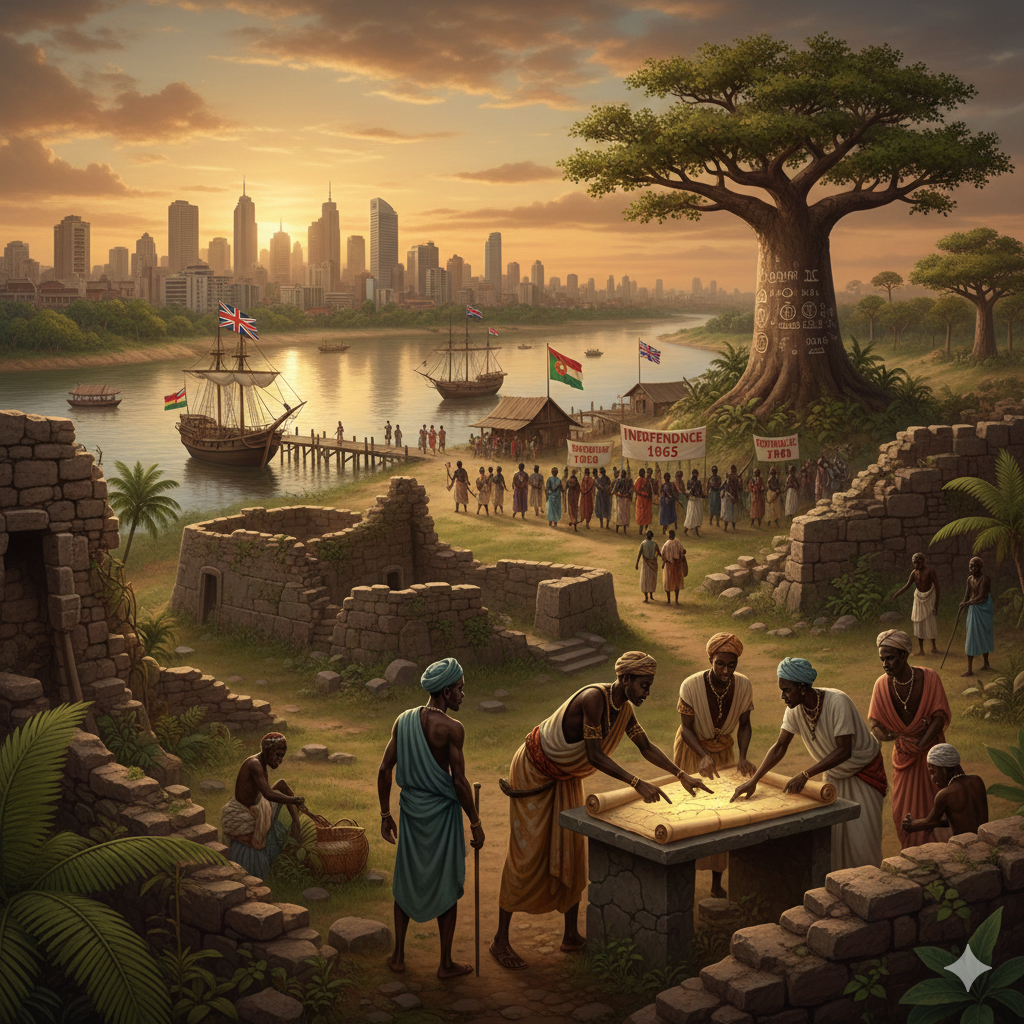
1. Ancient Origins and the Stone Circles
The human History of Gambia begins long before written records. Archaeological evidence suggests that the region has been inhabited for thousands of years. The most striking remnants of this era are the Senegambian Stone Circles.
These megalithic structures, found across the Central River Region, date back to between the 3rd century BCE and the 16th century CE. They represent a highly organized society with sophisticated burial customs and a deep understanding of astronomy and geology.
2. The Era of the Great Empires (10th – 16th Century)
During the medieval period, The Gambia was a vital part of the trans-Saharan trade routes. It fell under the influence of several powerful West African empires:
-
- The Ghana Empire: While its core was further north, Ghana’s influence over trade brought Islam and new economic structures to the river basin.
-
- The Mali Empire: In the 13th century, the Mandinka people, led by generals of Sundiata Keita, expanded into the Senegambia region. The Gambia became a province known as Gabú. This era solidified the Mandinka language and culture as dominant in the region.
-
- The Jolof Empire: By the 15th century, the Jolof (Wolof) Empire rose to prominence in the north, controlling parts of the north bank of the Gambia River.
3. European Arrival and the Atlantic Slave Trade
The arrival of the Portuguese in 1455 marked a radical shift. They were the first to document the Gambia River, which they recognized as an ideal “highway” into the interior of Africa.
The Struggle for Control
The river became a site of intense competition between European powers:
-
- The Portuguese: Dominated trade in the 15th and 16th centuries.
-
- The Courlanders and Latvians: Briefly established a fort on Kunta Kinteh Island (formerly James Island) in the 1650s.
-
- The British and French: For the next 200 years, Britain and France fought for control of the waterway. The British eventually secured the river via the Treaty of Versailles (1783).
The Impact of Slavery
The Gambia was a major hub for the Trans-Atlantic Slave Trade. Millions of people were captured from the hinterlands and shipped from James Island to the Americas. This dark chapter is famously captured in Alex Haley’s Roots, which traces the protagonist Kunta Kinte’s origins to the Gambian village of Juffure.
4. British Colonial Rule (1816–1965)
In 1807, Britain abolished the slave trade. To enforce this ban and prevent illegal slave ships from entering the river, the British established Bathurst (now Banjul) in 1816.
The “Enclave” Colony
The Gambia’s borders were the result of a strange colonial compromise. The British wanted the river, while the French wanted the surrounding territory (Senegal). In 1889, a secret agreement defined the borders: The Gambia would be a narrow strip of land extending roughly 10 miles on either side of the river. This created the “finger” shape of the country, entirely surrounded by Senegal.
5. Independence and the Jawara Era (1965–1994)
The Gambia achieved independence on February 18, 1965, as a constitutional monarchy within the Commonwealth. Sir Dawda Kairaba Jawara became the nation’s first Prime Minister and later its President when it became a Republic in 1970.
-
- Stability: Unlike many neighbors, The Gambia remained a multi-party democracy for decades.
-
- The 1981 Coup Attempt: A bloody but unsuccessful coup led by Kukoi Samba Sanyang forced Jawara to seek military help from Senegal.
-
- The Senegambia Confederation: This led to a brief unification of the two countries (1982–1989), which eventually dissolved due to disagreements over sovereignty.
6. The Jammeh Dictatorship (1994–2017)
In 1994, a young lieutenant named Yahya Jammeh seized power in a bloodless coup. While he initially promised a return to civilian rule, his 22-year reign became increasingly authoritarian.
Jammeh’s era was defined by:
-
- Human rights abuses and the suppression of the press.
-
- Eccentric claims, such as discovering a cure for AIDS.
-
- The withdrawal of The Gambia from the Commonwealth in 2013.
7. The New Gambia: 2017 to Present
In a shocking turn of events in December 2016, opposition candidate Adama Barrow defeated Jammeh in a democratic election. After a brief military intervention by ECOWAS forces to ensure the transition, Jammeh fled into exile.
Under President Barrow, The Gambia has:
-
- Rejoined the Commonwealth.
-
- Established the Truth, Reconciliation and Reparations Commission (TRRC) to investigate the crimes of the Jammeh era.
-
- Focused on rebuilding the economy through tourism and agriculture.
Summary Table: Key Milestones
| Era | Key Event | Significance |
| Ancient | Stone Circles | Evidence of early complex societies. |
| 13th Century | Mali Empire expansion | Mandinka influence becomes dominant. |
| 1816 | Founding of Bathurst | End of slave trade; start of formal British rule. |
| 1965 | Independence | Birth of the modern Gambian state. |
| 201715 | Jammeh’s Departure16 | Return to democratic governance. |
Visit: www.dkbtech.com and. www.allcircular.com