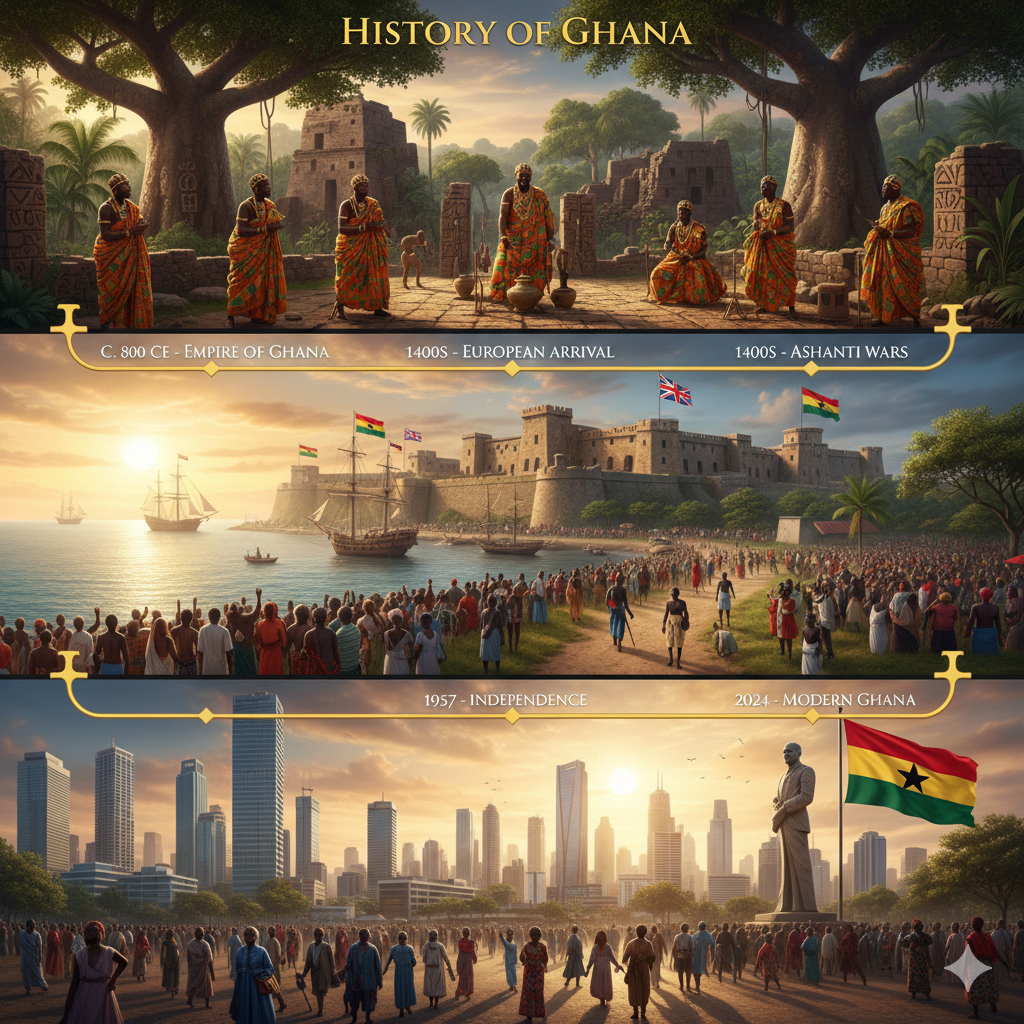
1. The Ancient Roots and the Medieval Empire
The History of Ghana does not begin with the modern borders we see today. It begins with the Ancient Ghana Empire (Wagadou), located hundreds of miles north of modern Ghana in present-day Mali and Mauritania.
-
- The Land of Gold: Flourishing between the 6th and 13th centuries, Wagadou was the first of the great Sahelian kingdoms. It grew wealthy through the Trans-Saharan trade, exchanging gold for salt with North African Berbers.
-
- The Migration South: As the ancient empire collapsed due to Almoravid invasions and environmental changes, various groups migrated southward into the forest and coastal regions of the “Gold Coast.”
2. The Rise of the Akan States and the Ashanti Empire
By the 15th century, the Akan people had established powerful centralized states. The most notable among these was the Ashanti (Asante) Empire.
The Golden Stool
In the late 17th century, Osei Tutu I and the high priest Okomfo Anokye unified the Ashanti clans. Legend says the Golden Stool descended from the skies to land on Osei Tutu’s knees, symbolizing the soul of the nation.
-
- Military Prowess: The Ashanti developed a highly organized bureaucracy and a formidable army that dominated the region for two centuries.
-
- Economic Might: They controlled the inland gold mines and established trade routes that would eventually meet European powers on the coast.
3. The Colonial Encounter: The Gold Coast
The arrival of Europeans changed the trajectory of the region. The Portuguese were the first to arrive in 1471, building Elmina Castle to protect their gold trade.
| Era | Key European Power | Focus of Trade |
| 15th – 16th Century | Portugal | Gold and Ivory |
| 17th – 18th Century | Netherlands, Britain, Denmark | Trans-Atlantic Slave Trade |
| 19th Century | Great Britain | Palm Oil, Rubber, and Cocoa |
The “Scramble” and Resistance
The British slowly expanded their influence, leading to the Anglo-Ashanti Wars. One of the most famous moments of resistance was led by Yaa Asantewaa, the Queen Mother of Ejisu, who in 1900 led a rebellion against the British demand for the Golden Stool. Despite their bravery, the British eventually annexed the Ashanti territories in 1902, forming the Gold Coast colony.
4. The Path to Independence (1945–1957)
Post-World War II, a wave of nationalism swept across the continent. Ghana was at the forefront.
-
- The UGCC: The United Gold Coast Convention, led by the “Big Six,” began the formal push for self-governance.
-
- Kwame Nkrumah: A charismatic leader who broke away from the UGCC to form the Convention People’s Party (CPP). His slogan was “Self-Government Now.”
-
- 1957: On March 6, Ghana became the first sub-Saharan African nation to gain independence from colonial rule.
“Our independence is meaningless unless it is linked up with the total liberation of the African continent.” — Kwame Nkrumah, 1957
5. Post-Independence: Coups and the Fourth Republic
The decades following independence were marked by high hopes followed by political instability.
-
- The Nkrumah Years: He invested heavily in infrastructure (like the Akosombo Dam) but moved toward a one-party state. He was overthrown in a CIA-backed coup in 1966.
-
- The Era of Coups: For the next 15 years, Ghana cycled through military and civilian governments.
-
- The Rawlings Era: Flight Lieutenant Jerry John Rawlings took power in 1981. While his early years were revolutionary and strict, he eventually steered the country back toward democracy and market reforms in the early 1990s.
6. Modern Ghana: The Beacon of Democracy
Since 1992, Ghana has operated under the Fourth Republic, characterized by a stable multi-party system and peaceful transitions of power between the New Patriotic Party (NPP) and the National Democratic Congress (NDC).
Today, Ghana is a leader in:
-
- Pan-Africanism: Hosting the “Year of Return” in 2019 to welcome the African diaspora.
-
- Economic Growth: Leveraging gold, cocoa, and recently discovered oil.
- Digital Innovation: Becoming a hub for tech and fintech in West Africa.