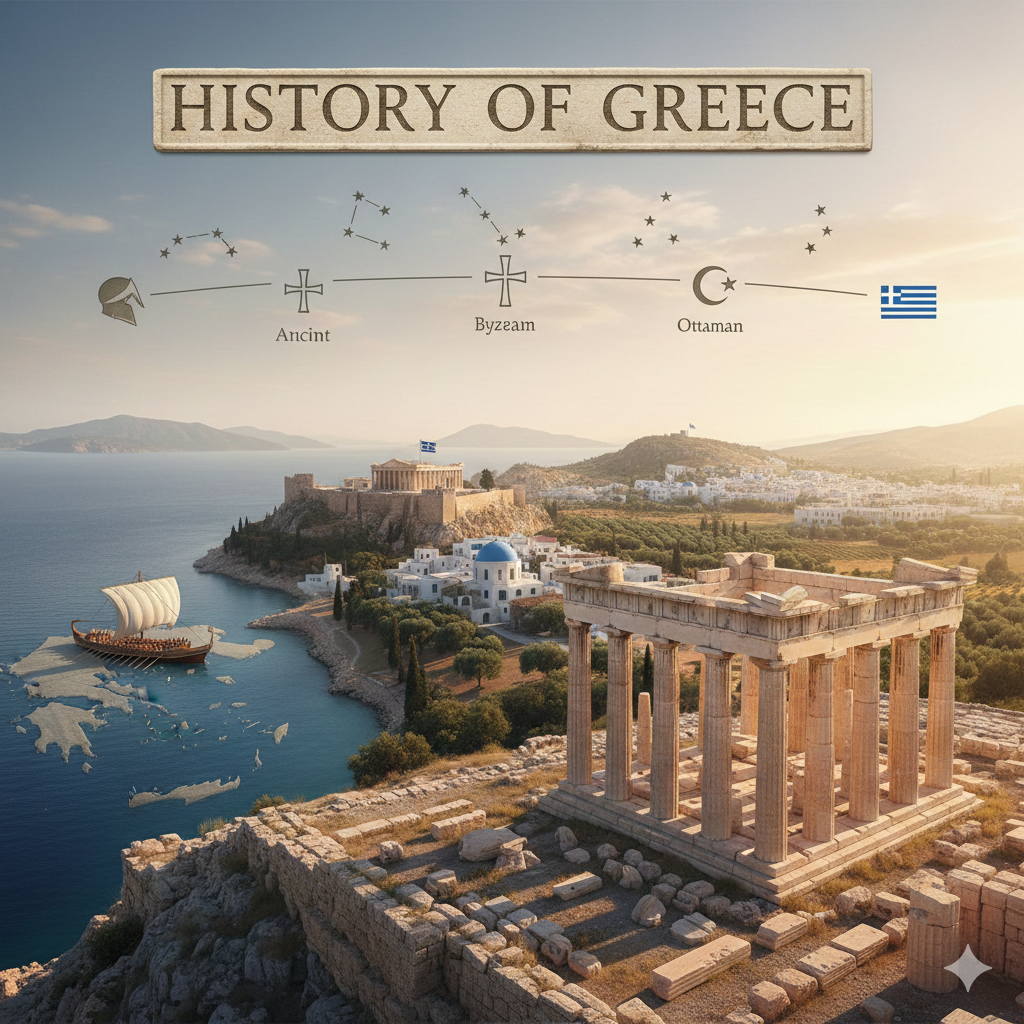
1. The Dawn of the Aegean: Minoans and Mycenaeans
The History of Greece does not begin on the mainland, but on the island of Crete. Around 2700 BCE, the Minoan civilization emerged as Europe’s first advanced society. Named after the mythical King Minos, they built sprawling palatial complexes like Knossos, which featured indoor plumbing and vibrant frescoes.
By 1600 BCE, the focus shifted to the mainland with the Mycenaeans. These were the warriors of the “Age of Heroes”—the people of Agamemnon and Achilles. Unlike the peaceful Minoans, the Mycenaeans built “Cyclopean” walls and thrived on conquest. Their eventual collapse around 1100 BCE, possibly due to the mysterious “Sea Peoples” or internal strife, plunged Greece into the Greek Dark Ages.
2. The Archaic Period: The Birth of the Polis
Emerging from the Dark Ages around 800 BCE, Greece underwent a “Renaissance.” This period saw:
-
- The Alphabet: Adapting the Phoenician script to create the Greek alphabet.
-
- Homer: The composition of the Iliad and the Odyssey.
-
- The Polis: The development of the city-state (Athens, Sparta, Corinth).
-
- The Olympics: The first recorded games in 776 BCE.
As populations grew, Greeks colonized the Mediterranean, from Sicily to the Black Sea, spreading their culture and bringing back new ideas.
3. The Classical Age: Glory and Fire
The 5th century BCE is often considered the “Golden Age.” It began with the Persian Wars, where a rare coalition of Greek city-states defeated the massive Persian Empire at Marathon, Thermopylae, and Salamis.
The Rise of Athens
Under the leadership of Pericles, Athens became a center for art, philosophy, and democracy. The Parthenon was constructed, and thinkers like Socrates began questioning the nature of virtue.
The Peloponnesian War
The rivalry between democratic Athens (a naval power) and oligarchic Sparta (a land power) eventually led to a devastating civil war (431–404 BCE). Sparta won, but the war left all of Greece exhausted and vulnerable.
4. Alexander the Great and the Hellenistic Era
With the city-states weakened, Philip II of Macedon conquered the mainland. His son, Alexander the Great, took this power and turned it eastward. In a lightning campaign, he toppled the Persian Empire and reached the borders of India.
Though Alexander died young (323 BCE), he ushered in the Hellenistic Age. Greek culture fused with Egyptian, Persian, and Indian influences. Great cities like Alexandria in Egypt became hubs of science, where figures like Eratosthenes calculated the Earth’s circumference.
5. Roman and Byzantine Greece
In 146 BCE, Greece was incorporated into the Roman Empire. However, the Romans were so enamored with Greek culture that it was said, “Captive Greece took captive her savage conqueror.”
When the Roman Empire split, the Greek-speaking east became the Byzantine Empire. Centered in Constantinople, this empire preserved Greek learning and Orthodox Christianity for over a thousand years, acting as a shield for Europe against Eastern invasions.
6. Ottoman Rule and the War of Independence
In 1453, Constantinople fell to the Ottoman Turks. For nearly 400 years, Greece was a province of the Ottoman Empire. While many aspects of Greek identity were suppressed, the Orthodox Church helped maintain the Greek language and heritage.
The enlightenment ideas of the late 18th century fueled a desire for liberty. In 1821, the Greek War of Independence began. Aided by “Philhellenes” like Lord Byron and the intervention of Great Britain, France, and Russia, Greece finally secured its independence in 1830.
7. Modern Greece
The 20th century was a turbulent era for Greece, marked by:
-
- The Balkan Wars: Doubling the nation’s territory.
-
- World War II: A brutal Axis occupation followed by a bitter Civil War.
-
- The Junta: A military dictatorship (1967–1974) that ended with the restoration of democracy.
- EU Integration: Joining the European Union in 1981, marking a shift toward modern European stability.