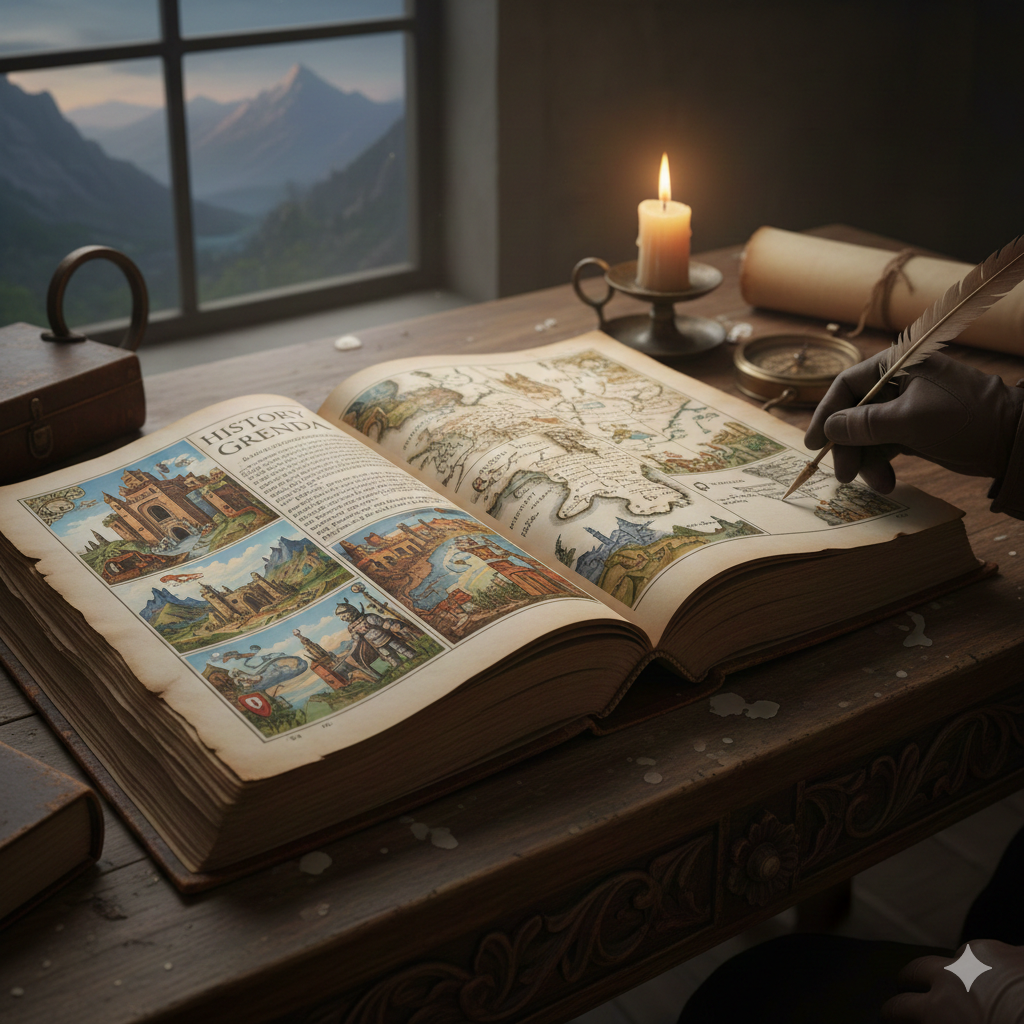
The Pre-Unification Era: The Age of the High Crags
Long before the name “Grenda” was etched into the annals of history, the region was known as the Shattered Reach. It was a landscape defined by its unforgiving geography—jagged mountain ranges, deep glacial valleys, and the sprawling, mist-shrouded Great North Forest.
The early inhabitants were the Aethel-folk, a semi-nomadic collection of clans. They did not view themselves as a single nation but as stewards of specific peaks and rivers. Their society was built on the principle of The Rite of Stones, a legal system where disputes were settled by the weight of physical evidence—literally stones placed on a scale representing the honor of each party.
The Arrival of the Iron-Seers
Around the year 400 of the Old Reckoning, a new group migrated from the Eastern Steppes: the Iron-Seers. They brought with them the secret of crucible steel. For two centuries, the Aethel-folk and the Iron-Seers engaged in a series of skirmishes known as the Cinder Wars. These conflicts were not merely about land, but about the clash of ideologies—traditional shamanism versus technological advancement.
The Founding: The Covenant of Grenda (Year 0)
The unification of the region is credited to Grenda the Tall, a warrior-diplomat who bridged the gap between the warring factions. Legend says she climbed the highest peak, the Summit of Clouds, and remained there for forty days without food. When she descended, she carried a vision of a kingdom that utilized the spirit of the mountains and the strength of the iron.
In the year 0, the Covenant of Grenda was signed. This document established:
-
- The Council of Three: A governance structure representing the Nobility, the Artisans, and the Clergy.
-
- The Common Tongue: A synthesis of Aethel and Seer dialects.
-
- The Capital of Oakhaven: Built at the confluence of the three major rivers, symbolizing unity.
The Golden Age of Expansion (Years 150–400)
Under the reign of the Aurelian Dynasty, Grenda experienced an explosion of culture and commerce. This era is characterized by:
-
- The Great Aqueducts: Using the engineering secrets of the Iron-Seers, Grenda redirected mountain runoff to the arid southern plains, turning them into the breadbasket of the realm.
-
- The Scholarium of Whispers: A university dedicated to the study of the natural sciences and philosophy, which attracted scholars from across the seas.
-
- The Silk-Road Alliance: Grenda established maritime trade routes, exporting high-quality steel and mountain-grown herbs in exchange for spices and textiles.
The Shadowed Century: The Plague and the Civil War
No history is without its darkness. In the year 412, the Blight of the Deep struck. A fungus-borne illness originated in the deep mines of the north, spreading through the grain supplies. Within five years, nearly a third of the population perished.
The resulting economic collapse led to the War of the Broken Crown. For seventy years, the central government in Oakhaven lost control as regional warlords claimed independence. The “History of Grenda” during this time is a patchwork of tragic ballads and ruined fortresses.
The Restoration and Modern Grenda
The restoration began with King Valerius II, who prioritized infrastructure over conquest. By rebuilding the trade roads first, he made it more profitable for the warlords to join the kingdom than to fight it.
Today, Grenda is a constitutional monarchy. 1 It is a land where ancient stone circles still stand in the shadows of modern steel refineries. It remains a bastion of stability, known for its neutrality in continental conflicts and its commitment to the “Rite of Stones”—now evolved into a sophisticated judicial system.
Visit : www.dkbtech.com and www.allcircular.com