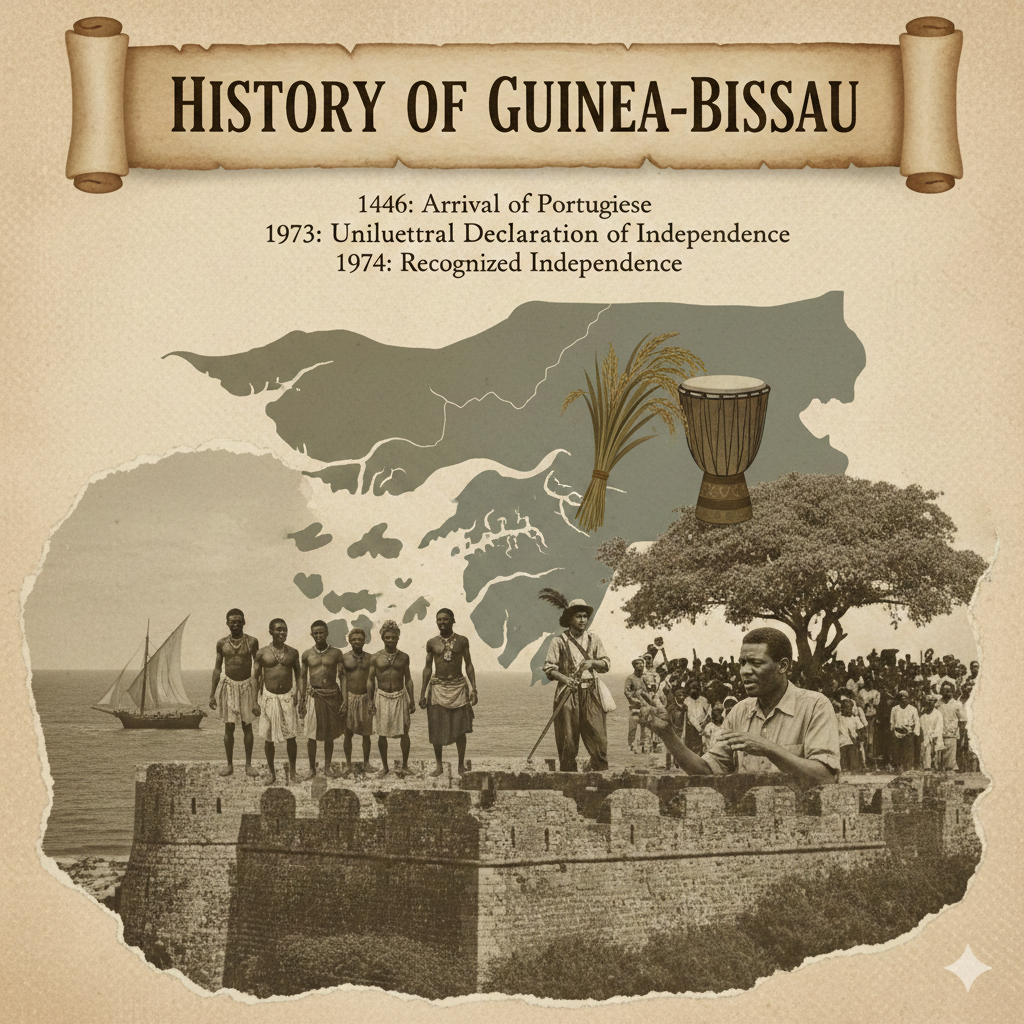
The History of Guinea-Bissau is a saga of resilience, from the height of medieval African empires and the dark centuries of the transatlantic slave trade to one of the most successful anti-colonial guerrilla wars in modern history. Since achieving independence in 1974, however, the nation has grappled with a persistent “cycle of instability,” marked by frequent military interventions and political assassinations.
1. Pre-Colonial Foundations: Empires and Migration
Long before European contact, the region of present-day Guinea-Bissau was home to diverse ethnic groups and sophisticated political structures.
The Rise of Kaabu and Mali Influence
By the 13th century, the region was integrated into the Mali Empire following the conquests of General Tiramakhan Traore. The westernmost province of Mali became known as Kaabu (or Gabu).
-
- The Kaabu Empire: As the central Mali Empire declined in the 15th century, Kaabu emerged as an independent and powerful Mandinka state. It was ruled by a military aristocracy known as the Nyancho.
-
- Social Structure: Kaabu was a highly stratified society where warriors held high status. The empire controlled the regional trade of gold, salt, and kola nuts.
-
- Ethnic Diversity: The coastal regions were inhabited by the Balanta, Papel, Manjak, and Biafada peoples. These groups were often decentralized, living in “stateless” societies that relied on rice cultivation and resisted the centralizing authority of the Mandinka and later the Fulani.
The Fulani Jihads
In the 18th and 19th centuries, the rise of the Imamate of Futa Jallon (in modern-day Guinea) led to a series of Islamic jihads. This culminated in the Battle of Kansala (1867), where the Kaabu Empire was finally defeated by Fulani forces. This shift in power significantly altered the ethnic and religious landscape of the interior.
2. The Portuguese Presence (1446–1915)
The Portuguese arrival in the mid-15th century marked the beginning of a long, often tenuous, colonial relationship.
The Era of the Slave Trade
In 1446, the Portuguese explorer Nuno Tristão reached the coast. For nearly 400 years, the Portuguese presence was largely confined to fortified coastal outposts called praças, such as Cacheu and Bissau.
-
- Economic Hub: These ports became vital nodes in the transatlantic slave trade. Portuguese traders worked with local African elites to export millions of people to the Cape Verde islands and the Americas (particularly Brazil and Cuba).
-
- Limited Control: Until the late 19th century, the Portuguese did not control the interior. They were “guests” of local African kings, paying rent or tribute to maintain their trading posts.
The Scramble for Africa
Following the Berlin Conference (1884–85), Portugal was forced to prove “effective occupation” of its claims. This led to the “Pacification Campaigns”—a series of brutal military expeditions to subjugate the interior tribes. It was not until 1915 that Portugal could claim full military control over the mainland, and the offshore Bijagós Islands were not fully brought under administration until 1936.
3. The Struggle for Independence (1956–1974)
Unlike many British or French colonies that transitioned to independence through negotiation, Guinea-Bissau’s path was forged through a decade-long war.
Amílcar Cabral and the PAIGC
In 1956, the agronomist Amílcar Cabral founded the PAIGC (African Party for the Independence of Guinea and Cape Verde). Initially seeking a peaceful transition, the party shifted to armed struggle after the Pidjiguiti Massacre in 1959, where Portuguese police killed striking dockworkers in Bissau.
Starting in 1963, the PAIGC launched a highly organized guerrilla campaign.
-
- The “Liberated Zones”: By the late 1960s, the PAIGC controlled nearly two-thirds of the country. In these areas, they established schools, clinics, and “People’s Stores,” creating a shadow state while the Portuguese remained holed up in fortified towns.
-
- International Support: The PAIGC received significant military aid from the Soviet Union, Cuba, and China, as well as diplomatic support from Sweden and other Nordic countries.
-
- Assassination of Cabral: In January 1973, Amílcar Cabral was assassinated in Conakry. While a major blow, the PAIGC continued its mission, unilaterally declaring independence on September 24, 1973.
The war finally ended following the Carnation Revolution in Portugal (April 1974), where a military coup overthrew the Portuguese dictatorship. The new government in Lisbon recognized Guinea-Bissau’s independence on September 10, 1974.
4. Post-Independence and Internal Conflict (1974–Present)
Independence brought hope, but it was quickly overshadowed by economic hardship and political rivalry.
The Era of João Bernardo “Nino” Vieira
The country’s first president was Luís Cabral (Amílcar’s half-brother). However, in 1980, he was ousted in a coup led by the prime minister and war hero João Bernardo “Nino” Vieira.
-
- The 1980 Coup: This event marked a split between the mainland (Guinea-Bissau) and Cape Verde, ending the PAIGC’s dream of a unified binational state.
-
- Civil War (1998–1999): After years of authoritarian rule, a rift between Vieira and his army chief, Ansumane Mané, sparked a devastating civil war. Vieira was eventually ousted and went into exile.
A Cycle of Instability
Since the late 1990s, Guinea-Bissau has struggled to maintain constitutional order:
-
- 2003: President Kumba Ialá was ousted in a bloodless coup.
-
- 2009: In a shocking 24-hour period, the Army Chief of Staff was killed in a bombing, and President Vieira was assassinated by soldiers in retaliation.
-
- 2012: A “cocaine coup” occurred mid-election, highlighting the growing influence of international drug trafficking cartels using the country as a transit point.
Recent Developments
In recent years, President Umaro Sissoco Embaló (elected in 2019) has survived multiple coup attempts, including a major attack in February 2022. The country remains one of the poorest in the world, yet its vibrant culture and history of resistance continue to define its national identity.
Summary Table: Key Milestones
| Period | Key Event | Significance |
| 13th–19th Century | Kaabu Empire | Hegemony of Mandinka and Fulani cultures. |
| 1446–1879 | Portuguese Outposts | Focus on transatlantic slave trade from coastal forts. |
| 1963–1974 | Independence War | PAIGC guerrilla victory against Portugal. |
| 1980 | Vieira’s First Coup | Ends the union with Cape Verde; start of long-term instability. |
| 1998–1999 | Civil War | Massive displacement and destruction of infrastructure. |
| 2009 | Double Assassination | Death of President Vieira and Army Chief Na Waie. |
Visit : www.dkbtech.com and www.allcircular.com