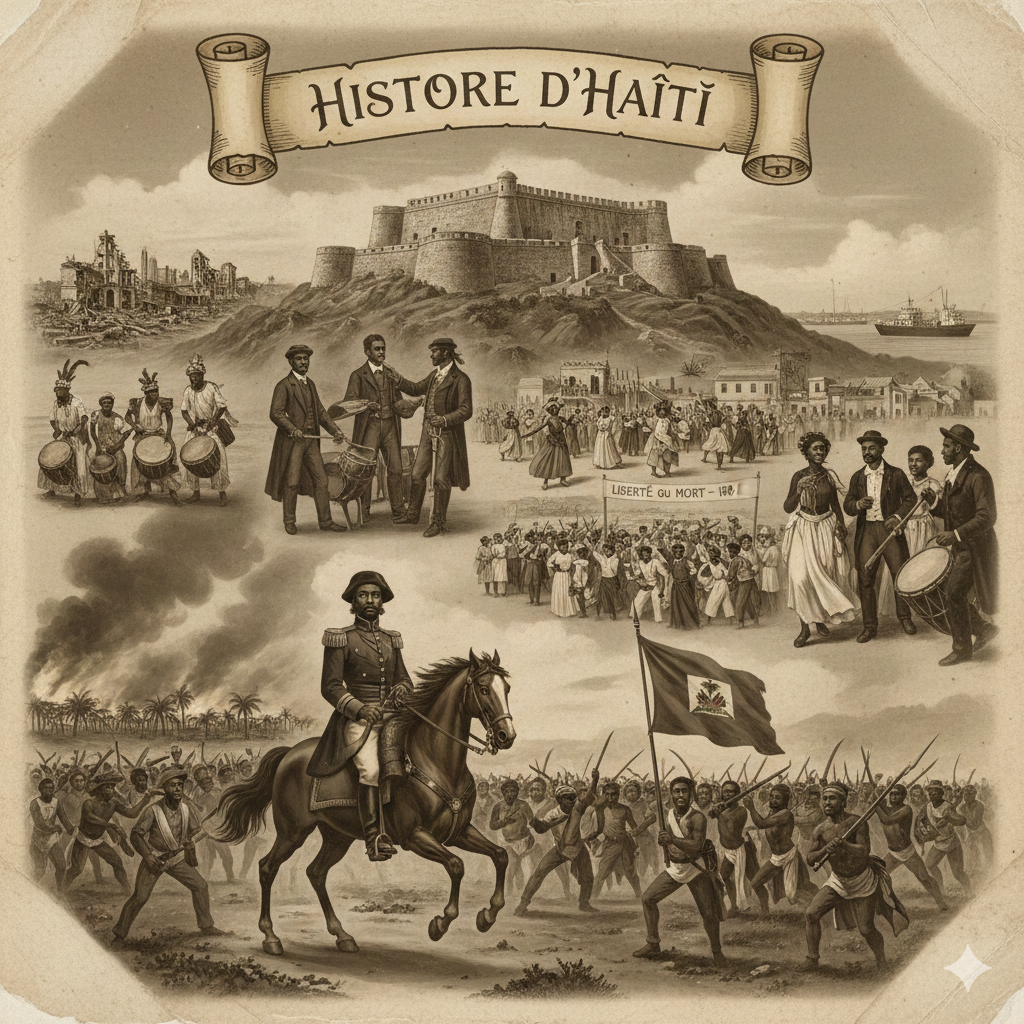
The History of Haiti is a monumental saga of human endurance, spanning from its origins as the Taino kingdom of Ayiti to its status as the world’s first free Black republic. It is a narrative defined by the most successful slave uprising in history, but also by a legacy of external interference and economic strangulation.
I. The Pre-Columbian Era and Spanish Conquest (1492–1625)
Before European arrival, the island of Hispaniola was inhabited by the Taíno people, who called the land Ayiti (“Land of High Mountains”). They lived in organized chiefdoms called cacicazgos.
In 1492, Christopher Columbus landed on the northern coast, claiming the island for Spain. The subsequent century was catastrophic for the indigenous population; through a combination of the brutal encomienda forced-labor system and Eurasian diseases like smallpox, the Taíno population—once numbering in the hundreds of thousands—was virtually extinguished by the mid-1500s. To replace them, the Spanish began importing enslaved Africans, establishing the foundational trauma of the transatlantic slave trade in the Americas.
II. French Saint-Domingue: The “Pearl of the Antilles” (1625–1789)
By the early 17th century, French pirates and settlers began occupying the western third of the island. In 1697, the Treaty of Ryswick formally ceded this territory to France, which renamed it Saint-Domingue.
Under French rule, the colony became the wealthiest in the world, producing 60% of the world’s coffee and 40% of the sugar imported by Europe. This wealth, however, was built on a regime of unparalleled cruelty. By 1789, the population consisted of:
-
- 32,000 Whites: Divided between wealthy planters (grands blancs) and working-class settlers (petits blancs).
-
- 24,000 Affranchis: Free people of color, often of mixed heritage, who held property but faced systemic discrimination.
-
- 500,000 Enslaved Africans: Living under the Code Noir, enduring life expectancies as low as 21 years due to overwork and abuse.
III. The Haitian Revolution (1791–1804)
The French Revolution of 1789, with its cry of “Liberté, Égalité, Fraternité,” ignited a powder keg in the colony. In August 1791, a Vodou ceremony at Bois Caïman, led by Dutty Boukman, signaled the start of a massive slave revolt.
Key Figures and Phases:
-
- Toussaint Louverture: A former slave and brilliant military strategist, he rose to lead the revolution, navigating complex alliances with the French, Spanish, and British. He eventually became Governor-General for life, drafting a constitution that abolished slavery.
-
- The Napoleonic Invasion: In 1802, Napoleon Bonaparte sent a massive fleet under General Leclerc to reinstate slavery. Toussaint was captured and died in a French prison in 1803.
-
- Jean-Jacques Dessalines: After Toussaint’s capture, Dessalines took command. In November 1803, the Haitian army decisively defeated the French at the Battle of Vertières.
On January 1, 1804, Dessalines declared independence, restoring the name Haiti. It was a world-historical event: the first permanent abolition of slavery in the New World.
IV. The Independence Debt and 19th Century Struggles
Independence brought isolation. Fearing that the “contagion” of liberty would spread to their own slave populations, the United States and European powers refused to recognize Haiti.
In 1825, French King Charles X sent a fleet of warships to demand “reparations” for lost property (including the former slaves themselves). To avoid re-invasion, Haiti agreed to pay 150 million francs. This debt, paid through high-interest loans from foreign banks, drained 80% of the national budget for decades and was not fully paid off until 1947. This “Double Debt” is a primary reason for Haiti’s long-term economic struggle.
V. The 20th Century: Occupation and Dictatorship
The 1900s were marked by further external intervention and internal repression:
-
- U.S. Occupation (1915–1934): Prompted by political instability and German interests in the region, the U.S. Marines occupied Haiti, rewriting its constitution and centralizing power in Port-au-Prince.
-
- The Duvalier Era (1957–1986): François “Papa Doc” Duvalier and later his son, Jean-Claude “Baby Doc,” ruled through terror. They utilized a brutal paramilitary force known as the Tontons Macoutes to suppress dissent, leading to a massive “brain drain” as the professional class fled the country.
VI. Modern Haiti (1986–Present)
The fall of the Duvaliers in 1986 led to a tumultuous transition to democracy, punctuated by the presidency of Jean-Bertrand Aristide and subsequent coups. The 21st century has seen Haiti grapple with catastrophic natural disasters, most notably the 2010 earthquake, and the 2021 assassination of President Jovenel Moïse, which has left the country in a profound governance crisis.
Summary Table of Key Eras
| Era | Key Defining Feature | Major Outcome |
| Colonial (1697–1791) | Brutal plantation slavery | “Pearl of the Antilles” (Wealth) |
| Revolution (1791–1804) | Slave uprising vs. Napoleon | Independence and Abolition |
| Indemnity (1825–1947) | 150 Million Franc debt | Chronic economic underdevelopment |
| Duvalier (1957–1986) | Totalitarian dictatorship | Political repression and exile |
Haiti’s history is a testament to the fact that freedom is rarely given; it is won through blood and maintained against incredible odds.
Visit: www.dkbtech.com and www.allcircular.com