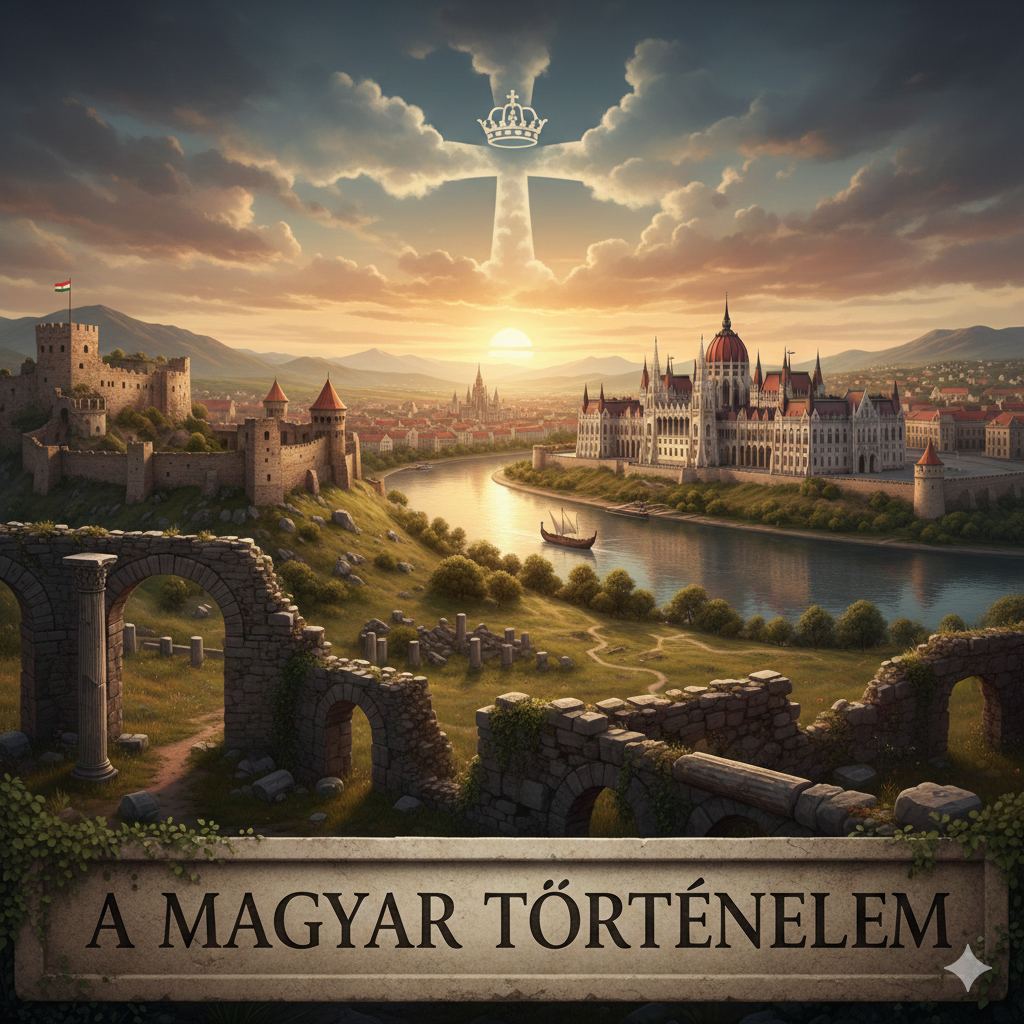
The History of Hungary is a dramatic saga of a nomadic people from the East who carved out a permanent home in the heart of Europe. Surviving Mongol invasions, Ottoman occupations, and the pressures of the Habsburg Empire, the Hungarian nation has maintained its unique language and identity for over a millennium.
1. The Dawn: From the Urals to the Danube
The origins of the Hungarians (Magyars) lie in the Ural Mountains. Unlike their Slavic or Germanic neighbors, they speak a Finno-Ugric language. Around 895–896 AD, seven Hungarian tribes led by Prince Árpád crossed the Carpathian Mountains and settled in the Pannonian Basin. This event is known as the Honfoglalás (Conquest of the Homeland).
For the next several decades, the Magyars were the “Scourge of Europe,” launching swift cavalry raids as far as Spain and Byzantium. However, after a decisive defeat at the Battle of Lechfeld in 955, they realized that to survive, they had to transition from a nomadic lifestyle to a settled, European state.
2. The Golden Age of the Árpáds (1000–1301)
The transformation was completed by Saint Stephen I, who was crowned the first King of Hungary on Christmas Day, 1000 AD. He established the Christian state, divided the land into counties, and invited Western missionaries to build churches.
-
- The Golden Bull (1222): Much like England’s Magna Carta, King Andrew II was forced to sign this charter, which limited royal power and guaranteed the rights of the nobility.
-
- The Mongol Invasion (1241): The “Tatar invasion” nearly wiped Hungary off the map. Half the population perished, but King Béla IV (the “second founder”) rebuilt the nation by constructing a network of stone fortresses.
3. Renaissance and the Ottoman Shadow
After the Árpád dynasty died out in 1301, Hungary saw a series of “elected kings.” The most famous was Matthias Corvinus (1458–1490). Under his rule, Hungary became a Renaissance powerhouse. His “Black Army” was one of the first standing mercenary forces in Europe, and his library, the Bibliotheca Corviniana, was second only to the Vatican’s.
However, internal strife after Matthias’s death left the country vulnerable. In 1526, at the Battle of Mohács, the Hungarian army was crushed by the Ottoman Turks. For the next 150 years, the country was split into three parts:
-
- Royal Hungary (West and North) – ruled by the Habsburgs.
-
- Ottoman Hungary (Central) – ruled by the Sultan.
-
- The Principality of Transylvania (East) – a semi-independent state that became the guardian of Hungarian culture.
4. The Long Struggle for Independence
The Turks were finally expelled in the late 17th century, but the Hungarians soon found their new masters, the Austrian Habsburgs, to be equally oppressive. This led to several uprisings, most notably Rákóczi’s War of Independence (1703–1711).
The 19th century brought the Reform Age, led by visionaries like Count István Széchenyi. This culminated in the Revolution of 1848, where Lajos Kossuth led a fight for total independence. Though crushed by the combined forces of Austria and Russia, the struggle eventually led to the Compromise of 1867, creating the Austro-Hungarian Dual Monarchy. This was a period of massive industrialization and the birth of modern Budapest.
5. The 20th Century: Tragedy and Triumph
The First World War brought the collapse of the Monarchy. In 1920, the Treaty of Trianon stripped Hungary of 72% of its territory and 64% of its population, a trauma that still echoes in Hungarian politics today.
-
- World War II: Hungary joined the Axis powers to regain lost lands but was eventually occupied by Nazi Germany and then “liberated” by the Soviet Union.
-
- 1956 Revolution: A student-led uprising against Soviet rule briefly tasted freedom before being brutally suppressed by Soviet tanks.
-
- 1989: Hungary played a key role in the fall of the Iron Curtain by opening its borders to East Germans, signaling the end of Communism in Eastern Europe.
Key Historical Figures
| Name | Role | Achievement |
| Stephen I | King | Founded the Christian Kingdom of Hungary |
| Matthias Corvinus | King | Brought the Renaissance and “Golden Age” |
| Lajos Kossuth | Revolutionary | Led the 1848 fight for independence |
| Imre Nagy | Prime Minister | Martyr of the 1956 Revolution |
Today, Hungary is a member of NATO and the EU, continuing its long history as a bridge between the East and the West.
Visit: www.dkbtech.com and www.allcircular.com