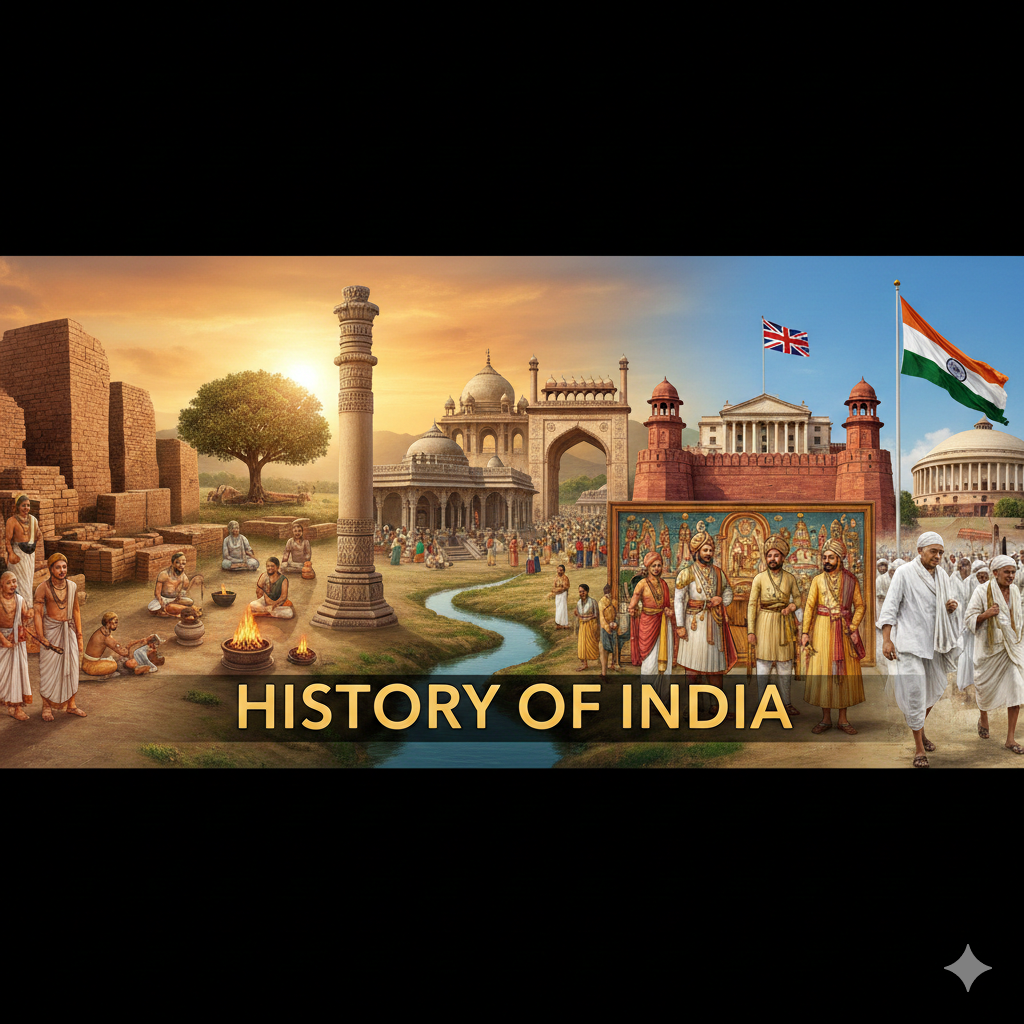
The History of India is one of the world’s oldest and most complex narratives, marked by continuous civilization, the birth of major world religions, repeated invasions, periods of grand empires, and a sustained struggle for independence.
The Indus Valley Civilization (c. 3300 – 1300 BCE)
Key Features: One of the three great early civilizations (along with Egypt and Mesopotamia). Highly developed urban planning in cities like Harappa and Mohenjo-daro, with sophisticated drainage systems and grid-like street layouts.
Economy & Society: Based on agriculture, trade (even with Mesopotamia), and standardized weights and measures. The script remains undeciphered.
Decline: Reasons are debated, but likely included climate change, shifts in river courses, and possibly foreign invasions.
The Vedic Period (c. 1500 – 600 BCE) History of India.
Arrival of the Indo-Aryans: A people speaking an Indo-European language, who gradually migrated into the subcontinent.
The Vedas: Composition of the Rigveda, Samaveda, Yajurveda, and Atharvaveda – the foundational sacred texts of Hinduism.
Social Structure: Emergence of the Varna (caste) system: Brahmanas (priests), Kshatriyas (warriors), Vaishyas (merchants), and Shudras (laborers).
Political Structure: Formation of small tribal principalities known as Janapadas
The Mahajanapadas and Religious Movements (c. 600 – 322 BCE)
Mahajanapadas: Consolidation into sixteen large kingdoms, with Magadha in the Ganges valley eventually becoming the most powerful.
Jainism: Founded by Mahavira (c. 6th century BCE), emphasizing Ahimsa (non-violence) and asceticism.
Buddhism: Founded by Siddhartha Gautama (the Buddha, c. 563 – 483 BCE), preaching the Four Noble Truths and the Eightfold Path.
The Mauryan Empire (c. 322 – 185 BCE)
Foundation: Established by Chandragupta Maurya after defeating the Nanda dynasty and repelling Greek forces following Alexander the Great’s invasion.
Ashoka the Great: The empire reached its zenith under Emperor Ashoka (r. 268 – 232 BCE). After the bloody Kalinga War, he converted to Buddhism and began propagating Dharma (moral law) through rock and pillar edicts.
Administration: Highly centralized, sophisticated government described in Kautilya’s Arthashastra.
Post-Mauryan and Classical Age (c. 185 BCE – 550 CE)
Regional Kingdoms: In a History of India a period of decentralization and external contact, including the Indo-Greeks, Shakas (Scythians), and Kushanas. The Kushana Emperor Kanishka was a major patron of Buddhism and his empire linked India to the Silk Road.
The Gupta Empire (c. 320 – 550 CE): Known as the “Golden Age of India.”
-
- Achievements: Remarkable advancements in science (e.g., the concept of zero, decimal system, Aryabhata), arts, literature (e.g., Kalidasa), and the flourishing of Hindu temple architecture. Hinduism was consolidated into its Puranic form.
The Medieval Period (c. 700 – 1757 CE)
The Early Medieval Period (c. 700 – 1206 CE)
Tripartite Struggle: A long conflict between three major powers for control of Northern India: the Palas (East), the Pratiharas (North), and the Rashtrakutas (Deccan).
The South: Rise of powerful Dravidian kingdoms: the Cheras, Cholas, Pandyas, and later the Vijayanagara Empire. The Cholas (c. 9th – 13th centuries) were a formidable naval power, extending their influence into Southeast Asia.
Early Islamic Invasions: Muhammad bin Qasim conquered Sindh in 712 CE. Later, Mahmud of Ghazni launched multiple devastating raids from the 11th century.
The Delhi Sultanate (1206 – 1526 CE)
Establishment: Founded by Qutb al-Din Aibak after the defeat of the Hindu Chauhan king Prithviraj III in the Second Battle of Tarain (1192).
Five Dynasties: Successive rule by the Mamluk (Slave), Khilji, Tughlaq, Sayyid, and Lodi dynasties.
Cultural Synthesis: A significant period of interaction and synthesis between Hindu and Islamic cultures, visible in architecture (e.g., Qutb Minar) and the rise of the Bhakti (devotional) and Sufi (mystical) movements.
The Mughal Empire (1526 – 1707 CE)
Foundation: Established by Babur after defeating the Lodi Sultan in the First Battle of Panipat (1526).
The Great Mughals (1556 – 1707):
-
- Akbar the Great (r. 1556 – 1605): Known for administrative genius, religious tolerance (Din-i-Ilahi and abolishing the Jizya tax), and vast territorial expansion.
-
- Jahangir & Shah Jahan: Patronage of the arts; Shah Jahan commissioned the Taj Mahal.
-
- Aurangzeb (r. 1658 – 1707): Expanded the empire to its maximum extent but reversed many of Akbar’s liberal policies, leading to rebellions (Marathas, Sikhs) and weakening the empire.
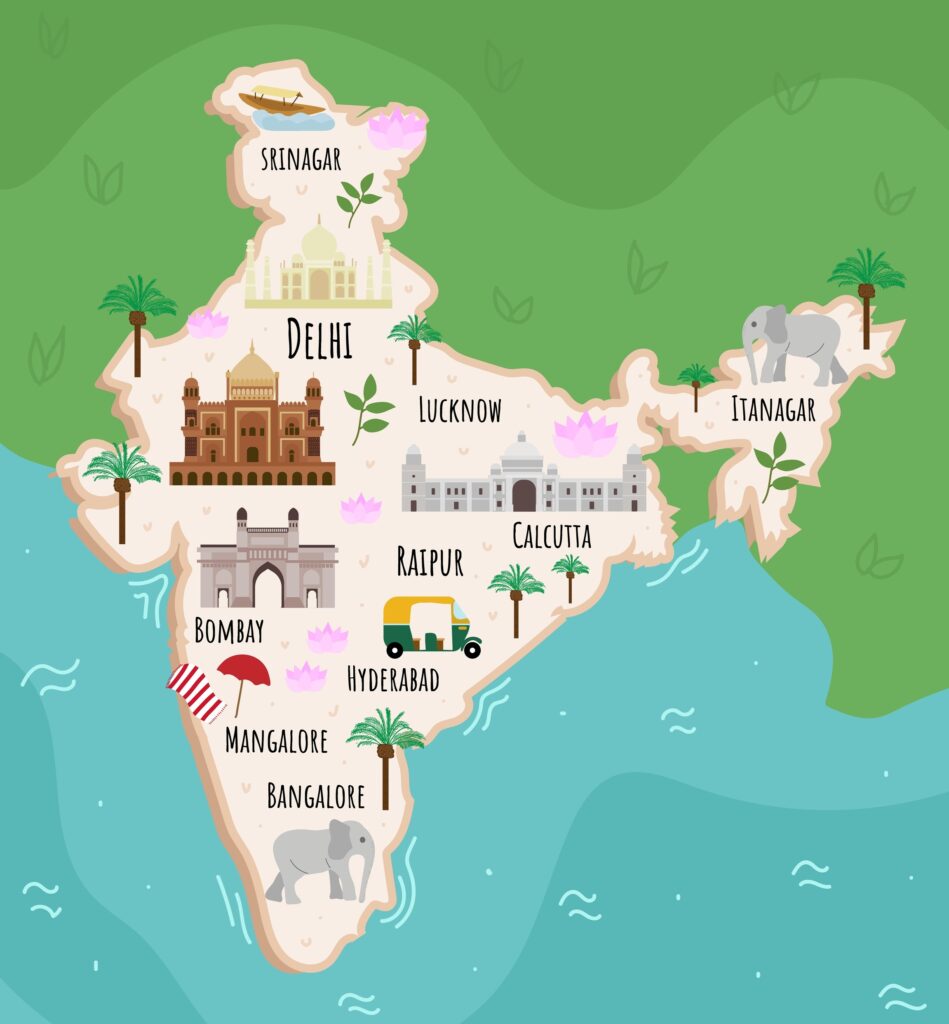 This is the map of History of India.
Decline: in the History of India the death of Aurangzeb ushered in the Later Mughals era, marked by weak rulers, succession crises, and the rise of regional powers (Marathas, Sikhs, Nawabs of Bengal and Awadh).
The Modern Period (c. 1757 – Present)
European Colonialism and the British East India Company (EIC)
Arrival: European traders (Portuguese, Dutch, French, British) began arriving in the 16th and 17th centuries, seeking spices and textiles.
British Ascendancy: The British East India Company emerged as the dominant European power after the Battle of Plassey (1757), defeating the Nawab of Bengal and effectively beginning British rule.
Consolidation: Through a series of wars (e.g., Anglo-Mysore, Anglo-Maratha), the EIC gradually annexed or controlled almost the entire subcontinent.
The British Raj (1858 – 1947) History of India
-
- The Revolt of 1857 (Sepoy Mutiny): A massive uprising against EIC rule, triggered by a complex mix of religious, economic, and political grievances.
-
- Transfer of Power: The revolt led the British Crown to dissolve the EIC and assume direct rule (the British Raj).
-
- Impact: Introduction of modern infrastructure (railways, telegraph), Western education, and a unified administrative structure, but also severe economic exploitation, drain of wealth, and recurring famines.
The History of Indian National Movement
Early Phase: Formation of the Indian National Congress (INC) in 1885. Initial phase led by Moderates seeking constitutional reforms.
Emergence of Mass Movements:
-
- Mahatma Gandhi: Returned to India in 1915 and transformed the INC into a mass movement, employing Satyagraha (non-violent resistance) and Ahimsa.
-
- Key Movements: Non-Cooperation Movement (1920-22), Civil Disobedience Movement (1930), and the Quit India Movement (1942).
The Demand for Pakistan: The All-India Muslim League, led by Muhammad Ali Jinnah, began demanding a separate Muslim state in the 1940s, fearing marginalization in a Hindu-majority India
Independence and Partition (1947) History of India.
-
- The Indian Independence Act (1947): The British Parliament passed the act, leading to the creation of two separate dominions: India and Pakistan (East and West).
-
- The Horror of Partition: The division along religious lines triggered one of the largest and most violent mass migrations in human history, resulting in hundreds of thousands of deaths and immense communal trauma.
Post-Independence History of India
Founding of the Republic (1950): India adopted its Constitution, becoming a sovereign, socialist, secular, democratic republic.
Jawaharlal Nehru: IIn History of Inida after independance India’s first Prime Minister, who championed a policy of Non-Alignment in the Cold War, and led the country through its initial years of nation-building, focusing on industrialization and scientific development.
Challenges: Ongoing issues include poverty, communal tensions, border conflicts (especially with Pakistan and China), and managing a diverse, multi-lingual society.
Modern Era: India has emerged as a major global power with a rapidly growing economy, becoming a leader in information technology and a significant player in international politics.
Key Themes for Elaboration of History of India
Religious Evolution: Tracing the transition from Vedic Dharma to modern Hinduism, and the parallel development and influence of Buddhism, Jainism, Sikhism, and Islam.
Cultural Synthesis: Analyzing the blend of indigenous and foreign influences across different periods, particularly in the Indo-Islamic and Indo-European contexts (e.g., in art, architecture, and language).
Economic History: The shift from the agricultural and trade-based economy of the Indus Valley to the state-controlled economy of the Mauryas, the textile-based economy of the Mughals, and the industrial impact of British colonialism.
The Nature of Empire: Comparing the centralized, religiously pluralistic administration of the Mauryas and Akbar with the highly decentralized power of the Cholas and the later, more rigid structure of the British Raj.
Next Story : History of America”