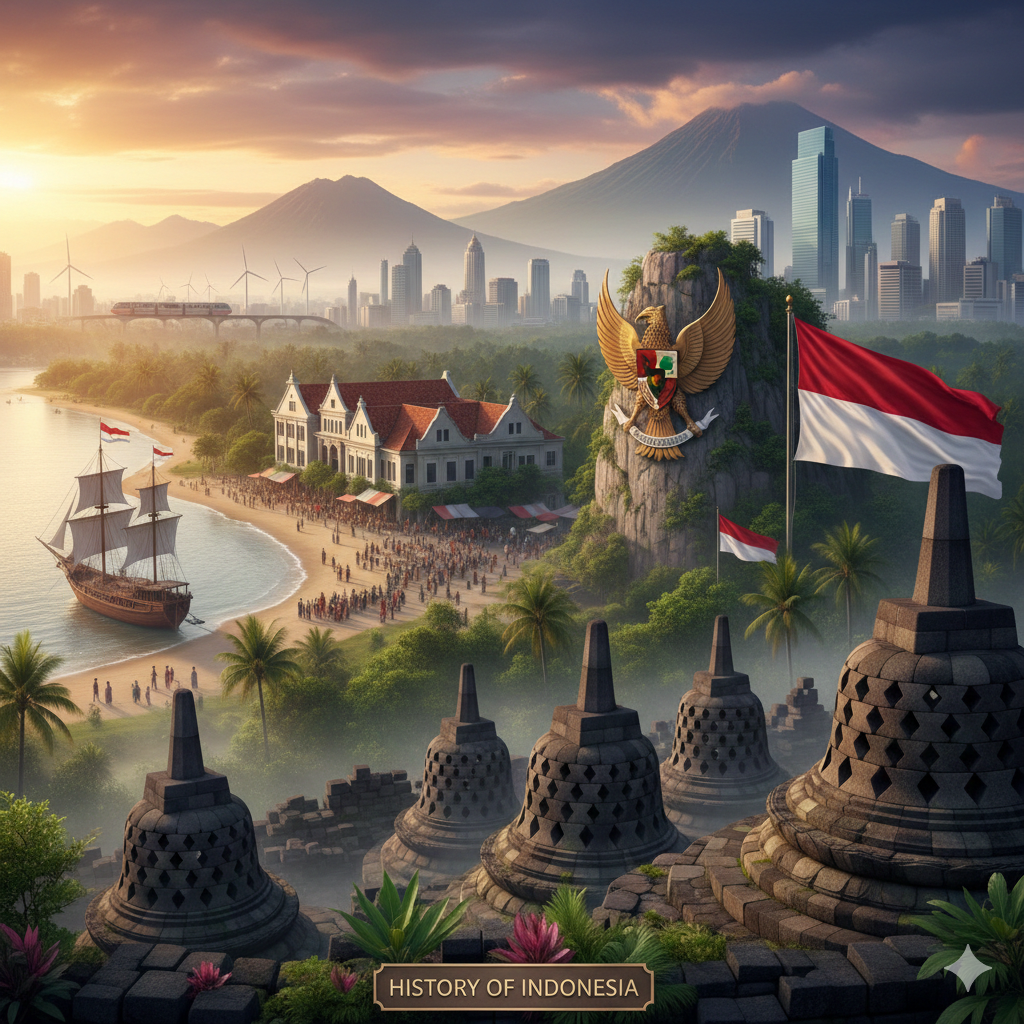
The Epic of the Archipelago: A Comprehensive History of Indonesia
Indonesia is not merely a country; it is a sprawling, 5,000-kilometer-wide bridge of islands that has served as the crossroads of the world for millennia. To understand its history is to understand the blending of every major world culture: Indian, Chinese, Arab, European, and the indigenous Austronesian spirit.
I. Prehistory: The Cradle of Humanity
The story of Indonesia begins far earlier than most civilizations. In the late 19th century, at Trinil in Central Java, the discovery of Homo erectus (popularly known as “Java Man”) revealed that human ancestors inhabited these islands as early as 1.7 million years ago. These early hominids lived in a world where land bridges connected Java, Sumatra, and Borneo to the Asian mainland (Sunda Shelf).
Around 2000 BCE, the modern ethnic makeup of Indonesia began to take shape with the Austronesian migration. Coming from Taiwan through the Philippines, these master seafarers brought with them wet-field rice cultivation, domesticated pigs, and the outrigger canoe. They pushed the indigenous Melanesian populations further east, creating the distinct ethnic divide seen today between western and eastern Indonesia.
II. The Hindu-Buddhist Dawn (4th Century – 15th Century)
By the 1st century CE, Indonesia was already a vital node in the “Maritime Silk Road.” As trade between India and China intensified, the archipelago’s strategic straits—Malacca and Sunda—became centers of wealth.
The Rise of Srivijaya
In the 7th century, the Buddhist maritime empire of Srivijaya emerged in Palembang, Sumatra. Srivijaya was not a land-based empire but a “thalassocracy” (sea power). It controlled the flow of spices from the east and silk from the north. It became a world-renowned center for Buddhist learning; Chinese monks would stop here for months to study Sanskrit before continuing to India.
The Javanese Golden Age: Borobudur and Prambanan
While Srivijaya ruled the seas, Central Java saw the rise of the Sailendra and Sanjaya dynasties. This era produced the world’s most magnificent monuments:
-
- Borobudur (c. 800 CE): The world’s largest Buddhist monument, a massive stone mandala representing the path to enlightenment.
-
- Prambanan (c. 850 CE): A towering Hindu temple complex dedicated to Shiva, built as a rival and a testament to the coexistence of faiths.
Majapahit: The Zenith of Unity
The pinnacle of pre-colonial Indonesian power was the Majapahit Empire (1293–1527). Founded after the repulsion of a Mongol invasion, Majapahit reached its height under King Hayam Wuruk and his legendary prime minister, Gajah Mada. Gajah Mada took the famous Palapa Oath, vowing not to consume spices (a symbol of pleasure) until he had unified the entire archipelago. At its peak, Majapahit claimed influence over nearly the entire modern territory of Indonesia and the Malay Peninsula.
III. The Crescent Moon: The Spread of Islam
Islam did not arrive via conquest but through the peaceful channels of trade. Beginning in the 13th century in Samudera Pasai (North Sumatra), Muslim merchants from India and Persia introduced the faith. By the 15th century, the decline of Majapahit allowed for the rise of Islamic sultanates like Demak in Java and the Sultanate of Malacca.
Islam in Indonesia became unique because it layered itself over existing Hindu-Buddhist and animist traditions, leading to the “Abangan” culture of Java—a syncretic, mystical version of the faith that remains a hallmark of Indonesian identity.
IV. The European Incursion (1512 – 1942)
The “Spice Islands” (Maluku) were the only place on Earth where nutmeg and cloves grew, making them the most valuable real estate in the world to 16th-century Europeans.
The VOC Era
The Portuguese arrived first in 1512, but it was the Dutch East India Company (VOC), founded in 1602, that changed the course of history. The VOC was the world’s first multinational corporation with the power to wage war. They established their headquarters in Batavia (modern-day Jakarta) and systematically dismantled local trade networks. The VOC’s rule was brutal; in the Banda Islands, they nearly exterminated the local population to secure a monopoly on nutmeg.
The Dutch East Indies
When the VOC went bankrupt in 1799, the Dutch government took over, forming the Dutch East Indies. Throughout the 19th century, the Dutch faced fierce resistance, most notably the Java War (1825–1830) led by Prince Diponegoro. To pay for these wars, the Dutch implemented the Cultivation System (Cultuurstelsel), forcing Indonesian farmers to grow export crops like coffee and sugar instead of rice, leading to widespread famine and suffering.
V. The Birth of a Nation (1900 – 1945)
At the dawn of the 20th century, a new generation of educated Indonesians began to dream of a unified nation. This “National Awakening” culminated in the Youth Pledge (Sumpah Pemuda) of 1928, where young people from across the islands declared: “One Motherland, One Nation, One Language: Indonesia.”
The Japanese Occupation
World War II was the catalyst for independence. The Japanese invaded in 1942, shattering the myth of European superiority. While the occupation was harsh, the Japanese allowed the use of the Indonesian language and placed local leaders like Sukarno in positions of power, effectively training the future administrators of an independent state.
VI. Revolution and the Sukarno Years (1945 – 1966)
On August 17, 1945, just days after Japan’s surrender, Sukarno and Mohammad Hatta proclaimed independence. The Dutch, however, attempted to reclaim their colony, leading to a four-year bloody National Revolution. Under international pressure and fierce guerrilla warfare, the Dutch finally recognized Indonesian sovereignty in 1949.
Sukarno, the “Great Leader of the Revolution,” sought to unite a diverse nation through the philosophy of Pancasila (Five Principles). However, his later years were marked by economic instability and a delicate balancing act between the military and the Indonesian Communist Party (PKI).
VII. The New Order and Reformasi (1966 – Present)
Following a failed coup in 1965 and a tragic period of mass violence, General Suharto took power, ushering in the “New Order.” For 32 years, Suharto focused on economic development and stability but at the cost of political freedom and rampant corruption.
The 1997 Asian Financial Crisis finally brought the New Order to its knees. Massive student protests forced Suharto to resign in May 1998, sparking the Reformasi era. Since then, Indonesia has transformed into the world’s third-largest democracy, navigating challenges from the 2004 Tsunami to the current relocation of its capital to Nusantara in Borneo.
Summary Table: Key Eras of Indonesian History
| Era | Key Features | Major Legacy |
| Ancient | Austronesian migration, Java Man | Agricultural roots, maritime skill |
| Hindu-Buddhist | Srivijaya, Majapahit, Borobudur | Concept of “Nusantara” (Archipelago) |
| Islamic | Sultanates of Demak, Aceh, Mataram | Shift in social & religious identity |
| Colonial | VOC, Cultivation System, Dutch rule | Modern borders, infrastructure |
| Revolution | Japanese occupation, 1945 Proclamation | Sovereignty and National Identity |
| New Order | Suharto’s 32-year authoritarian rule | Economic growth, centralized power |
| Reformasi | Democracy, decentralization | Modern democratic state |
Visit: www.dkbtech.com and. www.allcircular.com