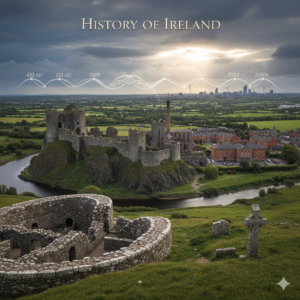
1. Prehistoric Ireland: The First Footprints (c. 10,000 BC – 600 BC)
The History of Ireland begins not with a nation, but with a landscape emerging from the grip of the last Ice Age. Around 10,000 BC, as the ice sheets retreated, a tundra-like environment formed. While a land bridge likely connected Ireland to Britain and Britain to mainland Europe for a time, rising sea levels soon isolated the island, a geographical fact that would define its destiny.
The Mesolithic and Neolithic Eras
The earliest confirmed human activity dates to the Mesolithic period (c. 8000 BC). These were nomadic hunter-gatherers who crossed the narrow seas in skin-covered boats. They lived on the edges of rivers and coasts, leaving behind flint tools and “middens”—ancient rubbish heaps of shells and bones.
The true transformation of the landscape began around 4000 BC with the Neolithic Revolution. These new settlers were farmers. They cleared the vast oak and pine forests to plant cereal crops and graze cattle. Most significantly, they were the “Megalith Builders.” Across the island, they constructed massive stone tombs that dwarf the imagination even today. The most famous, Newgrange in the Boyne Valley (built c. 3200 BC), is older than the Pyramids of Giza. Its precise alignment with the winter solstice sun demonstrates a sophisticated understanding of astronomy and a deeply organized society.
The Bronze and Iron Ages
Around 2500 BC, the arrival of metalworking signaled the Bronze Age. Gold ornaments—torcs and lunulae—found in bogs suggest a wealthy elite and a culture obsessed with status and ritual. However, it was the arrival of Iron and the people we call the Celts (c. 600 BC) that forged the template for Gaelic Ireland.
The Celts did not arrive as a single invading army but rather as a series of migrations and a slow “celtization” of the existing population. They brought the Indo-European language that would become Irish (Gaeilge), a complex legal system known as Brehon Law, and a social structure based on the tuath (petty kingdom). This was an Ireland of warriors, bards, and druids, where wealth was measured in cattle and honor was defended with the sword.
2. Early Christian Ireland: The Island of Saints and Scholars (432 AD – 795 AD)
While the Roman Empire dominated Britain and much of Europe, it never conquered Ireland. The Romans called it Hibernia (The Land of Winter) and chose to trade rather than invade. This isolation allowed Gaelic culture to develop uninterrupted until the 5th century, when a new force arrived: Christianity.
The Mission of Saint Patrick
The traditional date for the arrival of Saint Patrick is 432 AD. A Romanized Briton who had been enslaved in Ireland as a youth, Patrick returned as a missionary. Unlike many other conversions in Europe, the Christianization of Ireland was remarkably peaceful. The new faith did not destroy Gaelic culture; it blended with it. Druidic sites became Christian monasteries, and the pagan festivals of Samhain and Imbolc were reimagined within the church calendar.
The Monastic Golden Age
By the 6th century, Ireland had become the intellectual powerhouse of Western Europe. While the “Dark Ages” saw the collapse of literacy on the continent, Irish monasteries like Clonmacnoise, Glendalough, and Skellig Michael preserved Latin and Greek learning.
Monks produced breathtaking illuminated manuscripts, most notably the Book of Kells, which features intricate Celtic knotwork and vibrant pigments. This era also saw the “Green Martyrdom”—monks who left Ireland to found monasteries across Europe (like St. Columbanus in Italy), effectively re-evangelizing the continent.
3. The Viking and Norman Invasions (795 AD – 1534 AD)
The isolation of the Golden Age was shattered in 795 AD when the first Viking longships appeared off the coast of Lambay Island.
The Viking Age
Initially, the Vikings were raiders, targeting the wealthy, undefended monasteries. However, by the mid-9th century, they began to stay. They established longphorts (fortified bases) at the mouths of rivers, which grew into Ireland’s first true cities: Dublin, Cork, Limerick, and Waterford.
The Vikings introduced international trade and a money economy to Ireland. The conflict between the “Ostmen” (Vikings) and the Gaelic Irish culminated in the Battle of Clontarf in 1014. Though High King Brian Boru was killed, the battle broke the back of Viking political power, though the Norse remained as traders and eventually assimilated into Irish society.
The Anglo-Norman Conquest
The most pivotal turning point in Irish history occurred in 1169. It began not as a British invasion, but as an internal Irish dispute. Dermot MacMurrough, the ousted King of Leinster, sought military aid from King Henry II of England. Henry gave him permission to recruit Norman knights led by Richard de Clare, known as Strongbow.
The Normans, with their chainmail and superior siege tactics, quickly captured Dublin and Wexford. Fearing Strongbow would set up an independent kingdom, Henry II landed in 1171, declaring himself Lord of Ireland. This began over 800 years of English political involvement in Ireland. The Normans built the great stone castles (like Trim and Carrickfergus) that still dot the landscape, but over time, many became “more Irish than the Irish themselves,” adopting Gaelic dress and language.
4. The Tudor Conquest and the Plantations (1534 AD – 1691 AD)
By the 1500s, English control had shrunk to a small area around Dublin known as The Pale. The Tudor monarchs, particularly Henry VIII and Elizabeth I, determined to bring the entire island under direct control.
The Kingdom of Ireland
In 1541, Henry VIII declared himself King of Ireland (replacing the title “Lord”). The Reformation added a toxic new layer to the conflict: England became Protestant, while Ireland remained stubbornly Catholic. This made Ireland a potential “backdoor” for Catholic Spain to invade England.
The struggle reached its climax during the Nine Years’ War (1594–1603). The Gaelic lords of Ulster, led by Hugh O’Neill, fought a brilliant guerrilla campaign but were ultimately defeated at the Battle of Kinsale. In 1607, O’Neill and other lords fled to Europe in the Flight of the Earls, marking the symbolic end of the old Gaelic order.
The Ulster Plantation and Cromwell
To ensure loyalty, the English Crown implemented the Plantation of Ulster, settling thousands of Protestant Scottish and English farmers on confiscated land. This created a demographic divide in the north that persists to this day.
The 17th century was one of blood and fire. Following a Catholic rebellion in 1641, Oliver Cromwell arrived in 1649 to “pacify” the island. His brutal sieges of Drogheda and Wexford and the mass confiscation of Catholic land (“To Hell or to Connacht”) left a scar on the Irish psyche that never fully healed. By the time of the Battle of the Boyne (1690), where the Protestant William of Orange defeated the Catholic James II, the Protestant Ascendancy was firmly in control.
5. The 18th Century and the Act of Union (1691 AD – 1845 AD)
The 1700s were the era of the Penal Laws. These were designed to keep the Catholic majority (and Dissenting Protestants) in a state of poverty and political impotence. Catholics were forbidden from voting, holding office, or owning valuable land.
The 1798 Rebellion
Inspired by the American and French Revolutions, Wolfe Tone and the United Irishmen sought to unite “Protestant, Catholic, and Dissenter” in a secular republic. The 1798 Rebellion was a bloody failure, resulting in 30,000 deaths. In its aftermath, the British government abolished the Irish Parliament through the Act of Union (1800), making Ireland an integral part of the United Kingdom.
Daniel O’Connell
The early 19th century was dominated by the “Liberator,” Daniel O’Connell. Using mass mobilization, he achieved Catholic Emancipation in 1829, allowing Catholics to sit in the British Parliament. He then turned his focus to repealing the Act of Union, but his efforts were overtaken by a natural catastrophe.
6. The Great Famine and the Road to Revolution (1845 AD – 1914 AD)
In 1845, a fungus-like organism (Phytophthora infestans) arrived from America, causing the potato blight. For an impoverished population dependent on a single crop, the results were apocalyptic.
The Great Hunger (An Gorta Mór)
Between 1845 and 1851, approximately one million people died of starvation and disease (typhus and cholera). Another one million emigrated, mostly to the United States, Britain, and Canada. The British government’s response, rooted in laissez-faire economics, was woefully inadequate. Even as people starved, Ireland continued to export grain and livestock. The Famine cut the population by 25% and changed Ireland forever, marking the decline of the Irish language and the rise of a bitter, revolutionary nationalism in the diaspora.
The Home Rule Movement
The late 19th century saw the rise of Charles Stewart Parnell and the “Land War,” which eventually allowed Irish tenants to buy back their land. Parnell also brought the British Parliament to a standstill demanding Home Rule (a devolved parliament for Ireland). Just as Home Rule seemed certain in 1914, World War I broke out, and the “Irish Question” was put on hold.
7. Independence, Partition, and Modern Ireland (1916 AD – Present)
The 1916 Rising and Independence
Frustrated by delays, a small group of rebels staged the Easter Rising in 1916. Though the rising was crushed, the execution of its leaders (like Patrick Pearse and James Connolly) radicalized the public. In 1919, the War of Independence began, led by Michael Collins and his guerrilla tactics.
he conflict ended with the Anglo-Irish Treaty (1921), which created the Irish Free State (26 counties) but partitioned the 6 northern counties, which remained part of the UK as Northern Ireland. This sparked a tragic Civil War (1922-23) between pro-treaty and anti-treaty forces.
The Troubles and The Good Friday Agreement
In Northern Ireland, the Catholic minority suffered decades of discrimination, leading to a civil rights movement in the 1960s and the outbreak of The Troubles—a 30-year conflict between republican paramilitaries (IRA), loyalist paramilitaries, and the British Army. Over 3,600 people died before the landmark Good Friday Agreement (1998) established a power-sharing government and a path to peace.
The Celtic Tiger and Today
The Republic of Ireland joined the European Economic Community (EU) in 1973, transforming from an agrarian society into a high-tech hub. The “Celtic Tiger” era of the 1990s saw unprecedented wealth, followed by a sharp crash in 2008 and a subsequent recovery. Today, Ireland is a modern, socially liberal republic (legalizing same-sex marriage and abortion by popular vote), standing as a bridge between Europe and the Americas, while still carrying the deep, complex echoes of its 10,000-year journey.
Visit: www.dkbtech.com and www.allcircular.com