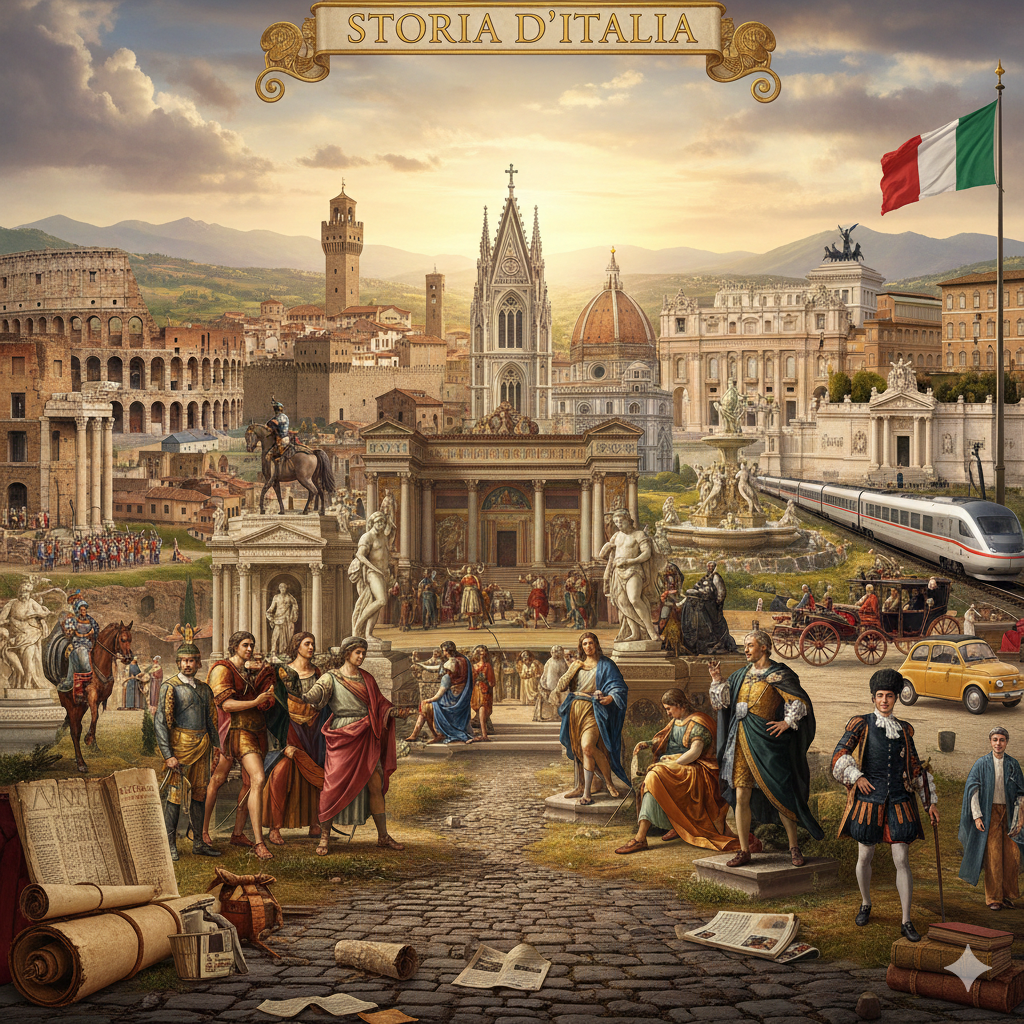
The History of Italy is one of the richest and most complex in the world, spanning millennia and encompassing the rise and fall of empires, the birth of Western civilization, a magnificent artistic and intellectual Renaissance, and centuries of division, struggle, and eventual unification. The Italian peninsula has been the center of power, religion, culture, and innovation for much of Western history.
I. Prehistory and the Ancient World
A. Pre-Roman Italy (c. 1000 BCE – 272 BCE)
Long before Rome’s ascendance, the Italian peninsula was home to diverse peoples and sophisticated cultures.
-
- Indo-European Migrations: Beginning around 2000 BCE, waves of Indo-European peoples, including the ancestors of the Latins, Oscans, and Umbrians, moved into the peninsula, settling alongside indigenous groups.
-
- The Villanovan Culture (c. 1000–750 BCE): Considered the earliest Iron Age culture in central and northern Italy, characterized by cremation burials in distinctive urns.
-
- The Etruscans (c. 800–300 BCE): The most powerful and mysterious pre-Roman civilization. The Etruscans were highly influential, establishing city-states (like Veii and Tarquinia) primarily in Tuscany, Umbria, and Lazio. They developed a unique language, sophisticated metallurgy, and had significant influence on early Roman culture, notably in architecture and religious practices.
-
- Magna Graecia (Great Greece): Starting in the 8th century BCE, Greek colonists settled extensively in Southern Italy (especially Calabria, Puglia, and Sicily), founding thriving cities like Syracuse, Tarentum (Taranto), and Neapolis (Naples). These cities introduced Hellenic culture, philosophy, and political structures to the peninsula.
-
- The Celts/Gauls: Tribes of Celtic people occupied the Po Valley (Cisalpine Gaul) in Northern Italy.
1. The Roman Republic (509 – 27 BCE)
Tradition places the founding of Rome in 753 BCE. After overthrowing its Etruscan kings, Rome established a Republic, based on a complex system of elected magistrates (Consuls) and a powerful Senate.
-
- Conquest of Italy (c. 500 – 272 BCE): Rome gradually subdued its neighbors—the Latins, the Etruscans, and the Samnites—and successfully defended itself against a Gallic invasion (c. 390 BCE). The ultimate victory in the Pyrrhic War (280–275 BCE) secured Rome’s control over the entire peninsula.
-
- Punic Wars (264 – 146 BCE): A series of three conflicts against Carthage, the major maritime power of the Western Mediterranean. Rome’s decisive victory, culminating in the destruction of Carthage, made it the undisputed master of the Mediterranean (or Mare Nostrum—Our Sea).
-
- Social and Political Crisis: Massive territorial expansion led to severe internal instability. Issues included land distribution, the rise of powerful generals, and the conflict between the Optimates (traditional aristocrats) and the Populares (reformers). This era saw figures like the Gracchi brothers, Marius, Sulla, and the First Triumvirate (Caesar, Pompey, Crassus).
-
- The End of the Republic: Julius Caesar’s conquest of Gaul and his subsequent victory in the Civil War against Pompey marked the end of the Republican ideal. His assassination (44 BCE) was followed by further civil wars, which were ultimately resolved when Octavian (Caesar’s adopted son) defeated Mark Antony and Cleopatra.
2. The Roman Empire (27 BCE – 476 CE)Octavian ushered in the Pax Romana (Roman Peace) and established the Empire, taking the title Augustus (27 BCE).
-
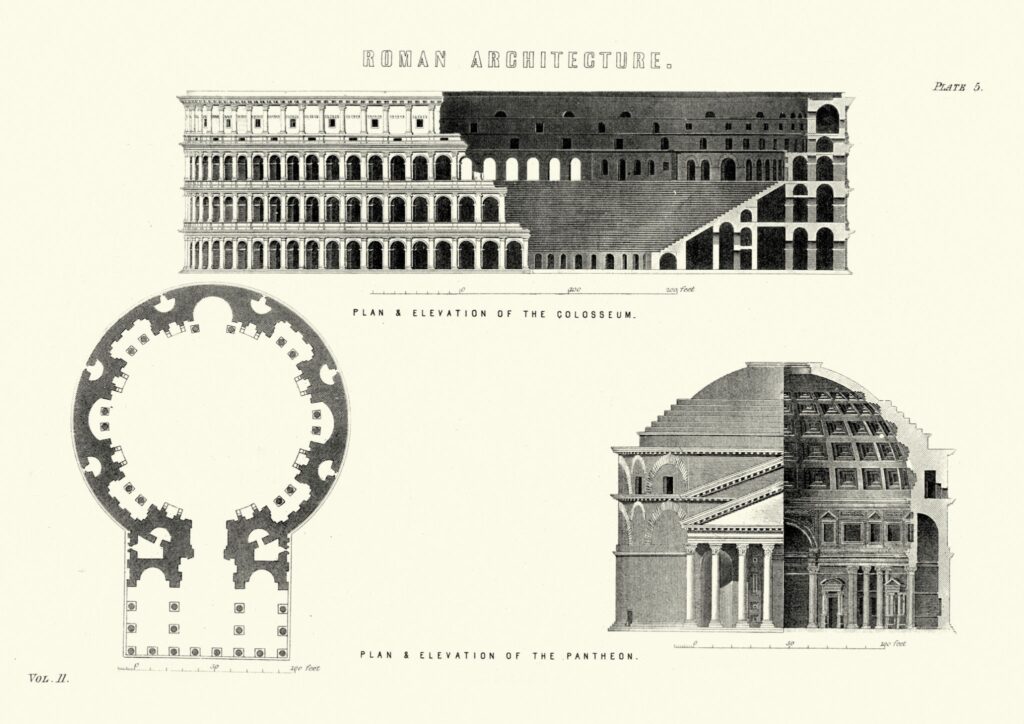
- The Principate (27 BCE – 284 CE): This “golden age” saw the Empire reach its greatest extent, stability, and prosperity under dynasties like the Julio-Claudians (Tiberius, Caligula, Nero) and the Antonines (Trajan, Hadrian, Marcus Aurelius). Italy, especially the city of Rome, was the political, economic, and cultural heart of the vast territory.
-
- The Dominate (284 – 476 CE): Facing mounting external pressure and internal chaos, the Empire became increasingly autocratic. Emperor Diocletian (r. 284–305) introduced the Tetrarchy (rule by four) to better administer the vast territory.
-
- Christianity and Constantinople: Constantine the Great legalized Christianity (Edict of Milan, 313) and, crucially, founded a new capital at Constantinople (330) in the East, beginning a shift in the Empire’s center of gravity away from Italy.
-
- The Western Collapse: Increasing pressure from Germanic tribes (Goths, Vandals, Huns) led to the sack of Rome in 410 (by the Visigoths) and 455 (by the Vandals). The traditional date for the de facto end of the Western Roman Empire is 476 CE, when the last Emperor, Romulus Augustulus, was deposed by the Germanic chieftain Odoacer.
II. The Medieval Period (c. 476 – 1400)
The fall of the Western Empire plunged the Italian peninsula into an era of political fragmentation, characterized by competing foreign powers and the rising influence of the Papacy.
A. The Era of Barbarian Kingdoms (476 – 800)
-
- Odoacer and the Ostrogoths (476 – 553): Odoacer’s rule was soon challenged by the Ostrogoths under Theodoric the Great, who established an impressive kingdom in Italy, attempting to fuse Roman and Germanic traditions.
-
- Byzantine Reconquest: The Byzantine (Eastern Roman) Emperor Justinian I launched a devastating war (the Gothic War, 535–554) to reclaim Italy, succeeding in shattering the Ostrogothic kingdom but leaving the peninsula impoverished and depopulated.
-
- The Lombards (568 – 774): The Lombard (or Langobard) invasion soon after the Byzantine victory marked the true end of political unity. They established a powerful kingdom in the north and central south, leaving Byzantium in control only of the Exarchate of Ravenna, Rome, and the far south. This division between a Lombard North and Byzantine South would endure for centuries.
B. The Fragmentation of Italy (800 – 1150)
Italy became a battleground for competing imperial, local, and religious powers.
-
- The Carolingian Interlude: Charlemagne, King of the Franks, defeated the Lombards in 774 and was crowned Emperor of the Romans by Pope Leo III in 800, establishing the Carolingian Empire and solidifying the Papacy’s political authority. When the Carolingian Empire dissolved, the title of Holy Roman Emperor remained tied to Italy, drawing German rulers into peninsula affairs.
-
- The Rise of the Papacy: The Popes in Rome, claiming the spiritual succession of the Roman Empire and the temporal authority granted by the Donation of Pepin, consolidated their territorial control over Central Italy (the Papal States).
-
- The Norman Conquest (c. 1000 – 1130): In a remarkable series of campaigns, Norman adventurers conquered the Byzantine and independent Lombard principalities in Southern Italy and Sicily. Roger II united these holdings into the Kingdom of Sicily (1130), a powerful, multicultural state blending Latin, Greek, and Arab influences.
C. The Communes and the Emperor (1150 – 1400)
In Northern and Central Italy, the absence of a strong centralized authority allowed independent city-states to flourish.
-
- The Rise of the Communes: Cities like Florence, Milan, Venice, and Genoa evolved into Communes—independent, republican governments ruled by an oligarchy of wealthy merchants and nobles. This period saw a massive expansion of trade, finance, and manufacturing.
-
- Conflict with the Holy Roman Empire: The burgeoning autonomy of the communes brought them into direct conflict with the German Holy Roman Emperors (especially the Hohenstaufen dynasty, like Frederick I Barbarossa and Frederick II). The cities formed the Lombard League and, with Papal support, successfully fought for their independence, notably at the Battle of Legnano (1176).
-
- The Guelphs and Ghibellines: Medieval Italian politics were defined by the bitter struggle between the Guelphs (pro-Papacy) and the Ghibellines (pro-Emperor). This division fueled internal conflicts and civil wars within virtually every city.
-
- The Rise of the Signorie: As internal strife within the Communes became paralyzing, many cities gradually ceded power to powerful, charismatic individuals or families (a Signore), leading to the replacement of republics with hereditary Signorie (Lordships). Examples include the Medici in Florence and the Visconti/Sforza in Milan.
III. The Renaissance and Foreign Domination (c. 1400 – 1796)
The Italian peninsula entered an era of unparalleled cultural, artistic, and intellectual splendor—the Renaissance—coexisting with an intensifying struggle for political mastery by powerful foreign kingdoms.
A. The Italian Renaissance (c. 1400 – 1600)
The Italian Renaissance began in Florence in the 14th century and spread across the peninsula, driven by a rediscovery of classical antiquity (humanism) and patronage by wealthy families and the Church.
-
- The Five Major Powers: The 15th century saw a delicate balance of power maintained between the five major regional states:
-
- The Duchy of Milan (under the Visconti and Sforza).
-
- The Republic of Venice (a powerful maritime empire).
-
- The Republic of Florence (dominated by the Medici family).
-
- The Papal States (under the Popes in Rome).
-
- The Kingdom of Naples (controlled by various foreign dynasties).
-
- The Five Major Powers: The 15th century saw a delicate balance of power maintained between the five major regional states:
-
- The Peace of Lodi (1454): This treaty temporarily stabilized the political situation, allowing for a sustained period of cultural blossoming.
-
- Cultural Zenith: This era produced an explosion of genius across all fields:
-
- Art: Leonardo da Vinci, Michelangelo, Raphael, Botticelli, Titian.
-
- Literature: Petrarch, Boccaccio, Machiavelli (author of The Prince).
-
- Architecture: Brunelleschi, Alberti.
-
- Cultural Zenith: This era produced an explosion of genius across all fields:
B. The Italian Wars and Foreign Hegemony (1494 – 1796)
The fragility of the Italian political balance was shattered by foreign intervention, ushering in centuries of foreign domination.
-
- The Italian Wars (1494 – 1559): Sparked by the French King Charles VIII’s invasion of Naples, these wars pitted France against the rising power of the Habsburg dynasty (Spain and the Holy Roman Empire) for control of the peninsula.
-
- The Habsburg Ascendancy: The conflict ended with the Treaty of Cateau-Cambrésis (1559), which confirmed Spanish Habsburg dominance over most of Italy. Spain directly ruled the Kingdom of Naples, Sicily, Sardinia, and the Duchy of Milan. The remaining states, though nominally independent (e.g., Venice, Genoa, Tuscany), were largely vassals of Madrid.
-
- Economic Decline: The center of European trade shifted from the Mediterranean to the Atlantic, and Spanish control proved stifling, leading to a long period of economic and political decline for the peninsula, despite the ongoing brilliance of the Counter-Reformation Baroque culture (e.g., Bernini).
-
- The War of the Spanish Succession (1701 – 1714): This European war broke the Spanish hold. By the terms of the treaties of Utrecht and Rastatt, Austria replaced Spain as the dominant foreign power, taking control of Milan and Naples.
-
- The 18th Century: The political map of Italy continued to shift through various dynastic agreements. The House of Savoy (ruling the Kingdom of Sardinia/Piedmont) emerged as a significant player, expanding its mainland territories. The Spanish Bourbon dynasty gained control of Naples and Sicily. However, Italy remained a patchwork of independent, but weak, states subject to the will of great European powers.
IV. The Age of Revolution and Unification (1796 – 1914)
This era began with the revolutionary shockwave of Napoleonic France and culminated in the political unification of Italy (Risorgimento).
A. The Napoleonic Period (1796 – 1814)
Napoleon Bonaparte’s campaigns fundamentally destabilized the old political order and introduced modern political ideas.
-
- French Invasion: Napoleon’s brilliant campaigns in Italy (1796–1797) dismantled the existing states, replacing them with a series of French satellite republics (the Cisalpine, Ligurian, Roman, and Parthenopean Republics).
-
- Kingdom of Italy: In 1805, Napoleon created the Kingdom of Italy in the North, with himself as King and his stepson, Eugène de Beauharnais, as Viceroy. Naples was ruled by his brother-in-law, Joachim Murat. The Papal States were annexed.
-
- Legacy: French rule was brief but transformative. It introduced modern administrative and legal codes, unified currencies, abolished feudalism in the South, and instilled a powerful sense of modern Italian identity and nationalism that would fuel the Risorgimento.
B. The Restoration and the Risorgimento (1815 – 1870)
After Napoleon’s defeat, the Congress of Vienna (1815) attempted to restore the pre-Napoleonic order, but the seeds of Italian nationalism could not be contained.
1. The Restoration and Early Insurrections (1815 – 1848)
-
- The Political Landscape: The peninsula reverted to a mosaic of reactionary monarchies, dominated by Austrian influence in the North and Center. The primary states were:
-
- The Kingdom of Sardinia-Piedmont (ruled by the House of Savoy).
-
- The Austrian-controlled Kingdom of Lombardy-Venetia.
-
- The Papal States.
-
- The Bourbon Kingdom of the Two Sicilies.
-
- The Political Landscape: The peninsula reverted to a mosaic of reactionary monarchies, dominated by Austrian influence in the North and Center. The primary states were:
-
- Secret Societies: The desire for a united, liberal Italy was kept alive by secret revolutionary groups, notably the Carbonari, who organized failed insurrections in the 1820s and 1830s.
-
- The Architects of Unification: The movement found its theoretical and political leaders:
-
- Giuseppe Mazzini: The radical idealist who founded Young Italy and championed the creation of a unified, democratic Italian Republic.
-
- Count Camillo Cavour: The pragmatic Prime Minister of Piedmont-Sardinia, who believed unification must be led by the Savoy monarchy through diplomacy and war.
-
- Giuseppe Garibaldi: The charismatic military leader and republican who championed the cause through popular revolt.
-
- The Architects of Unification: The movement found its theoretical and political leaders:
2. The Wars of Independence (1848 – 1870)
The Kingdom of Sardinia-Piedmont under King Victor Emmanuel II became the engine of unification.
-
- The Revolutions of 1848: Revolts erupted across Italy, forcing rulers to grant constitutions, but Piedmont’s subsequent attempts to drive out the Austrians failed.
-
- Second War of Italian Independence (1859): Cavour, having secured a secret alliance with France’s Napoleon III, provoked Austria. Piedmontese-French victory led to the acquisition of Lombardy and inspired popular votes (plebiscites) in central Italian states (Tuscany, Modena, Parma) to join Piedmont.
-
- Garibaldi’s Expedition of the Thousand (1860): The most dramatic event. Garibaldi and his Redshirts (volunteers) sailed from Genoa, conquered the entire Kingdom of the Two Sicilies in a lightning campaign, and then famously handed over his conquests to King Victor Emmanuel II.
-
- Proclamation of the Kingdom: The Kingdom of Italy was officially proclaimed on March 17, 1861, with Victor Emmanuel II as the first King. Venice and Rome were still outside the Kingdom.
-
- Completion of Unification:
-
- Venice was acquired in 1866 as a result of the Austro-Prussian War (Third War of Independence).
-
- Rome was seized in 1870, after French protection was withdrawn due to the Franco-Prussian War. Rome became the capital in 1871.
-
- Completion of Unification:
C. The Liberal Kingdom (1870 – 1914)
The newly unified nation faced immense challenges—political consolidation, economic disparity, and social tension.
-
- A “Mutilated” Victory: Unification was not a democratic Mazzinian republic but a liberal monarchy built around the institutions of Piedmont. The franchise was highly restricted.
-
- The Southern Question: The deep economic and social divide between the industrialized North and the impoverished, agricultural South (Mezzogiorno) became the most persistent challenge, fueling mass emigration to the Americas.
-
- Church-State Conflict: The Papacy refused to recognize the new Italian state, leading to a long-standing standoff (non expedit) that forbade Catholics from participating in national elections.
-
- Colonialism: Eager to assert its status as a Great Power, Italy embarked on unsuccessful colonial adventures, notably the conquest of Eritrea and Somalia, and a humiliating defeat at Adwa (Ethiopia, 1896). A later war against the Ottoman Empire (1911–1912) secured Libya.
-
- Industrialization: The late 19th and early 20th centuries saw significant, though uneven, industrialization, concentrated in the “Industrial Triangle” of Milan, Turin, and Genoa.
V. The World Wars and the Fascist Era (1914 – 1945)
The Kingdom of Italy was destabilized by the trauma of World War I, leading to the collapse of the liberal state and the rise of a totalitarian regime.
A. World War I (1914 – 1918)
-
- Neutrality to Intervention: Despite being part of the Triple Alliance with Germany and Austria-Hungary, Italy declared neutrality in 1914. Driven by irredentist claims (territories with Italian-speaking populations held by Austria-Hungary, primarily Trentino and Trieste) and promises of land from the Allies, Italy entered the war on the side of the Triple Entente (Britain, France, Russia) in May 1915.
-
- The Alpine Front: The war was fought primarily along the mountainous border with Austria-Hungary (the Isonzo and Trentino fronts) and was characterized by brutal, static trench warfare in high-altitude terrain.
-
- Caporetto and Victory: A devastating Austrian-German breakthrough at Caporetto in 1917 nearly shattered the Italian army, but a reorganized defense held the line. Final victory came at the Battle of Vittorio Veneto (1918).
-
- A “Mutilated Victory”: Italy gained Trentino, South Tyrol, Trieste, and Istria, but felt cheated out of promised territories (like Dalmatia) by the other Allies. This sense of a “mutilated victory” fueled post-war nationalism and resentment.
B. The Rise of Fascism (1919 – 1925)
The post-war period was marked by economic crisis, mass unemployment, political chaos, and intense social conflict (the Biennio Rosso—”Two Red Years”).
-
- Mussolini and the Fasci: Benito Mussolini, a former socialist, founded the Fasci di Combattimento (Combat Groups) in 1919, advocating for an aggressive nationalism, anti-liberalism, and anti-socialism.
-
- The Blackshirts: Fascism grew rapidly, using paramilitary squads (the Squadristi or Blackshirts) to violently suppress striking workers, socialists, and political opponents, often with the tacit approval of police and landowners.
-
- The March on Rome (October 1922): Feeling confident, Mussolini threatened a march on the capital. King Victor Emmanuel III, fearing a civil war and under pressure from conservative elites, refused to sign an order declaring martial law. Instead, he invited Mussolini to form a government, thus legally transferring power to the Fascists.
C. Fascist Italy (1925 – 1943)
Mussolini gradually dismantled the liberal democratic structures and established a one-party totalitarian state, becoming the Duce (Leader).
-
- Establishment of Dictatorship: Following the murder of socialist deputy Giacomo Matteotti in 1924, Mussolini consolidated power, formally declaring a dictatorship in 1925.
-
- State and Ideology: Fascism was characterized by an extreme cult of personality, state control over the economy (corporatism), aggressive nationalism, and the goal of restoring the glory of the Roman Empire. Public works (like the draining of the Pontine Marshes) and propaganda were central.
-
- The Lateran Pacts (1929): Mussolini successfully negotiated a treaty with the Papacy, resolving the long-standing Roman Question. The Vatican City was recognized as an independent state, and Catholicism was confirmed as the state religion.
-
- Foreign Policy and Axis: Mussolini pursued an aggressive foreign policy, invading Ethiopia (1935–1936), which led to League of Nations sanctions and pushed Italy closer to Nazi Germany. Italy entered into the Pact of Steel with Germany (1939).
D. World War II and the Collapse of Fascism (1940 – 1945)
-
- Intervention and Defeat: Italy entered WWII in June 1940, believing the war was already won by Germany. The Italian military was ill-prepared and suffered disastrous defeats in North Africa, Greece, and the Soviet Union.
-
- The Fall of Mussolini (July 1943): Following the Allied invasion of Sicily, the Fascist Grand Council voted to depose Mussolini. He was arrested, and Marshal Pietro Badoglio took over, secretly negotiating an armistice with the Allies, announced on September 8, 1943.
-
- Civil War and Occupation: Germany responded by invading and occupying Italy. Mussolini was rescued by German commandos and set up the Italian Social Republic (RSI), a Fascist puppet state in the German-occupied north (Salò Republic).
-
- The Italian Resistance: The Armistice created a massive vacuum. Anti-Fascist political parties and armed groups (Partisans) formed the Resistance Movement. A brutal Civil War ensued between the Fascist RSI forces and the Partisans, while the Allies fought the Germans up the peninsula (Gothic Line).
-
- Liberation: Mussolini was captured and executed by Partisans in April 1945, coinciding with the final collapse of German resistance in Italy.
VI. The Modern Italian Republic (1946 – Present)
The war brought about the creation of a new nation: a democratic republic built on the foundations of the Resistance.
A. The Birth of the Republic (1946 – 1948)
-
- The Referendum (June 2, 1946): Italians voted in a national referendum to abolish the monarchy (blamed for the rise of Fascism and the defeat in the war) and establish a Republic. On the same day, elections were held for a Constituent Assembly.
-
- The New Constitution: The Assembly drafted a new, democratic Constitution, which came into effect on January 1, 1948.
-
- The First Elections: The first general election of the Republic in 1948 was a crucial event of the Cold War, dominated by the rivalry between the US-backed Christian Democrats and the Soviet-backed Communist Party. The Christian Democracy (DC) party won a decisive majority, beginning their dominant role in Italian politics for the next four decades.
B. The Post-War Boom and the First Republic (1948 – 1992)
-
- The Economic Miracle (Il Miracolo Economico): From the late 1950s to the mid-1960s, Italy experienced rapid, spectacular industrial growth, transforming it from a largely agrarian society into one of the world’s leading industrial powers (a G7 nation). This led to massive urbanization and consumerism.
-
- The Era of Christian Democratic Rule: The DC, often in coalition with smaller centrist parties (the Pentapartito), governed Italy continuously. The opposition was led by the powerful, but permanently excluded, Italian Communist Party (PCI).
-
- The Years of Lead (Anni di Piombo, c. 1968 – 1980): This period was marked by political extremism, terrorism, and social unrest from both the far-left (e.g., the Red Brigades, responsible for the 1978 kidnapping and murder of former Prime Minister Aldo Moro) and the far-right. The state also faced allegations of involvement in a “Strategy of Tension” involving domestic bombings.
-
- The Rise of Corruption (Tangentopoli): The political system became increasingly characterized by chronic corruption and the control of organized crime (Mafia, Camorra, ‘Ndrangheta), especially in the South.
C. The Second Republic and Contemporary Italy (1992 – Present)
A massive corruption scandal brought about the end of the post-war political order.
-
- Mani Pulite (Clean Hands) and Tangentopoli (1992–1994): Judicial investigations uncovered a vast network of political corruption (the “Bribe City” scandal). The DC and Socialist Party were virtually wiped out, and the political system collapsed. This transition is often referred to as the passage from the First Republic to the Second Republic.
-
- The Berlusconi Era: The political vacuum was filled by new parties and leaders, most notably media magnate Silvio Berlusconi, who entered politics in 1994 with his party, Forza Italia. His dominance, interrupted by periods of center-left government, defined Italian politics for two decades.
-
- European Integration: Italy was a founding member of the European Economic Community (1957) and adopted the Euro in 2002. Integration into the European Union has been a central and generally stabilizing element of its economic and foreign policy.
-
- 21st Century Challenges: Contemporary Italy faces ongoing issues: persistent North-South economic inequality, high public debt, a complex and often unstable political system, an aging population, and the challenge of managing migration flows from the Mediterranean.
-
- Recent Politics: The political scene has been characterized by fragmentation and the rise of populist/anti-establishment parties (like the Five Star Movement and the League), reflecting deep socio-economic anxieties. In 2022, Giorgia Meloni, leader of the conservative Brothers of Italy party, became the first female Prime Minister, leading a right-wing coalition.
Conclusion
The history of Italy is a continuous narrative of transformation, from the monumental legacy of the Roman Empire to the diverse cultural and political landscapes of the city-states, and finally, to the modern, often-turbulent Republic. It is a history that has irrevocably shaped Western culture, law, art, and religion, and one that continues to evolve as Italy navigates the complexities of the 21st century.
Visit: www.dkbtech.com and allcircular.com