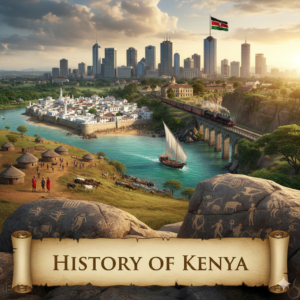
1. Pre-Colonial Kenya: The Cradle of Mankind
Kenya is often cited as the “Cradle of Mankind.” Archaeological sites like the Turkana Basin have yielded some of the oldest hominid fossils in the world, including Homo erectus.
-
Migration Patterns: Around 2000 BCE, Cushitic speakers from the Horn of Africa settled in the region. They were followed by Nilotic and Bantu migrations between 500 BCE and 1000 CE.
-
The Swahili Coast: By the 8th century, Arab and Persian traders established settlements along the coast (Mombasa, Lamu, Malindi). This led to the birth of the Swahili culture and language, a blend of African Bantu and Arabic influences.
-
The Portuguese Era: In 1498, Vasco da Gama reached Malindi. The Portuguese dominated the coast for two centuries, building Fort Jesus in 1593, before being ousted by the Omani Arabs in 1698.
2. The Colonial Era (1885–1963)
The “Scramble for Africa” formalized British interest in Kenya.
-
The East Africa Protectorate (1895): Britain established a protectorate to secure a trade route to Uganda.
-
The “Lunatic Line”: The construction of the Kenya-Uganda Railway (1896–1901) transformed the interior. It brought thousands of Indian laborers and led to the founding of Nairobi as a supply depot.
-
White Highlands: After Kenya became a formal British Colony in 1920, fertile lands were seized from the Kikuyu and Maasai to settle European veterans of WWI. This “land alienation” became the primary catalyst for the independence struggle.
3. The Struggle for Independence
Resistance grew throughout the 1920s and 30s through organizations like the Kikuyu Central Association (KCA), where Jomo Kenyatta emerged as a leader.
-
The Mau Mau Uprising (1952–1960): A militant movement, primarily among the Kikuyu, launched a guerrilla war against British rule. The British responded with a State of Emergency, detaining over 100,000 Africans, including Kenyatta (one of the “Kapenguria Six”).
-
Path to Uhuru: Although the Mau Mau were militarily defeated, the rebellion made the cost of colonialism unsustainable for Britain. Kenya gained independence on December 12, 1963, with Jomo Kenyatta as the first Prime Minister (later President).
4. The Post-Independence Eras
Kenya’s modern history is defined by its four (and now five) presidencies:
Visit : www.dkbtech.com, www.allcircular.com