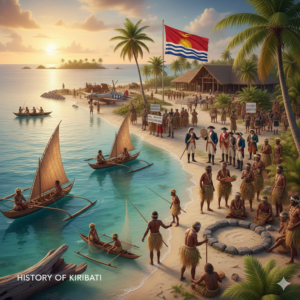
1. The Dawn of the Islands: Migration and Settlement
The history of Kiribati begins with the incredible seafaring feats of Austronesian-speaking peoples. Thousands of years ago, these navigators traveled across the vast Pacific in outrigger canoes, guided by the stars, ocean currents, and the flight patterns of birds.
-
Early Settlement (c. 3000 BC – 1300 AD): The ancestors of the I-Kiribati people settled the Gilbert Islands. They developed a complex society centered on the maneaba (meeting house), which remains the heart of Kiribati culture today.
-
The Samoan Influence: Around the 14th century, invasions and migrations from Samoa, Tonga, and Fiji introduced new cultural elements and lineage structures, blending with the indigenous Micronesian traditions to create a unique cultural identity.
2. Early European Contact (16th – 19th Century)
The first recorded European sighting of the islands was by Spanish explorer Pedro Fernandes de Queirós in 1606. However, it wasn’t until the late 18th and early 19th centuries that Western contact became frequent.
-
Naming the Islands: The name “Gilbert Islands” was bestowed in 1820 by the Russian Admiral Adam von Krusenstern, in honor of British Captain Thomas Gilbert, who sailed through the archipelago in 1788.
-
The Arrival of Whalers and Traders: By the 1830s, whaling ships and “blackbirders” (labor recruiters who often coerced or kidnapped islanders) began frequenting the waters. This period introduced foreign goods but also devastating diseases and social upheaval.
3. The British Colonial Era
In the late 19th century, the Pacific became a theater for European imperial expansion.
-
The Protectorate (1892): Seeking to curb the chaos of the labor trade and tribal warfare, Britain declared a protectorate over the Gilbert and Ellice Islands.
-
The Colony (1916): The islands were formally annexed as the Gilbert and Ellice Islands Colony (GEIC). During this time, the island of Banaba (Ocean Island) became a focal point of British interest due to its massive phosphate deposits. The intensive mining of Banaba led to significant environmental destruction and the eventual relocation of its people to Fiji.
4. World War II and the Battle of Tarawa
Kiribati was a strategic frontline during World War II. In 1941, Japanese forces occupied the islands shortly after the attack on Pearl Harbor.
-
The Occupation: For two years, the I-Kiribati lived under Japanese military rule.
-
The Battle of Tarawa (1943): One of the bloodiest battles in the Pacific took place on Betio Island, Tarawa. U.S. Marines launched an amphibious assault to reclaim the islands. Over 6,000 men died in just 76 hours of fighting. The scars of this battle—concrete bunkers and rusted shipwrecks—are still visible today.
5. The Path to Independence
After the war, the movement for self-determination grew. However, there was a cultural and political divide between the Gilbert Islands (Micronesian) and the Ellice Islands (Polynesian).
-
Separation: In 1975, the Ellice Islands voted to secede, eventually becoming the independent nation of Tuvalu.
-
Independence (July 12, 1979): The Gilbert Islands officially became the Republic of Kiribati. The name “Kiribati” (pronounced Kiri-bass) is the local rendition of “Gilberts.”
6. Modern Kiribati: Challenges and Resilience
Since independence, Kiribati has navigated the complexities of being a small island developing state across three time zones.
-
Geography: Kiribati is the only country in the world to fall into all four hemispheres. In 1995, it moved the International Date Line to ensure the entire country shared the same calendar day.
-
Climate Change: As a nation composed mostly of low-lying coral atolls, Kiribati is on the front lines of the climate crisis. Rising sea levels threaten the freshwater lenses and the very existence of the islands.
-
Resilience: The government has engaged in “Migration with Dignity” programs and purchased land in Fiji as a potential future refuge, while simultaneously fighting for international climate action.
| Period | Key Event |
| Pre-1300 | Austronesian/Micronesian settlement and Maneaba-based society. |
| 1788 | Captain Thomas Gilbert passes through the islands. |
| 1892 | Britain establishes a Protectorate. |
| 1943 | The Battle of Tarawa marks a turning point in WWII. |
| 197918 | Independence from the United Kingdom.19 |
| Present | Leadership in global climate advocacy. |
Visit : wwww.dkbtech.com, www.allcircular.com