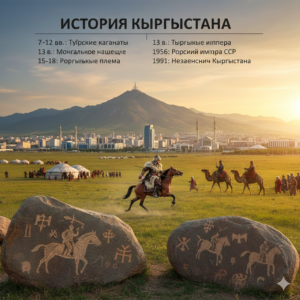
The history of Kyrgyzstan is a sprawling narrative of resilience, defined by a nomadic spirit that has survived the rise and fall of global empires. From the ancient banks of the Yenisei River to the high peaks of the Tian Shan, the Kyrgyz people have maintained a distinct identity through three millennia of migration, conquest, and political transformation.
Ancient Origins and the Yenisei Era (201 BCE – 840 CE)
The first written records of the Kyrgyz appear in Chinese chronicles (such as the Shiji) around 201 BCE, placing their ancestors in the upper Yenisei River valley of central Siberia. These ancient Kyrgyz were part of the Xiongnu confederation and were described as a nomadic people with a mixed economy of animal breeding and skilled ironworking.
During this era, the Kyrgyz were often subjects of larger Turkic empires, including the Göktürk Khaganate. However, they remained a fierce and independent-minded group. In the 8th century, they lived under the shadow of the Uyghur Empire, frequently engaging in rebellions. This period of resistance culminated in 840 CE, when the Kyrgyz launched a massive military campaign, sacked the Uyghur capital of Ordu-Baliq, and established the Great Kyrgyz Khaganate. At its peak, this empire stretched from Siberia to the Aral Sea, representing the “Golden Age” of Kyrgyz power.
The Silk Road and Mongol Conquest (10th – 18th Century)
By the 10th century, Kyrgyz dominance in Mongolia began to wane, and many tribes migrated south toward the Tian Shan mountains—the territory of modern-day Kyrgyzstan. This migration brought them into direct contact with the Silk Road, where cities like Osh became vital hubs for trade between China, Persia, and Europe.
-
Islamization: During the 10th-12th centuries, under the Karakhanid Khanate, Islam began to take root in the region, though it blended deeply with traditional nomadic shamanism.
-
Mongol Rule: In 1207, the Kyrgyz submitted to the Mongol Empire. Under Genghis Khan and later the Chagatai Khanate, the Kyrgyz social structure was disrupted, and their written language was largely lost.
-
The Epic of Manas: It was during these centuries of struggle against various invaders (including the Oirats and Kalmyks) that the Epic of Manas was forged. This oral masterpiece, which tells the story of a hero unifying forty tribes, became the spiritual backbone of the nation.
Russian Empire and the Soviet Era (1876 – 1991)
The 19th century saw a shift in power as the Khanate of Kokand expanded its control over the region, building the fortress of Pishpek (modern-day Bishkek). Oppressed by Kokand taxes, many Kyrgyz tribes sought protection from the Russian Empire.
By 1876, following the defeat of Kokand, Kyrgyzstan was formally incorporated into Russia. This period brought modernization but also disaster; Russian settlers seized the best pasturelands, leading to the 1916 Urkun (Great Flight) uprising, where hundreds of thousands of Kyrgyz fled to China under brutal Tsarist repression.
The Soviet Transformation
After the 1917 Bolshevik Revolution, the region underwent radical changes:
-
Statehood: The Kyrgyz Soviet Socialist Republic was established as a full union republic in 1936.
-
Sedition: Stalin’s forced collectivization in the 1930s ended the traditional nomadic lifestyle, causing widespread famine and cultural upheaval.
-
Modernization: Despite the repression, the Soviet era brought near-total literacy, industrialization, and the growth of Bishkek into a major administrative center.
Independence and the “Island of Democracy” (1991 – Present)
Kyrgyzstan declared independence on August 31, 1991, following the collapse of the USSR. Under its first president, Askar Akayev, the country was initially hailed as an “Island of Democracy” in Central Asia due to its liberal economic reforms and multi-party system
However, the path has been rocky. Corruption and economic hardship led to three major revolutions:
-
The Tulip Revolution (2005): Ousted Akayev.
-
The 2010 Revolution: Ousted Kurmanbek Bakiyev and led to a transition toward a parliamentary system.
-
The 2020 Protests: Resulted in the rise of the current president, Sadyr Japarov, and a return to a stronger presidential system under the 2021 constitution.
Today, Kyrgyzstan remains a unique political landscape in Central Asia—a nation defined by its mountainous geography, its strategic role in the “New Silk Road,” and a fierce, restless commitment to political pluralism.
| Era | Key Feature |
| Ancient | Yenisei roots and the defeat of the Uyghurs (840 CE). |
| Medieval | Migration to Tian Shan; Silk Road trade; Mongol vassalage. |
| Imperial | Russian conquest (1876) and the 1916 Urkun rebellion. |
| Soviet | Forced settlement; Industrialization; 1936 SSR status. |
| Modern | 1991 Independence; Series of democratic revolutions. |
Visit : www.dkbtech.com , www.allcircular.com