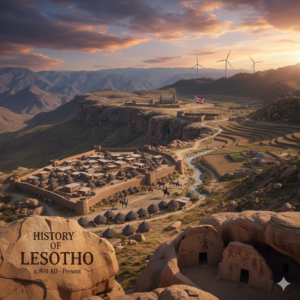
The Origins: Ancient Inhabitants and the Lifaqane
The history of Lesotho begins long before its formal unification. The earliest inhabitants were the San (Bushmen), whose presence is immortalized in the vibrant rock art found in caves across the Maloti Mountains. By the late first millennium, Sotho-speaking groups began migrating into the fertile Caledon River Valley.
The defining catalyst for the nation’s creation was the Lifaqane (or Mfecane)—a period of intense tribal warfare and displacement in the early 19th century. Amidst this chaos, a minor chief named Moshoeshoe emerged as a brilliant strategist. He gathered displaced clans and retreated to the natural fortress of Thaba Bosiu, an impregnable sandstone plateau that would become the spiritual heart of the nation.
The Reign of Moshoeshoe I (1822–1870)
King Moshoeshoe I is revered not just as a conqueror, but as a diplomat. Unlike many of his contemporaries, he expanded his influence through mercy and alliance rather than sheer force.
-
Diplomacy: He invited missionaries from the Paris Evangelical Missionary Society to act as advisers, helping him navigate the complexities of European expansion.
-
The Conflict with the Boers: As Trekboers moved inland, Lesotho lost significant portions of its fertile western lands. After years of war with the Orange Free State, Moshoeshoe realized that his nation’s survival depended on external protection.
-
British Protection: In 1868, he successfully petitioned Queen Victoria to make Basutoland a British protectorate, preventing its total absorption by the Boers.
The Colonial Era: Basutoland
The British era was marked by tension between traditional Sotho law and colonial administration.
-
The Gun War (1880–1881): When the Cape Colony attempted to disarm the Basotho, the people revolted. Their success led to Basutoland being governed directly by the British Crown rather than as part of South Africa.
-
Labor and Identity: During the 20th century, Lesotho became a “labor reserve” for South African mines, yet the Basotho fiercely maintained their distinct cultural identity and monarchical traditions.
Independence and the Modern Era
Lesotho gained full independence from Britain on October 4, 1966, becoming the Kingdom of Lesotho. The post-independence years were characterized by political turbulence, including military coups and constitutional crises, often exacerbated by the country’s geographical enclosure within apartheid-era South Africa.
Today, Lesotho stands as a unique Constitutional Monarchy. While it faces economic challenges, its history remains a testament to the resilience of a people who used a mountain stronghold to preserve their sovereignty against overwhelming odds.
| Year | Event | Significance |
| 1822 | Founding of the Nation | Moshoeshoe I establishes his capital at Butha-Buthe. |
| 1868 | British Protectorate | Basutoland is annexed by the UK to prevent Boer conquest. |
| 1881 | The Gun War ends | The Basotho retain their arms and distinct status. |
| 1966 | Independence | The Kingdom of Lesotho is born with Moshoeshoe II as King. |
| 1998 | Political Reform | Introduction of a mixed-member proportional voting system. |
Visit: www.dkbtech.com, www.allcircular.com