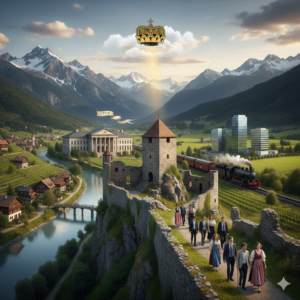
The History of the Principality of Liechtenstein—one of the world’s smallest and wealthiest nations—requires looking back through a tapestry of Holy Roman Empire politics, Alpine survival, and a remarkable 20th-century economic metamorphosis.
1. The Ancient Roots: Raetia and the Romans
Before the name “Liechtenstein” ever appeared on a map, the narrow strip of land between the Rhine and the Alps was inhabited by the Raetians. By 15 BC, the Roman Empire under Augustus conquered the region, integrating it into the province of Raetia.
-
Roman Influence: The Romans built roads that connected the Italian peninsula to the Germanic North. Small settlements and villas dotted the Rhine Valley.
-
The Middle Ages transition: As the Roman Empire collapsed, the area was settled by the Alemanni, a Germanic tribe. By the 8th century, it was integrated into the Frankish Empire under Charlemagne.
2. The Feudal Foundations: Vaduz and Schellenberg
The modern territory of Liechtenstein was originally composed of two distinct feudal estates: the County of Vaduz and the Lordship of Schellenberg.
Throughout the High Middle Ages, these lands were passed between various noble families (such as the Werdenbergs). Life was difficult; the population was primarily composed of subsistence farmers dealing with the unpredictable flooding of the Rhine and the harsh Alpine winters.
3. The Rise of the House of Liechtenstein
The House of Liechtenstein, from which the country takes its name, originated not in the Alps, but in Lower Austria. They were one of the most powerful noble families in the Holy Roman Empire, amassing vast estates in Moravia and Austria.
However, the family faced a political problem: despite their wealth, they did not hold a seat in the Imperial Diet (the Reichstag). To obtain this, they needed to own land held directly from the Holy Roman Emperor, without any intermediate lord.
-
1699: Prince Johann Adam Andreas bought the Lordship of Schellenberg.
-
1712: He purchased the County of Vaduz.
-
January 23, 1719: Emperor Charles VI decreed that Vaduz and Schellenberg be united and elevated to the status of a Principality, named Liechtenstein in honor of his faithful servant, Anton Florian of Liechtenstein.
4. Sovereignty and the Napoleonic Wars
Liechtenstein remained a quiet backwater for its first century. The Princes rarely visited their Alpine lands, preferring the glamor of their palaces in Vienna.
Sovereignty came almost by accident during the Napoleonic era:
-
The Confederation of the Rhine: When Napoleon dissolved the Holy Roman Empire in 1806, he included Liechtenstein in the Confederation of the Rhine. This effectively made Liechtenstein a sovereign state, as it no longer owed allegiance to a central Emperor.
-
Congress of Vienna (1815): Following Napoleon’s defeat, Liechtenstein’s independence was confirmed. It joined the German Confederation, a loose grouping of sovereign states.
5. The Long 19th Century: Poverty and Reform
For much of the 1800s, Liechtenstein was remarkably poor. It lacked industry and was frequently devastated by Rhine floods.
-
The Customs Union (1852): Realizing they could not survive in isolation, Liechtenstein entered a customs treaty with the Austro-Hungarian Empire. This tied their economy to Vienna for the next 70 years.
-
The Constitution of 1862: Prince Johann II (known as “The Good”) granted the first modern constitution, establishing a representative parliament (Landtag), though the Prince retained significant power.
-
Abolition of the Army (1868): In a move that became legendary, Liechtenstein abolished its army of 80 men to save money. They have remained unarmed ever since.
6. World War I and the Great Pivot
The First World War was a catastrophe for Liechtenstein. Because of its close ties to Austria, the country suffered under the Allied economic blockade. Famine and inflation decimated the population.
When the Austro-Hungarian Empire collapsed in 1918, Liechtenstein realized it had to change its orientation to survive.
-
Turning to Switzerland: In the early 1920s, Liechtenstein dissolved its treaty with Austria and signed a series of monumental treaties with Switzerland.
-
The Swiss Connection: They adopted the Swiss Franc (1924) and entered a postal and customs union with Switzerland that remains the backbone of their sovereignty today.
7. World War II: A Neutral Tightrope
Liechtenstein remained neutral during WWII, but its position was precarious. The “National Union” (a small pro-Nazi movement) attempted a coup in 1939 to force an annexation by Germany, but it failed miserably.
Prince Franz Josef II was the first Prince to take up permanent residence in Vaduz Castle (1938), signaling his commitment to defending the land. His presence became a symbol of national identity against the threat of Nazi absorption.
8. The Economic Miracle
Following WWII, Liechtenstein transformed from a peasant agrarian society into one of the most industrialized and wealthy nations in the world.
-
Industrialization: Companies like Hilti (power tools) and Ivoclar Vivadent (dental products) grew into global leaders.
-
Financial Services: Low taxes and strict bank secrecy laws turned the country into a global financial hub.
-
Innovation: Today, Liechtenstein has more registered companies than citizens and boasts one of the highest GDPs per capita on Earth.
9. Modern Liechtenstein: Tradition and Direct Democracy
In 2003, a national referendum granted the Prince expanded powers, making Liechtenstein one of the few European countries where the monarch still wields significant political influence (though the people have the constitutional right to abolish the monarchy at any time).
Today, the country is a member of the UN and the EEA, balancing its historic traditions with a cutting-edge, tech-forward economy.
| Figure | Role | Achievement |
| Prince Johann Adam Andreas | Founder | Purchased the lands that became Liechtenstein. |
| Prince Johann II | Reformer | Ruled for 70 years; granted the 1862 Constitution. |
| Prince Franz Josef II | Protector | Moved the residence to Vaduz; navigated WWII. |
| Prince Hans-Adam II | Modernizer | Led the country into the UN and oversaw the 2003 reforms. |
Visit : www.dkbtech.com. , www.allcircular.com