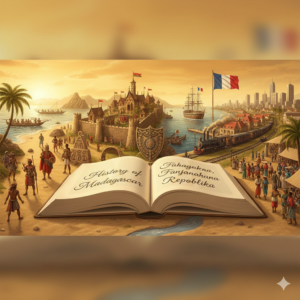
The Great Red Island: A Comprehensive History of Madagascar
Introduction: The Island That Time Forgot
Madagascar is often called the “eighth continent.” Situated in the Indian Ocean off the southeastern coast of Africa, it is the fourth-largest island in the world. Its history is as unique as its biodiversity. While its flora and fauna evolved in isolation for 88 million years, its human history is a fascinating tapestry of Austronesian voyagers, East African migrants, Arab traders, European pirates, and a powerful highland monarchy that eventually fell to French colonial ambitions.
I. Prehistory and the Mystery of First Arrival (2000 BCE – 500 CE)
The Geological Canvas
Before humans arrived, Madagascar was a pristine wilderness. It separated from the Indian subcontinent approximately 88 million years ago, allowing evolution to take a distinct path. This resulted in a land of lemurs, elephant birds, and baobabs—an ecosystem that would eventually be radically altered by human hand.
The First Footprints
For a long time, it was believed that humans arrived in Madagascar around 500 CE. However, recent archaeological finds, including bones of the extinct Aepyornis (elephant bird) with tool marks, suggest that hunter-gatherers may have visited the island as early as 2000 BCE. These were likely transient visitors—foragers from the African mainland—rather than permanent settlers.
The Austronesian Migration
The true “founding” of the Malagasy people occurred between 200 BCE and 500 CE. In one of the most incredible maritime feats in human history, Austronesian-speaking people from the Sunda Islands (modern-day Indonesia, specifically Borneo) crossed the Indian Ocean in outrigger canoes. They didn’t come directly from Africa; they came from across the sea, bringing with them:
-
Rice cultivation (the staple of Malagasy life).
-
Outrigger canoe technology.
-
The Malagasy language, which remains more closely related to languages in Borneo than to any African tongue.
II. The Great Admixture (500 CE – 1500 CE)
The African Arrival
By the 9th century, Bantu-speaking migrants from East Africa began crossing the Mozambique Channel in large numbers. They brought with them Zebu cattle, which became a central symbol of wealth and spirituality in Madagascar. Over centuries, these two primary groups—the Austronesians and the Bantus—intermarried, creating the unique Malagasy ethnic identity.
Arab and Islamic Influence
Arab traders established outposts on the northern coasts by the 10th century. While Islam did not become the dominant religion, it left an indelible mark:
-
The Sorabe alphabet: An Arabic-based script used to write Malagasy before the Latin alphabet was introduced.
-
Astrology and Divination: Many traditional Malagasy practices, like Sikidy, have roots in Arab occult sciences.
-
Trade: Madagascar became a hub for the Indian Ocean trade of slaves, gold, and ivory.
III. The Era of Small Kingdoms and Pirates (1500 – 1780)
European “Discovery”
In 1500, the Portuguese captain Diogo Dias became the first European to sight the island after his ship was blown off course. The Portuguese named it São Lourenço. Throughout the 16th and 17th centuries, the Dutch, English, and French all attempted to establish settlements (such as the French at Fort-Dauphin in 1643), but most failed due to disease and fierce resistance from the local Malagasy.
The Golden Age of Piracy
Because of its strategic location and lack of a central government, the eastern coast of Madagascar (specifically Île Sainte-Marie) became a world-renowned pirate haven. Legendary figures like Captain Kidd and Henry Every used the island as a base to raid treasure-laden ships of the Great Mogul and the East India Company. This era also gave rise to the Zana-Malata, a mixed-race population of pirate-Malagasy descendants who eventually formed the Betsimisaraka confederation.
The Rise of Coastal Kingdoms
Before the central highlands rose to power, coastal kingdoms dominated:
-
The Sakalava: On the west coast, the Sakalava kingdoms of Menabe and Boina used firearms obtained from trade to conquer vast territories.
-
The Betsimisaraka: A powerful confederation on the east coast, unified by Ratsimilaho.
IV. The Rise of the Merina Monarchy (1780 – 1895)
Unification under Andrianampoinimerina
In the late 18th century, a prince named Andrianampoinimerina (whose name means “The Prince Who is the Desire of Imerina”) unified the warring principalities of the central highlands. He established a sophisticated social and legal code and famously declared: “The sea shall be the boundary of my rice field,” signaling his intent to rule the entire island.
Radama I and Modernization
His son, Radama I (1810–1828), invited British missionaries and advisors. Under his reign:
-
The Malagasy language was first written in the Latin alphabet.
-
The army was modernized with European weapons.
-
The slave trade was officially abolished (though replaced by a system of forced labor called fanompoana).
The “Wicked” Queen Ranavalona I
After Radama’s death, his wife Ranavalona I took the throne. Fearing the loss of Malagasy culture and sovereignty, she:
-
Expelled most Europeans and missionaries.
-
Persecuted Malagasy Christians.
-
Successfully repelled a joint Franco-British naval attack in 1845. While Western historians often portrayed her as a “female Caligula,” many modern Malagasy view her as a staunch defender of national independence.
The Fall of the Monarchy
The late 19th century was a “Great Game” between Britain and France. Eventually, the British recognized French claims to Madagascar in exchange for Zanzibar. Despite the efforts of the last three queens and the powerful Prime Minister Rainilaiarivony, the French launched a full-scale invasion in 1894. The capital, Antananarivo, fell in 1895.
V. French Colonial Rule (1896 – 1960)
The Conquest and the Menalamba Revolt
The French officially annexed Madagascar in 1896. This sparked the Menalamba rebellion, a nationalist and traditionalist revolt that was brutally suppressed by General Joseph Gallieni. Queen Ranavalona III was exiled to Algeria, ending the 300-year Merina monarchy.
The Colonial Economy
Under French rule, Madagascar was transformed into a plantation economy. The French built railroads and roads, but largely through forced labor. They introduced coffee, vanilla, and tobacco as export crops.
The 1947 Uprising
The desire for independence peaked after World War II. In 1947, a massive armed rebellion broke out against French rule. It was one of the bloodiest episodes in colonial history; the French military response resulted in the deaths of tens of thousands of Malagasy (estimates range from 11,000 to 80,000). Though the rebellion was crushed, it made Malagasy independence inevitable.
VI. Independence and the Four Republics (1960 – Present)
The First Republic (1960–1972)
Madagascar gained full independence on June 26, 1960. The first president, Philibert Tsiranana, maintained very close ties with France. However, his “neo-colonial” policies led to student protests and a military-backed handover of power in 1972.
The Second Republic and Socialism (1975–1992)
Didier Ratsiraka came to power and established a Marxist-socialist regime. He nationalized industries and severed many Western ties. This period was marked by economic decline and social unrest, eventually leading to a return to multi-party democracy in the early 90s.
The Third and Fourth Republics (1992–Today)
The modern era has been characterized by “cycles of crisis.”
-
2001-2002: A disputed election between Ratsiraka and Marc Ravalomanana led to a stand-off that nearly split the country.
-
2009: A military-backed coup led by Andry Rajoelina (then mayor of the capital) ousted Ravalomanana.
-
Current Status: Madagascar continues to struggle with extreme poverty and political instability, yet remains a vibrant democracy with a resilient population.
Conclusion: The Legacy of a Unique People
The history of Madagascar is a story of survival. From the first paddlers who crossed an ocean to the queens who defied empires, the Malagasy people have maintained a distinct identity. Today, as the country navigates the challenges of the 21st century—from climate change to economic development—it does so with a deep respect for the Razana (ancestors) who shaped this extraordinary land.
________________________________________________________________________________________
Visit: www.dkbtech.com, www.allcircular.com