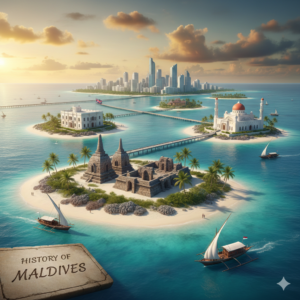
I. Ancient Beginnings and the Buddhist Era (c. 500 BCE – 1153 CE)
The origins of the Maldivian people are shrouded in legend and archaeological mystery. While the islands appear as mere specks on a map, their location at the center of the Indian Ocean made them a vital waypoint for ancient mariners.
1. The First Settlers: Dheyvis and Aryans
The earliest inhabitants of the Maldives are believed to have arrived before 500 BCE. Local folklore speaks of the Dheyvis, a seafaring people who established the first communities. Archaeological evidence, including pottery and tools, suggests these settlers came from South India and Sri Lanka, likely of Dravidian and Indo-Aryan descent.
These early people were likely practitioners of ancient folk religions or early forms of Hinduism. They relied on the “dhoni” (traditional boat) for survival, fishing the abundant reefs and trading cowrie shells—which would later become the “international currency” of the Indian Ocean.
2. The Golden Age of Buddhism
Buddhism arrived in the Maldives around the 3rd century BCE, likely during the expansion of the Mauryan Empire under Emperor Ashoka. For over 1,400 years, the Maldives was a Buddhist kingdom.
-
Archaeological Evidence: Even today, the remains of Buddhist stupas (known locally as usthubu) and monasteries can be found on islands like Fuvahmulah, Gan, and Isdhoo.
-
Cultural Influence: The Maldivian language, Dhivehi, evolved during this period, sharing strong linguistic roots with Elu (an ancient form of Sinhala). The intricate stone carvings found in ruins show a high level of craftsmanship and a deep connection to the artistic traditions of Sri Lanka and India.
By the 10th and 11th centuries, the Maldives was well-known to the world. Roman geographer Ptolemy mentioned the islands in his writings, and Arab travelers began documenting the “Money Isles” due to the wealth of cowries.
II. The Great Transformation: The Conversion to Islam (1153 CE)
3. The History of Maldives: A Journey Through Time
The year 1153 marks the most significant turning point in Maldivian history. The transition from Buddhism to Islam was not just a religious change; it completely restructured the nation’s legal, social, and political identity.
1. The Legend of the Sea Demon
According to Maldivian lore, the conversion was triggered by a terrifying ordeal. The islands were said to be haunted by a sea demon called Rannamaari, who demanded the monthly sacrifice of a virgin.
A North African traveler, Abu al-Barakat Yusuf al-Barbari, offered to take the place of a young girl. He spent the night in the temple reciting the Quran. When the sun rose, the demon was gone, and Abu al-Barakat remained unharmed. Impressed by this power, the reigning King Dhovemi Kalaminja converted to Islam, taking the title Sultan Muhammad al-Adil.
2. The Establishment of the Sultanate
While the legend is colorful, historians suggest the conversion was likely a strategic move to align the Maldives with the powerful Arab trading networks that dominated the Indian Ocean.
-
Social Change: Following the conversion, Buddhist temples were replaced by mosques, including the famous Hukuru Miskiy (Friday Mosque) in Malé, built with intricately carved coral stone.
-
Ibn Battuta’s Visit: In the 1340s, the famous Moroccan traveler Ibn Battuta visited the Maldives and served as a judge (qadi). His writings provide a vivid window into this era, noting the islands’ prosperity and the surprising social freedom of Maldivian women.
III. The Colonial Struggle: Portuguese and Dutch Influence
As European powers began their quest for spice and sea-lane control in the 16th century, the Maldives’ strategic location became a target.
1. The Portuguese Occupation (1558–1573)
The Portuguese, operating out of Goa, seized Malé in 1558. This 15-year period is remembered as one of the darkest in Maldivian history. The Portuguese tried to enforce Christianity and monopolize the trade of ambergris and cowrie shells.
2. The Heroism of Muhammad Thakurufaanu
Resistance was led by the national hero Muhammad Thakurufaanu and his brothers. Using their ship, the Kalhuohfummi, they waged a brilliant eight-year guerrilla war, attacking Portuguese garrisons under the cover of darkness. In 1573, they finally liberated Malé. Thakurufaanu is today celebrated as the “Great Sultan,” and his reign established a long period of independence and stability.
3. The Dutch Hegemony
By the mid-17th century, the Dutch replaced the Portuguese as the dominant power in the region. However, unlike the Portuguese, the Dutch took a “hands-off” approach. The Maldives became a protectorate of the Dutch rulers of Ceylon (Sri Lanka), paying an annual tribute in exchange for protection, while maintaining internal autonomy.
IV. The British Protectorate and the Path to Independence (1887–1965)
In 1796, the British took over Ceylon from the Dutch, and the Maldives naturally shifted into the British sphere of influence.
1. The 1887 Agreement
The status was formalized in 1887 when the Sultan signed a treaty with the British Governor of Ceylon. The Maldives became a British Protectorate. Britain handled foreign affairs and defense but promised not to interfere in local administration.
2. The First Republic (1953)
The mid-20th century saw the first tremors of modern political change. In 1953, the monarchy was briefly abolished, and the First Republic was formed under Mohamed Amin Didi. He was a modernizer who introduced women’s rights and education reforms, but his tenure was short-lived. Due to a severe famine and political opposition, he was ousted within a year, and the Sultanate was restored.
3. Independence (1965)
The push for full sovereignty intensified under Prime Minister Ibrahim Nasir. On July 26, 1965, the Maldives signed an agreement with the United Kingdom, gaining full political independence.
V. The Modern Era: Tourism, Republic, and Reform
After independence, the Maldives underwent a rapid metamorphosis, shifting from a secluded fishing nation to a world-renowned luxury destination.
1. The Second Republic (1968)
In 1968, a national referendum abolished the Sultanate for good. The Second Republic was born, with Ibrahim Nasir as the first President. He focused on infrastructure and education, but his rule became increasingly authoritarian.
2. The Era of Maumoon Abdul Gayoom (1978–2008)
Gayoom’s 30-year presidency was a period of immense stability and economic growth.
-
The Tourism Boom: Starting with the opening of Kurumba in 1972, tourism became the backbone of the economy.
-
The 1988 Coup: In 1988, a group of Sri Lankan mercenaries attempted a coup. President Gayoom requested help from India, leading to Operation Cactus, where Indian paratroopers quickly restored order.
3. The Democratic Transition
By the early 2000s, public demand for democratic reform grew. Following civil unrest, a new constitution was adopted in 2008, leading to the country’s first multi-party elections. Mohamed Nasheed, a former political prisoner, was elected president, marking a historic shift.
VI. Present Day: Resilience and the Climate Challenge
Today, the Republic of Maldives is a nation balancing rapid development with environmental survival. As the lowest-lying country in the world, the threat of rising sea levels is an existential crisis. The history of the Maldives is no longer just about who rules the islands, but about ensuring the islands themselves continue to exist.
Comparison of Key Historical Eras:
| Era | Primary Religion | Governance | Main Trade Item |
| Ancient (c. 500 BCE) | Folk Religions | Tribal/Chiefdoms | Fish, Coconuts |
| Buddhist (c. 300 BCE) | Buddhism | Kings (Radhun) | Cowrie Shells |
| Islamic Sultanate (1153) | Sunni Islam | Sultans | Cowries, Coir, Fish |
| Colonial/Protectorate | Sunni Islam | Sultan (Under British/Dutch) | Dried Fish |
| Modern Republic (1968) | Sunni Islam | President | Tourism, Tuna |
________________________________________________________________________________________
Visit: www.dkbtech.com , www.allcircular.com