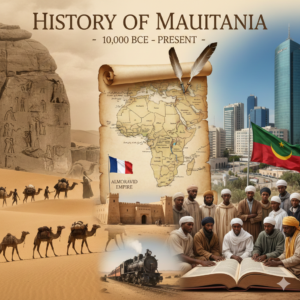
The History of Mauritania requires a deep dive into the shifting sands of the Sahara, the rise of powerful empires, and the complex social fabric of a nation that serves as the bridge between the Arab Maghreb and Sub-Saharan Africa.
1. Prehistoric Foundations: The Green Sahara
Long before the Sahara became the world’s largest hot desert, the region of modern-day Mauritania was a lush, fertile landscape. Between 10,000 BCE and 3,000 BCE, the area was characterized by lakes, rivers, and savannas.
-
Neolithic Inhabitants: Archaeological evidence from sites like the Dhar Tichitt cliffs reveals that early inhabitants were sedentary farmers and herders. They built sophisticated stone-walled settlements and engaged in millet cultivation.
-
Rock Art: The caves and cliffs of the Adrar and Tagant plateaus are home to vibrant rock art depicting giraffes, elephants, and cattle—animals that can no longer survive in the arid climate of today.
-
Desiccation: Around 2,500 BCE, a dramatic climatic shift began. As the Sahara dried up, the sedentary populations began to migrate south toward the Senegal River valley, while nomadic lifestyles became more prevalent in the north.
2. The Berber Migrations and the Sanhaja Confederation
As the environment changed, new groups moved into the territory. The most significant were the Berbers (Amazigh) from North Africa.
By the 3rd century CE, the introduction of the dromedary camel revolutionized the region. The camel allowed for long-distance travel across the desert, leading to the formation of the Sanhaja Berber confederation. This group controlled the lucrative trans-Saharan trade routes, moving salt from the north and gold from the south.
3. The Almoravid Empire (11th Century)
One of the most pivotal moments in Mauritanian history was the rise of the Almoravid movement.
-
The Movement: Founded by Abdallah ibn Yasin, the Almoravids were a militant Islamic reformist movement. They sought to spread a fundamentalist version of Maliki Islam.
-
Conquest: From their base in modern-day Mauritania (likely an island in the Senegal River), they conquered a vast empire stretching from the Senegal River to the Ebro River in Spain.
-
Legacy: The Almoravids were responsible for the definitive Islamization of the region. They also founded the city of Marrakech and left an indelible mark on the architecture and legal systems of North Africa and Andalusia.
4. The Arrival of the Beni Hassan and Arabization
Between the 14th and 17th centuries, the ethnic and linguistic makeup of Mauritania changed again with the arrival of the Beni Hassan, a group of Arab nomads from the Arabian Peninsula (via Egypt and the Maghreb).
The Char Bouba War (1644–1674)
This thirty-year conflict was a struggle for dominance between the indigenous Sanhaja Berbers and the immigrating Beni Hassan Arabs.
-
Outcome: The Arabs emerged victorious. This led to a rigid social hierarchy:
-
Hassan: The warrior class (descendants of the Beni Hassan).
-
Zawaya: The religious and scholarly class (largely of Berber descent).
-
Haratin: Freed slaves or sedentary populations.
-
-
Linguistic Shift: This period saw the spread of Hassaniya, an Arabic dialect that remains the primary language of Mauritania today.
5. The Colonial Era: French Mauritania (1902–1960)
Unlike other parts of Africa, French interest in Mauritania was primarily strategic—to link their holdings in Senegal with those in Morocco and Algeria.
-
Xavier Coppolani: In 1902, the French began a “peaceful penetration” strategy led by Coppolani. He relied on alliances with powerful Marabouts (religious leaders) to gain control.
-
Resistance: Mauritanians did not submit easily. Figures like Sheikh Ma al-Aynin led a fierce decades-long resistance from the north, supported by Moroccan forces.
-
Colonial Status: Mauritania was declared a French territory in 1904 and a colony in 1920. However, it was governed from Saint-Louis in Senegal. It wasn’t until 1957 that the capital was moved to the newly built city of Nouakchott.
6. Independence and the Era of Moktar Ould Daddah
Mauritania gained independence on November 28, 1960. Its first president, Moktar Ould Daddah, faced the daunting task of building a nation from scratch.
-
The Challenge of Unity: Daddah had to balance the interests of the Arab-Berber (Moor) populations in the north with the Black African ethnic groups (Halpulaar, Soninke, and Wolof) in the south.
-
The Western Sahara Conflict: In 1975, Mauritania entered a disastrous war for control over Western Sahara (formerly Spanish Sahara) against the Polisario Front. The war crippled the economy and led to Daddah’s overthrow in a 1978 military coup.
7. Military Rule and Ethnic Tensions
The period from 1978 to 2005 was defined by a series of military juntas.
-
Maaouya Ould Sid’Ahmed Taya (1984–2005): His long presidency was marked by “Arabization” policies that increased tensions between the Moor-led government and Black Mauritanians.
-
The 1989 Border Conflict: A dispute with Senegal escalated into ethnic violence. Thousands of Black Mauritanians were expelled or fled to Senegal, an event that remains a sensitive scar in the nation’s memory.
-
Slavery: Although officially abolished in 1981 (and criminalized in 2007), vestigial forms of traditional slavery and social caste systems have remained a persistent human rights issue.
8. Modern Mauritania: Transitions and Stability
Since 2005, Mauritania has experienced several coups, but it has also seen a trend toward democratic transitions.
-
The 2019 Election: President Mohamed Ould Ghazouani took office in the first peaceful transfer of power between elected leaders since independence.
-
Economic Outlook: The country relies heavily on iron ore exports, fishing, and increasingly, offshore natural gas.
-
Security: In a volatile Sahel region, Mauritania has been recognized for its relatively successful counter-terrorism strategies and regional diplomacy through the G5 Sahel.
Key Historical Figures of Mauritania