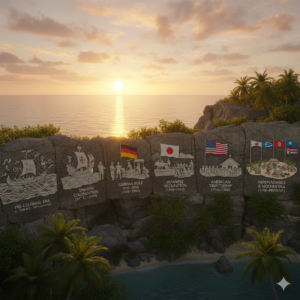
The history of Micronesia is a journey through thousands of years of human migration, sophisticated seafaring, and a complex colonial legacy.
I. The Dawn of the Great Voyagers (c. 2000 BCE – 500 CE)
The story of Micronesia (“Small Islands”) begins not on the islands themselves, but on the vast blue highways of the Pacific. Unlike the settlement of Polynesia, which moved primarily from west to east, the peopling of Micronesia was a multi-directional feat of navigation.
-
The Western Stream: Around 3,500 to 4,000 years ago, seafaring groups from the Philippines and Indonesia reached the western islands of Palau and the Marianas. They brought with them the tradition of pottery (notably the Marianas Redware) and the cultivation of betel nut.
-
The Eastern Stream: Centuries later, migrants from the Solomon Islands and Vanuatu moved northward into the Marshall Islands and Kiribati.
-
Mastery of the Sea: These early Micronesians developed the most sophisticated navigational techniques in human history. Using stick charts (to map ocean swells), star paths, and the flight patterns of birds, they maintained vast trade networks across thousands of miles of open water.
II. The Era of Stone Empires (500 CE – 1500 CE)
As populations grew, complex social hierarchies and monumental architecture emerged. Two sites stand as testaments to this era’s power:
Nan Madol (Pohnpei)
Often called the “Venice of the Pacific,” Nan Madol was the ceremonial and political seat of the Saudeleur Dynasty. Built on 92 artificial islets linked by canals, it was constructed using massive basalt columns. The sheer scale of the ruins suggests a highly organized, centralized state capable of mobilizing immense labor.
Leluh (Kosrae)
A similar, though slightly later, megalithic city was built on Kosrae. Leluh served as the capital for a paramount chief who ruled the entire island, featuring walled compounds and royal tombs that mirrored the social stratification of the time.
III. The Spanish “Lake” and Early Contact (1521 – 1899)
The arrival of Ferdinand Magellan in Guam in 1521 marked the beginning of European intrusion.
-
The Marianas: For over 150 years, Spain ignored much of Micronesia, focusing instead on the “Manila Galleon” trade route. However, in the late 17th century, they began the forceful colonization of the Marianas. This led to the Spanish-Chamorro Wars, which, combined with introduced diseases, decimated the native population.
-
Cultural Fusion: Despite the tragedy, this era created the unique Chamorro identity—a blend of indigenous heritage with Spanish Catholicism and language.
IV. The Era of Four Flags (1899 – 1945)
The late 19th and early 20th centuries saw Micronesia become a pawn in global geopolitics.
-
Germany (1899–1914): Following the Spanish-American War, Spain sold its remaining Micronesian claims (the Carolines and Marshalls) to Germany. The Germans focused on commercial interests, specifically copra (dried coconut meat) production.
-
Japan (1914–1944): At the start of WWI, Japan seized Germany’s Micronesian possessions. Under the South Seas Mandate, Japan aggressively developed the islands, moving in thousands of Japanese, Okinawan, and Korean settlers. By the 1930s, the indigenous population was a minority in many areas.
-
World War II: Micronesia became one of the bloodiest theaters of the Pacific War. Battles at Peleliu, Tarawa, and the devastating “Operation Hailstone” in Chuuk Lagoon (where a whole Japanese fleet was sunk) forever scarred the landscape.
V. The American Trusteeship (1947 – 1986/1994)
After WWII, the UN established the Trust Territory of the Pacific Islands (TTPI), administered by the United States.
-
Nuclear Testing: In one of the darker chapters of this era, the U.S. conducted 67 nuclear tests in the Bikini and Enewetak Atolls (Marshall Islands) between 1946 and 1958. The environmental and health impacts remain a major issue today.
-
The Move Toward Sovereignty: In the 1970s, the different districts of the TTPI began to chart their own futures. This led to the formation of four distinct political entities:
-
The Commonwealth of the Northern Mariana Islands (CNMI): Chose to remain a U.S. territory.
-
The Federated States of Micronesia (FSM): Independent in 1986.
-
The Republic of the Marshall Islands (RMI): Independent in 1986.
-
The Republic of Palau: Independent in 1994.
-
VI. Micronesia Today: Modern Challenges
Modern Micronesia is defined by the Compact of Free Association (COFA) agreements with the U.S., which provide economic aid and defense in exchange for U.S. military access.
Today, the region faces existential threats from climate change and rising sea levels, which threaten the very existence of low-lying atolls like those in Kiribati and the Marshall Islands. Yet, the spirit of the voyagers remains; Micronesians continue to revitalize their traditional seafaring skills and fight for “climate justice” on the world stage.
_________________________________________________________________________________________
Visit: www.dkbtech.com, www.allcircular.com