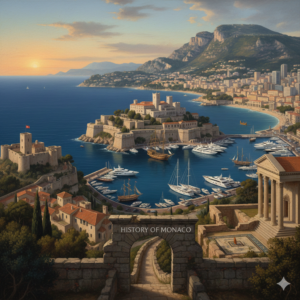
The history of Monaco is a saga of survival, strategic brilliance, and the enduring legacy of the House of Grimaldi. Despite its minuscule size, this Mediterranean enclave has navigated centuries of European power struggles to become one of the most prosperous and glamorous nations on Earth.
Ancient Foundations: The Rock of Hercules
Before it was a playground for the wealthy, the Rock of Monaco was a site of religious and strategic significance.
-
Ancient Settlements: Evidence of human life in the Saint Martin’s Gardens dates back to the Stone Age.
-
The Greeks and Phoenicians: Founded by the Phocaeans of Massalia in the 6th century BCE, the colony was named Monoikos. The name, roughly translating to “Single House,” reflected the area’s isolation and self-sufficiency.
-
The Legend of Hercules: Ancient myths claim Hercules passed through the region, leading to the naming of its largest harbor, Port Hercule. During the Roman era, the Rock served as a vital naval outpost until the collapse of the Western Roman Empire in 476 CE.
The Birth of the Fortress (1191–1215)
The modern history of Monaco began not with a prince, but with a wall.
-
Genoese Control: In 1191, Holy Roman Emperor Henry VI granted suzerainty over the area to the Republic of Genoa.
-
The First Stone: On June 10, 1215, a detachment of Genoese Ghibellines began constructing a fortress atop the Rock. To attract settlers to this remote military outpost, they offered land grants and tax exemptions—a precursor to Monaco’s future as a tax haven.
The Grimaldi Dynasty: “Malizia” and the Monk
The Grimaldi family, prominent Guelphs from Genoa, entered the scene during the civil strife between the Guelphs (pro-papal) and Ghibellines (pro-imperial).
The Legend of 1297: On January 8, 1297, François Grimaldi, nicknamed Malizia (“The Cunning”), disguised himself as a Franciscan monk to gain entry to the fortress. Once inside, he and his cousin Rainier I opened the gates for their soldiers and seized the Rock. This event is immortalized on the Monégasque coat of arms, which features two monks wielding swords.
Although the Grimaldis lost and regained control several times over the next century, they secured permanent rule by 1419, when they purchased the Rock from the Crown of Aragon.
Sovereignty and Alliances (1524–1814)
Survival for a tiny state required shifting alliances with Europe’s giants:
-
Spanish Protectorate (1524–1641): Under the Treaty of Burgos, Monaco sought protection from Spain. During this time, the Grimaldis began using the title of “Prince” to assert equality with European royalty.
-
The French Alliance (1641): Prince Honoré II negotiated the Treaty of Péronne with King Louis XIII of France. This ended Spanish influence, secured French protection, and guaranteed Monaco’s sovereignty.
-
The French Revolution: The Grimaldis were deposed in 1793 when revolutionary France annexed the territory, renaming it “Fort Hercule.” The family’s treasures were dispersed, and they remained in exile until the fall of Napoleon in 1814.
The Invention of Monte Carlo (1861–1910)
In 1861, Monaco lost 95% of its territory (the towns of Menton and Roquebrune) to France. Facing bankruptcy, Prince Charles III made a desperate, visionary gamble.
-
The Casino: In 1863, the Société des Bains de Mer was created, and the Monte Carlo Casino opened its doors.
-
The Railway: The arrival of the French railway in 1868 brought the European elite to the “Spélugues” plateau, which Charles III renamed Monte Carlo in his own honor.
-
Economic Boom: The casino was so successful that by 1869, Charles III abolished direct taxation for his citizens, a policy that remains a cornerstone of the Monégasque identity.
The 20th Century: The “Builder Prince” and Grace Kelly
Monaco’s modern transformation was guided by two pivotal figures: Prince Albert I and Prince Rainier III.
-
-
Prince Albert I (The Scientist): Known as the “Scholar Prince,” he founded the world-renowned Oceanographic Museum and granted Monaco its first constitution in 1911.
-
Prince Rainier III (The Builder): Acceding in 1949, Rainier III oversaw massive land reclamation projects, expanding the country’s territory by 20%.
-
The Wedding of the Century: In 1956, Rainier III married American actress Grace Kelly. This union brought global glamour to the principality, cementing its status as a premier destination for the international “jet set.”
-
Monaco Today
Under the reign of Prince Albert II (since 2005), Monaco has shifted its focus toward environmental sustainability and transparent banking.
| Key Milestone | Year | Significance |
| UN Membership | 1993 | Official recognition as a sovereign state by the global community. |
| Euro Adoption | 2002 | Phased out the French Franc; linked Monaco to the European economy. |
| New Constitution | 2002 | Updated succession laws to include females and their descendants. |
Today, Monaco remains a unique constitutional monarchy—a tiny, sovereign “Single House” that has survived the rise and fall of empires to remain a symbol of prestige and independence.
________________________________________________________________________________________
Visit: www.dkbtech.com , www.allcircular.com