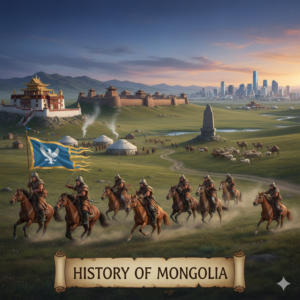
The history of Mongolia is a vast tapestry of nomadic migration, imperial conquest, and ideological transformation. From the early confederations of the steppe to the global shockwaves of the Mongol Empire and the modern transition to democracy, the Mongolian story is one of resilience and adaptation.
1. Ancient Roots and the “First Empires”
Long before the name “Mongol” appeared in records, the high plateaus of Central Asia were home to sophisticated nomadic cultures. The harsh climate—extreme winters and arid summers—demanded a lifestyle based on pastoralism.
-
The Xiongnu (209 BC – 93 AD): The first major nomadic confederation to challenge the settled dynasties of China. Under leaders like Modu Chanyu, they established a power structure that would serve as a blueprint for future steppe empires. The Great Wall of China was largely expanded and connected specifically to keep the Xiongnu at bay.
-
Successive Steppe Powers: After the Xiongnu came the Xianbei, the Rouran (who first used the title “Khan”), and the Göktürks. These groups refined horse-based warfare and the “Ortoo” (postal relay) systems that allowed for communication across vast distances.
2. The Era of Chinggis Khan (1206–1227)
The birth of Temüjin (later Chinggis Khan) in 1162 marked a turning point in world history. At the time, the Mongol tribes were fractured, engaged in endless blood feuds.
-
Unification: Through a combination of brilliant diplomacy, meritocratic promotion, and military genius, Temüjin united the “people of the felt walls.” In 1206, a khuriltai (assembly) proclaimed him Chinggis Khan (Universal Ruler).
-
The Great Law (Yassa): He implemented a strict code of laws that forbade kidnapping women, livestock theft, and religious persecution—extraordinary for the 13th century.
-
Expansion: The Mongol army, composed of the world’s finest light cavalry, began a series of campaigns that conquered Northern China (the Jin Dynasty), Central Asia (the Khwarazmian Empire), and reached into the Caucasus.
3. The World Empire and Pax Mongolica
Following Chinggis Khan’s death in 1227, the empire reached its greatest extent under his successors, notably Ögedei, Möngke, and Kublai Khan.
-
The Four Khanates: The empire eventually split into four major realms:
-
The Golden Horde (Russia and Eastern Europe)
-
The Chagatai Khanate (Central Asia)
-
The Ilkhanate (Persia/Middle East)
-
The Yuan Dynasty (China and Mongolia)
-
-
The Pax Mongolica: For a century, the “Mongol Peace” allowed the Silk Road to flourish. Ideas, technology (like gunpowder and the compass), and trade flowed safely from East to West.
-
Kublai Khan: He moved the capital to Khanbaliq (modern Beijing) and founded the Yuan Dynasty, becoming the first non-Chinese ruler to conquer all of China.
4. Fragmentation and the Qing Era
By the mid-14th century, the empire began to collapse due to the Black Death, succession crises, and overextension. In 1368, the Mongols were driven out of China, retreating to their homeland to form the Northern Yuan.
-
The Buddhist Conversion: In the 16th century, Altan Khan invited the Dalai Lama to Mongolia, leading to a massive conversion to Tibetan Buddhism. This fundamentally altered Mongolian society, as thousands of men became monks (lamas).
-
Manchu Rule (1691–1911): Seeking protection from internal rivals (the Oirats), the Khalkha Mongols submitted to the Qing Dynasty. For over 200 years, Mongolia was a province under Manchu oversight, though it maintained a degree of cultural autonomy.
5. Modern Independence and the Socialist Era
The collapse of the Qing Dynasty in 1911 gave Mongolia the chance to reclaim its sovereignty.
-
The Bogd Khanate (1911): Mongolia declared independence under the 8th Bogd Gegeen, a spiritual leader. However, it faced continued pressure from China and the Russian Civil War.
-
The 1921 Revolution: With Soviet help, Mongolian revolutionaries led by Damdin Sükhbaatar drove out Chinese and “White Russian” forces.
-
The People’s Republic (1924–1990): Mongolia became the world’s second socialist state. This era brought modernization, literacy, and healthcare, but also dark chapters: the Stalinist purges of the 1930s saw the destruction of hundreds of monasteries and the execution of thousands of monks and intellectuals.
6. The Democratic Revolution (1990 – Present)
In 1990, inspired by global movements, Mongolians engaged in peaceful hunger strikes and protests in Ulaanbaatar. Unlike many of its neighbors, the transition from Communism to Democracy was achieved without a single drop of blood.
Today, Mongolia is a vibrant democracy with a thriving market economy, known for its “Third Neighbor” policy—seeking strong ties with countries like the US, Japan, and the EU to balance the influence of its two giant neighbors, Russia and China.
________________________________________________________________________________________
Visit: www.dkbtech.com, www.allcircular.com