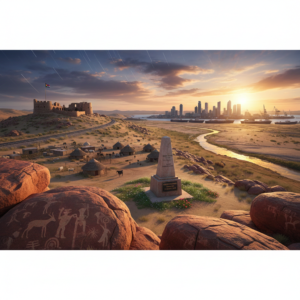
1. Pre-Colonial Namibia: The Cradle of the San
Namibia’s human history begins with the San (Bushmen), who have inhabited the region for at least 25,000 years. Their legacy is etched into the landscape at sites like Twyfelfontein, a UNESCO World Heritage site featuring thousands of rock engravings.
Understanding the History of Namibia allows us to appreciate its rich cultural heritage and the resilience of its people.
The Great Migrations
By the 9th century AD, various Bantu-speaking groups began migrating into the region:
-
The Damara: One of the oldest groups, their origins are still debated by historians.
-
The Nama: A Khoikhoi group that migrated from the south (modern-day South Africa).
-
The Herero: Pastoralists who arrived with large herds of cattle, settling in the central and northern regions.
-
The Ovambo: Agriculturalists who settled in the fertile northern floodplains (Cuvelai basin).
The History of Namibia is marked by the arrival of diverse groups contributing to its complex social fabric.
2. The Dawn of Colonialism (1800s)
Before formal colonization, Namibia (then known as South West Africa) was a land of shifting alliances and conflict over grazing land.
The History of Namibia during the colonial period is filled with both conflict and cultural exchange.
-
The Oorlam Incursions: Led by Jonker Afrikaner, the Oorlam people (descendants of Nama and Dutch settlers) arrived with horses and guns, establishing a powerful hegemony centered in Windhoek.
In exploring the History of Namibia, one must not overlook the impact of missionary work on local communities.
-
The Missionaries: London and Rhenish Missionary Societies arrived in the mid-1800s, introducing Christianity and western education, but also inadvertently paving the way for European influence.
3. German South West Africa (1884–1915)
In 1884, at the Berlin Conference, the region was declared a German protectorate. German rule was characterized by the seizure of land and cattle, leading to immense tension.
The Herero and Nama Genocide (1904–1908)
Resistance culminated in a massive uprising. Under the command of Lothar von Trotha, German forces issued “Extermination Orders.”
The tragedy of the Herero and Nama genocide is a crucial chapter in the History of Namibia.
-
Battle of Waterberg: Herero forces were defeated and driven into the Omaheke Desert, where thousands died of thirst.
-
Shark Island: One of the world’s first concentration camps was established at Lüderitz to imprison Nama and Herero survivors.
-
Casualties: It is estimated that 80% of the Herero population and 50% of the Nama population were killed.
4. South African Mandate and Apartheid
Post-genocide, the History of Namibia shifted as South Africa took control, impacting its governance.
During World War I, South Africa (acting for the British Empire) captured the territory. In 1920, the League of Nations granted South Africa a “C-class mandate” to administer the land.
The Extension of Apartheid
Despite the mandate’s goal of “promoting the well-being” of the inhabitants, South Africa began implementing Apartheid policies:
Understanding the History of Namibia reveals the hardships faced by its people under apartheid.
-
Homelands (Bantustans): Black Namibians were moved to impoverished “reserves” while the best farmland was reserved for whites.
-
Contract Labor: A system that forced men to leave their families for months to work in mines and on farms for pittance.
5. The Struggle for Liberation (1960–1990)
Resistance took a formal turn in 1960 with the formation of SWAPO (South West Africa People’s Organisation), led by Sam Nujoma.
The Border War
The History of Namibia saw significant international involvement as it sought independence.
In 1966, the UN revoked South Africa’s mandate, but South Africa refused to leave. This sparked the Namibian War of Independence, primarily fought in the north (Ovamboland) and across the border in Angola.
International Pressure
The 1980s saw escalating international sanctions and the famous Battle of Cuito Cuanavale in Angola, which proved that the South African military could be challenged. Under the UN Transition Assistance Group (UNTAG), Namibia finally moved toward elections.
The 1980s were pivotal in shaping the History of Namibia as global pressures mounted against apartheid.
6. Independence and Modern Namibia (1990–Present)
On March 21, 1990, Namibia became an independent nation. Sam Nujoma was sworn in as the first president.
The emergence of Namibia as an independent state is a key moment in the History of Namibia.
Key Milestones:
-
Constitution: Namibia adopted one of the most democratic and environmentally progressive constitutions in the world.
-
Walvis Bay: The strategic deep-water port was finally handed back to Namibia by South Africa in 1994.
-
Stability: Unlike many of its neighbors, Namibia has maintained a peaceful, multi-party democracy for over three decades.
Today, Namibia faces challenges like extreme income inequality and land reform, yet it remains a global leader in wildlife conservation and a burgeoning hub for green hydrogen energy.
Today, the History of Namibia continues to evolve as it tackles modern challenges and opportunities.
______________________________________________________________________________________
Visit : www.dkbtech.com , allcircular.com