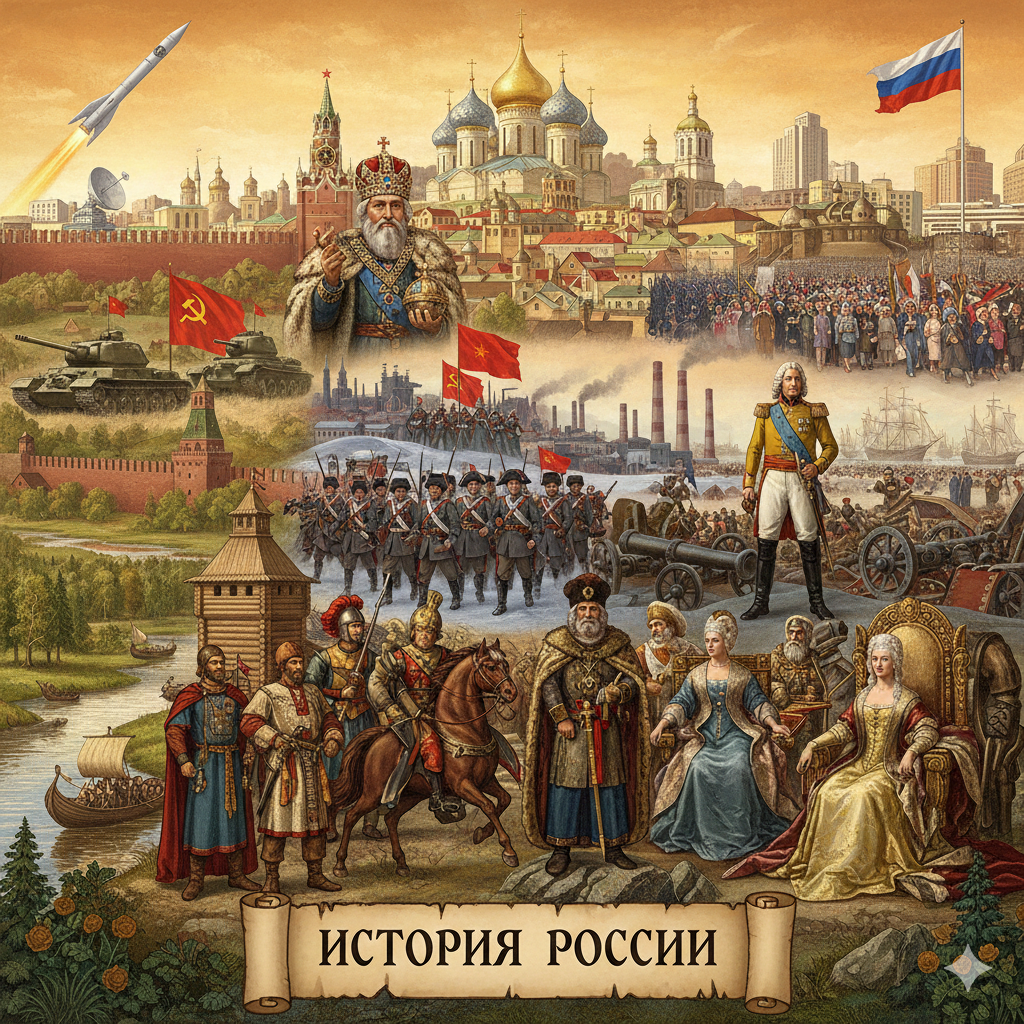
The history of Russia can be broadly divided into seven major eras:
Kievan Rus’ (c. 862–1240) – The Foundation 
-
- A. East Slavs and Early Settlements: Indigenous tribes, Viking (Varangian) influence, trade routes (the “Route from the Varangians to the Greeks”).
-
- B. The Rise of Kyiv: Oleg and the consolidation of power.
-
- C. Christianization (988): Vladimir the Great, adoption of Orthodox Christianity, cultural impact (alphabet, art, architecture).
-
- D. Yaroslav the Wise: Zenith of power, Russkaya Pravda (first legal code).
-
- E. Fragmentation: Princely feuds and decline of Kyiv.
The Period of Fragmentation and Mongol Yoke (1240–1480) 
-
- A. Mongol Invasion (1237–1240): Batu Khan and the destruction of Kievan Rus’.
-
- B. The Golden Horde: Yoke (taxation and tribute) and indirect rule.
-
- C. Rise of Regional Centers:
-
- Novgorod: Independent city-state, democratic traditions, Alexander Nevsky.
-
- Vladimir-Suzdal: Shift of power to the Northeast.
-
- Moscow: Its strategic, modest beginnings and alliance with the Orthodox Church.
-
- C. Rise of Regional Centers:
The Rise of Muscovy (1480–1613) – Gathering the Russian Lands 
-
- A. Ivan III (the Great): End of the Mongol Yoke (1480), tripling of territory, adoption of the Byzantine imperial tradition (Moscow as the “Third Rome”).
-
- B. Ivan IV (the Terrible):
-
- Zemshchina and Oprichnina: Internal terror and centralizing power.
-
- Conquests: Kazan and Astrakhan, expansion eastward.
-
- B. Ivan IV (the Terrible):
-
- C. The Time of Troubles (1598–1613): Dynastic crisis (end of Rurikids), famine, civil war, Polish and Swedish intervention.
The Romanov Dynasty and the Russian Empire (1613–1917) 
-
- A. Early Romanovs (Mikhail, Alexis): Stabilization, legal consolidation of serfdom (Ulozhenie of 1649), Raskol (schism) in the Church.
-
- B. Peter the Great (1682–1725):
-
- Westernization and Modernization: Reforms in the military, administration, and culture.
-
- Great Northern War: Defeat of Sweden, securing the Baltic coast.
-
- Founding of St. Petersburg: Shift of the capital, creation of the Empire.
-
- B. Peter the Great (1682–1725):
-
- C. The Age of Palace Revolutions and Catherine the Great (1762–1796):
-
- Enlightened Absolutism: Territorial expansion (Crimea, partitions of Poland), increased power of the nobility.
-
- C. The Age of Palace Revolutions and Catherine the Great (1762–1796):
-
- D. The 19th Century: Conservatism and Reform:
-
- Napoleonic Wars: The Patriotic War of 1812.
-
- The Decembrist Revolt (1825): First organized revolutionary challenge.
-
- Alexander II (1855–1881): Emancipation of the Serfs (1861), Zemstvo (local self-government) reforms.
-
- Industrialization and Revolutionary Movements: Rise of populism, socialism, and Marxism.
-
- Nicholas II: Russo-Japanese War, 1905 Revolution and the creation of the Duma.
-
- D. The 19th Century: Conservatism and Reform:
The Collapse of the Empire and the Revolutions (1917–1922) 
-
- A. World War I: Military setbacks, economic strain, and collapse of morale.
-
- B. The February Revolution (1917): Abdication of Nicholas II, Provisional Government established.
-
- C. The October Revolution (1917): Bolshevik coup d’état led by Lenin.
-
- D. Russian Civil War (1917–1922): Reds vs. Whites, foreign intervention, War Communism.
-
- E. Formation of the USSR (1922).
The Soviet Union (1922–1991) ☭
-
- A. Lenin’s Years: New Economic Policy (NEP).
-
- B. The Stalinist Era (1924–1953):
-
- Collectivization and Industrialization: Five-Year Plans.
-
- The Great Purge (Terror): Gulags and political repression.
-
- World War II (The Great Patriotic War): Pivotal role in defeating Nazi Germany, immense casualties.
-
- B. The Stalinist Era (1924–1953):
-
- C. The Cold War and De-Stalinization (Khrushchev): Space Race, Cuban Missile Crisis, “Secret Speech.”
-
- D. The Stagnation Era (Brezhnev): Economic decline, military buildup, invasion of Afghanistan.
-
- E. Collapse of the USSR (Gorbachev): Perestroika (restructuring) and Glasnost (openness), Chernobyl, coup attempt, dissolution in 1991.
The Russian Federation (1991–Present) 
-
- A. The Yeltsin Era: “Shock Therapy” (economic reforms), constitutional crisis, Chechen Wars.
-
- B. The Putin Era: Consolidation of power, stabilization of the economy (due to oil prices), shift towards greater state control, foreign policy (Georgia, Ukraine).
-
- C. Contemporary Russia: Current challenges and place in the world.
Kievan Rus’ and the Foundation of the Russian State (Part I)
The history of Russia is not merely the chronicle of a state, but the complex, often violent, and immensely resilient evolution of a vast, multi-ethnic civilization whose geopolitical destiny was forged at the crossroads of Europe and Asia. From its foundational beginnings in the muddy banks of the Dnieper River to the sprawling, modern state it is today, the Russian narrative is one marked by periods of cultural blossoming interspersed with crushing foreign domination and titanic, often brutal, efforts at modernization and centralization.
Kievan Rus’ (c. 862–1240) – The Foundation
The story of the Russian state, in its earliest recognizable form, begins with the East Slavs, a collection of related tribal groups inhabiting the forest-steppe regions of Eastern Europe. By the 8th and 9th centuries, these groups were engaged in rudimentary agriculture and extensive fur trapping, but lacked a unified political structure. Their world, however, was already being shaped by two great currents: the southern trade route running from the Baltic Sea to the Black Sea, and the influence of the Scandinavian warrior-traders known as the Varangians (or Vikings).
The Primary Chronicle, the foundational historical text of the region, posits the legendary “calling of the Varangians” in 862 AD, an event often viewed as the semi-mythical beginning of Russian statehood. According to the legend, the feuding Slavic tribes invited the Varangian chieftain Rurik to rule them, seeking a strong external figure to establish order. Rurik settled in Novgorod, establishing a dynasty that would rule the nascent Russian state for over seven centuries.
The true consolidation of power, however, occurred with Rurik’s successor, Oleg (d. 912), who led his forces south, seizing the critical city of Kyiv around 882 AD. Kyiv’s strategic location on the Dnieper River and its proximity to the wealthy Byzantine Empire made it the political and commercial heart of the new polity, which historians term Kievan Rus’. Oleg launched successful military campaigns, culminating in profitable treaties with Constantinople, securing the economic viability and diplomatic recognition of the new state. This period was characterized by a loose federation of principalities, with the Grand Prince of Kyiv nominally supreme over the various local rulers—often his own relatives, the Rurikid princes.
The defining moment of Kievan Rus’, and arguably of all subsequent Russian history, was the Christianization of Rus’ in 988 AD under Prince Vladimir I (the Great). Legend states that Vladimir, seeking a unifying state religion, considered Judaism, Islam, and various forms of Christianity before choosing the Byzantine Rite of Orthodox Christianity. This decision was a powerful geopolitical and cultural stroke. It immediately placed Rus’ within the Byzantine cultural sphere, importing not only religion but also a sophisticated system of written law, architecture, icon painting, and the Cyrillic alphabet. The adoption of Orthodoxy provided the disparate Slavic tribes with a potent shared identity and a powerful, centralized church structure that would prove crucial in maintaining national cohesion through future trials.
The zenith of Kievan Rus’ came during the reign of Yaroslav the Wise (1019–1054). Yaroslav codified the first Slavic legal system, the Russkaya Pravda (Russian Justice), built magnificent cathedrals like the Saint Sophia in Kyiv, and fostered extensive diplomatic and trade ties across Europe. His reign symbolized a golden age of stability and cultural achievement. However, even during this time, the seeds of future fragmentation were sown. Following Yaroslav’s death, the lestvichnaya (ladder) system of succession, where power passed laterally through brothers and then down to cousins, rather than directly from father to son, led to nearly constant, debilitating princely feuds over the throne of Kyiv. By the 12th century, the economic and political center of power began to shift away from the Dnieper, and Kievan Rus’ splintered into a dozen effectively independent principalities, making it tragically vulnerable to external threats.
The Period of Fragmentation and Mongol Yoke (1240–1480)
The vulnerability born of fragmentation was brutally exploited in the 13th century. In 1237, the Mongol armies of the Golden Horde, led by Batu Khan, swept westward out of Asia. Their lightning-fast campaign was devastating. City after city—Ryazan, Vladimir, Suzdal—was sacked and burned. In 1240, the magnificent city of Kyiv itself fell, marking a definitive end to the first period of Russian statehood. The Mongols did not fully occupy the Russian lands, but instead established the so-called “Mongol Yoke” (or Tatar Yoke), a system of indirect rule.
The Russian principalities were compelled to pay annual, heavy tribute (the vykhod) and required their princes to travel to the Horde’s capital, Sarai, to receive a yarlik (patent or charter) authorizing their rule. This arrangement had several profound, long-term consequences:
-
- Isolation from the West: The Yoke effectively cut the Russian lands off from the political and cultural developments of the Renaissance and Reformation, reinforcing the Byzantine Orthodox identity and fostering an enduring sense of separation from Catholic Europe.
-
- Increased Centralization: Mongol rule demanded princes be ruthless and efficient in collecting taxes. Those who cooperated, such as the princes of the increasingly important Muscovy, were rewarded with greater authority, which they used to consolidate power over their rivals.
-
- The Rise of Moscow: The power vacuum left by the destruction of Kyiv led to the ascendancy of new centers. One of the most important was the principality of Muscovy (Moscow). Its location in the dense forests offered some protection from Mongol raids. More crucially, the early Muscovite princes, beginning with Ivan I (Kalita, c. 1325–1340), proved exceptional diplomats. They gained the Mongol trust to become the chief tax collectors for the Horde and successfully convinced the head of the Russian Orthodox Church (the Metropolitan) to relocate his seat to Moscow, thereby cementing the city’s status as the spiritual capital of the Russian lands.
Parallel to the rise of Muscovy, the northwest city-state of Novgorod maintained a remarkable degree of independence. A thriving commercial center, Novgorod was a rare example of a Russian city with strong veche (assembly) traditions, making it more politically democratic and less affected by Mongol devastation than its southern counterparts. It was from Novgorod that the legendary prince Alexander Nevsky defeated the invading Swedes (1240) and Teutonic Knights (1242), victories that, in the Russian historical narrative, preserved the Orthodox faith and the integrity of the western borders. Nevsky’s strategy of pragmatic submission to the Mongols while fighting Catholic invaders solidified the long-standing Russian identification of Orthodox faith with state survival.
By the late 14th and 15th centuries, as the Golden Horde weakened through internal conflicts and dynastic struggles, the Muscovite princes grew bolder. A significant, though temporary, victory came at the Battle of Kulikovo Field in 1380, where Dmitry Donskoy led a united Russian army against the Mongols, demonstrating the growing military strength and unity under Moscow’s leadership. The final, formal end of the Mongol Yoke came in 1480 under Ivan III (the Great), the Grand Prince of Moscow.
The Rise of Muscovy (1480–1613) – Gathering the Russian Lands
The reign of Ivan III (1462–1505) marks the true beginning of the centralized Russian state. Having officially thrown off the Mongol dominion in 1480, Ivan set about the deliberate policy of “gathering the Russian lands,” annexing the vast territories of Tver, Yaroslavl, and most importantly, the wealthy republic of Novgorod in 1478. He tripled the size of the Muscovite state and established the foundation of an absolute monarchy.
Ivan III consciously adopted the trappings of imperial power from the recently fallen Byzantine Empire (Constantinople fell to the Ottomans in 1453). By marrying Sophia Palaiologina, niece of the last Byzantine Emperor, he claimed the mantle of Orthodox leadership. He introduced the double-headed eagle (the Byzantine symbol) as the state emblem and adopted the title of Tsar (Caesar). Moscow was now proclaimed the “Third Rome”—the spiritual and political successor to Rome and Constantinople—a powerful ideological claim that underpinned the legitimacy and messianic role of the Russian state for centuries to come.
Ivan’s grandson, Ivan IV (The Terrible) (r. 1533–1584), formally crowned himself the first Tsar of All Rus’ in 1547, and his reign represents the crystallization of Russian absolutism, albeit through terrifying means. Ivan IV began his rule with constructive reforms, convening the Zemsky Sobor (Assembly of the Land), reforming the legal code, and creating a standing army. Crucially, he oversaw massive territorial expansion, conquering the Tatar Khanates of Kazan (1552) and Astrakhan (1556), giving Russia control of the entire Volga River and opening the path for expansion deep into Siberia.
However, Ivan’s reign descended into a period of extreme personal tyranny. Following the death of his first wife and a period of increasing paranoia, Ivan initiated the Oprichnina (1565–1572). He divided Russia into two territories: the Zemshchina (the general populace) and the Oprichnina (his personal domain). He created a ruthless, black-clad secret police, the Oprichniki, who executed thousands of boyars (nobles) and peasants, destroying entire cities like Novgorod and Tver, which he suspected of treason. This systematic state terror effectively broke the power of the independent aristocracy, replacing them with a service nobility loyal only to the Tsar, thus centralizing power to an unprecedented and brutal degree.
The Rurikid dynasty tragically ended in 1598 with the death of Ivan IV’s son, Feodor I, leaving no heir. This ushered in a catastrophic period known as the Time of Troubles (1598–1613). The crisis was manifold:
-
- Dynastic Crisis: Contested claims to the throne, including the rise of False Dmitrys (impostors claiming to be Ivan IV’s dead son).
-
- Social Upheaval: Famine, peasant revolts (led by figures like Bolotnikov), and the rise of banditry.
-
- Foreign Intervention: Polish and Swedish armies invaded, occupying Moscow itself.
The crisis was ultimately resolved not by the nobles or the existing government, but by a popular national and religious resistance. Citizens, merchants, and landowners, rallied by the Orthodox Church and led by the merchant Kuzma Minin and Prince Dmitry Pozharsky, raised a volunteer army that successfully expelled the Polish invaders from Moscow in 1612. This victory paved the way for the Zemsky Sobor to elect a new Tsar in 1613: Mikhail Romanov, a distant relative of Ivan IV’s first wife, thus establishing the Romanov Dynasty that would rule Russia until 1917.
visit www.dkbtech.com