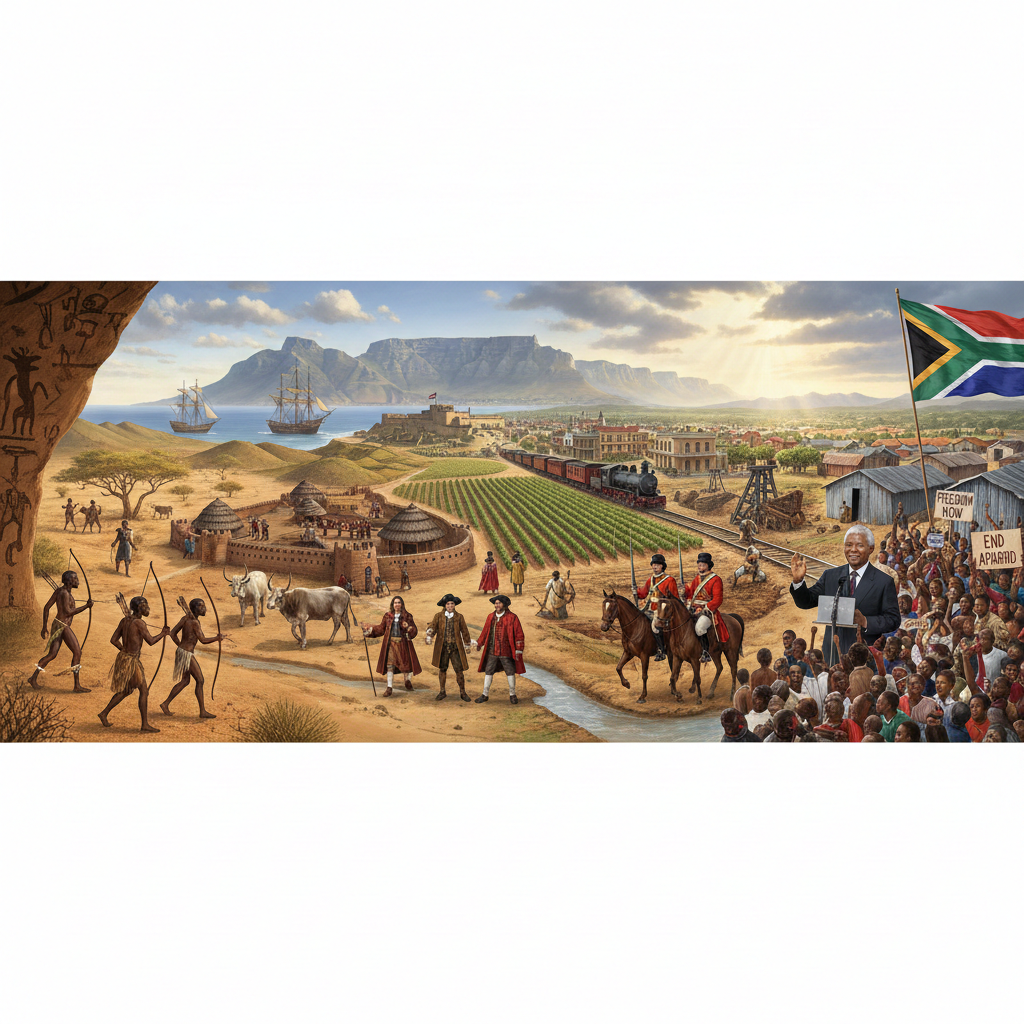
1. Pre-Colonial and Early Settler Period (Up to 1800)
The History of South Africa is one of the longest in the world, stretching back millions of years with evidence of early hominids. The human history of the region is defined by successive waves of migration and interaction among diverse groups.
The First Peoples: San and Khoikhoi
The earliest known inhabitants of South Africa were the San (hunter-gatherers, often referred to as Bushmen) and the Khoikhoi (pastoralists, often referred to as Hottentots). Together, these groups are known as the Khoisan. The San, with a deep history in the region, were expert nomadic hunters. The Khoikhoi arrived later, bringing domestic livestock and establishing a pastoral lifestyle, primarily along the coast. Their distinctive click languages and rock art are a testament to a vibrant, ancient culture.
The Arrival of the Bantu-Speakers
Around 2,000 years ago, Bantu-speaking agriculturalists began migrating south from central and western Africa. These groups, ancestors of the modern Zulu, Xhosa, Sotho, Tswana, Pedi, and others, brought with them ironworking technology, mixed-farming practices (crop cultivation and livestock), and permanent villages. They settled in the eastern and southern parts of the country, establishing powerful chiefdoms and complex social structures. By the 15th and 16th centuries, these groups had reached the Great Fish River in the Eastern Cape, setting a rough boundary between the expanding agricultural societies and the pastoral Khoisan closer to the Cape.
The Dutch East India Company (VOC) at the Cape (1652-1795)
The modern history of South Africa began dramatically in 1652 with the arrival of the Dutch East India Company (VOC) under Jan van Riebeeck. The initial purpose was not colonization but the establishment of a revictualling station (a refreshment post) at the Cape of Good Hope for ships traveling between the Netherlands and the East Indies.
-
- Settlement and Expansion: The settlement quickly grew beyond a mere post. Land was needed for cultivation, leading to the First Khoikhoi-Dutch War in 1659. The Khoikhoi were decimated by European diseases (especially smallpox), warfare, and the loss of their grazing lands, leading to the collapse of their societies.
-
- Slavery: To meet the labor demands of the growing colony, the VOC imported thousands of slaves from Indonesia, India, Ceylon, Madagascar, and East Africa. This labor force became the foundation of the Cape economy and society. The Cape Malay community is a direct descendant of these slave and political exile populations.
-
- The Trekboers: As the settlement expanded, Dutch farmers, known as Boers (later Trekboers as they moved inland), moved away from the Company’s control. These independent, Calvinist, and self-sufficient farmers moved into the interior, seeking grazing land, which brought them into increasing conflict with both the Khoisan and the southward-moving Bantu-speaking groups, particularly the Xhosa.
-
- The Xhosa Wars (Mfecane Context): The frontier between the colonists and the Xhosa became a zone of increasing tension. A series of nine frontier wars, known as the Cape Frontier Wars or Xhosa Wars, took place between 1779 and 1879. These clashes, primarily over land and cattle, are the longest-running military conflict in South African history and mark the beginning of the long struggle for control over the land.
2. British Rule and the Great Trek (1800-1870)
The geopolitical landscape of the Cape changed dramatically with the rise of British global power.
British Acquisition of the Cape
During the Napoleonic Wars, Great Britain seized the Cape Colony from the Dutch to prevent it from falling into French hands. They formally took permanent control in 1806. British rule introduced a new language, new administrative and legal systems, and a different approach to racial and labor relations.
Abolition of Slavery and Liberal Reforms
The British government enacted significant reforms that infuriated the conservative Dutch settlers.
-
- Abolition of Slavery: The most significant change was the abolition of slavery in 1834 throughout the British Empire. This, combined with British efforts to enforce laws protecting the rights of Khoisan and free Black people (Ordinance 50 of 1828), deeply angered the Boers, who viewed it as an attack on their economic and social order.
-
- Anglicization: The British administration attempted to anglicize the culture and language of the colony, replacing Dutch with English in administration and education.
he Great Trek (1830s-1840s)
Driven by resentment over British policies—especially the abolition of slavery, perceived lack of protection on the frontier, and the policy of equality before the law—thousands of disillusioned Boers decided to leave the Cape Colony. This movement, known as the Great Trek (or Groot Trek), involved the formation of organized groups, or Voortrekkers (pioneers), moving northeast into the interior.
The Voortrekkers sought to establish independent republics free from British rule and the influence of British liberal policies. Their migration fundamentally altered the demographic and political map of Southern Africa.
-
- Conflict with African Kingdoms: The Voortrekkers moved into areas where the indigenous populations were already disrupted by the Mfecane (or Difaqane), a period of intense warfare and political upheaval in the 1820s, largely attributed to the expansion of the Zulu Kingdom under Shaka kaSenzangakhona.
-
- Zulu and Ndebele Conflicts: Key battles ensued:
-
- The Ndebele, under Mzilikazi, were pushed north across the Limpopo River, eventually settling in what is now Zimbabwe.
-
- The Zulu, under Dingane (Shaka’s successor), clashed with the Voortrekkers. A pivotal event was the murder of Voortrekker leader Piet Retief and his party. This was followed by the Battle of Blood River in 1838, where a small Voortrekker force defeated a much larger Zulu army, which the Boers interpreted as a sign of divine favor.
-
- Zulu and Ndebele Conflicts: Key battles ensued:
The Boer Republics and British Expansion
The Voortrekkers established two main independent republics inland:
-
- The South African Republic (Zuid-Afrikaansche Republiek – ZAR): Located in the north (later known as the Transvaal).
-
- The Orange Free State (OFS): Located between the Orange and Vaal Rivers.
The British, initially reluctant to follow the Boers, gradually extended their influence. They annexed the territory of Natal in 1843, which the Voortrekkers had briefly established as the Republic of Natalia.
3. Diamonds, Gold, and Imperialism (1870-1910)
The discovery of mineral wealth transformed South Africa from a peripheral agricultural region into the industrial powerhouse of the continent.
The Mineral Revolution
-
- Diamonds (1867): Diamonds were discovered near the Vaal River in 1867, leading to the foundation of Kimberley. This discovery drew a massive influx of prospectors and capital from around the world. The Kimberley mines rapidly industrialized, leading to the establishment of the De Beers Consolidated Mines by Cecil Rhodes, who quickly gained a near-monopoly over the world’s diamond production.
-
- Gold (1886): The discovery of the world’s largest gold deposits on the Witwatersrand in the ZAR (Transvaal) in 1886 was even more momentous. It led to the founding of Johannesburg, a city built almost overnight by foreign capital and Black migrant labor. The gold mines required deep-level mining, massive investment, and a vast, disciplined, and cheap labor force.
The Roots of Segregation and Labor Control
The Mineral Revolution laid the groundwork for the racial segregation policies that would define 20th-century South Africa.
-
- Land Acts: Indigenous African societies were systematically dispossessed of their land through colonial wars and legislation.
-
- Pass Laws: The mining industry instituted strict control over the movement and labor of Black workers through Pass Laws, which required all Black men to carry identification and employment documentation.
-
- Migrant Labor System: The mining economy relied on the migrant labor system, where men were recruited from rural reserves and neighboring territories, housed in single-sex compounds, and paid low wages, while their families remained in impoverished rural areas. This system was vital for keeping wages low and preventing the formation of a permanent, organized Black working class in the urban centers.
The Anglo-Boer Wars (1880-1902)
The immense wealth of the gold-rich ZAR (Transvaal) attracted the attention of the British Empire, which aimed for a federation of all Southern African states under the British flag.
-
- First Boer War (1880-1881): A brief conflict where the Boers successfully asserted their independence against the British forces.
-
- Second Boer War (1899-1902): The major conflict. Tensions escalated between the British administration (led by High Commissioner Alfred Milner) and the Boers (led by ZAR President Paul Kruger) over the rights of Uitlanders (foreign workers, mainly British, drawn by the gold rush) and the Boers’ continued independence.
-
- Phase 1 (Conventional War): The war began with Boer sieges of British towns like Ladysmith, Kimberley, and Mafeking. The British eventually committed massive resources and troops, forcing the Boers back.
-
- Phase 2 (Guerrilla War): The Boers switched to effective guerrilla tactics, leading the British to adopt brutal counter-insurgency measures.
-
- British Scorched Earth Policy: To deprive the commandos of support, the British burned Boer farms and forcibly relocated hundreds of thousands of Boer women and children and African civilians into concentration camps. Conditions in these camps were horrific, with disease and starvation killing over 26,000 Boer women and children and an unknown number (estimates are at least 14,000) of African people.
-
- Second Boer War (1899-1902): The major conflict. Tensions escalated between the British administration (led by High Commissioner Alfred Milner) and the Boers (led by ZAR President Paul Kruger) over the rights of Uitlanders (foreign workers, mainly British, drawn by the gold rush) and the Boers’ continued independence.
The war ended with the Treaty of Vereeniging in 1902. The Boer republics surrendered their independence and became British colonies, but the treaty promised future self-government and, critically, stated that the ‘native’ question would not be resolved until after self-government was granted—a concession that ensured White political control over Black people.
4. Union and the Consolidation of Segregation (1910-1948)
The stage was now set for the political unification of the four territories.
The Union of South Africa (1910)
In 1910, the British colonies of Cape, Natal, Transvaal, and Orange River Colony were unified to form the Union of South Africa, a self-governing dominion within the British Empire.
-
- Political Structure: The Union was governed exclusively by the White minority. Black Africans were almost entirely excluded from the franchise, except for a limited, non-racial, but highly restricted franchise in the Cape Province (which would be gradually eroded).
-
- Key Figures: The first prime ministers were former Boer generals: Louis Botha (first Prime Minister) and Jan Smuts. They aimed to unify the White population (English and Afrikaner) and to ensure White supremacy.
Early Segregation Laws
The new Union Parliament immediately began codifying and expanding racial segregation and economic discrimination.
-
- The Natives Land Act (1913): This landmark act became the foundation of modern apartheid. It prohibited Black Africans from buying or leasing land outside of specific, designated “reserves” (later known as Bantustans). These reserves comprised only about 7% of the country’s land (later marginally increased to 13%), forcing the majority of the population into a tiny, overcrowded, and impoverished area, thereby ensuring a ready supply of cheap labor for White-owned mines and farms.
-
- Industrial Legislation: Other laws reserved skilled jobs for White workers, protected White trade unions, and made it difficult for Black workers to organize effectively.
The Rise of African Resistance
In response to the institutionalized disenfranchisement and land dispossession, Black leaders began to organize nationally.
-
- South African Native National Congress (SANNC): In 1912, the SANNC was founded by educated Black professionals and chiefs, including Sol Plaatje and John Langalibalele Dube. Its primary aim was to achieve equal rights and justice through constitutional means. In 1923, it was renamed the African National Congress (ANC).
-
- Communist Party: The Communist Party of South Africa (CPSA, founded 1921) was the first multi-racial political organization to oppose segregation, but initially focused on white worker’s rights. However, by the late 1920s, it shifted its focus to the Black majority’s liberation.
The Growth of Afrikaner Nationalism
Following the defeat in the Boer War and the consolidation of British political dominance, a strong cultural and political movement developed among the descendants of the Dutch settlers, who now called themselves Afrikaners.
-
- They developed their own language (Afrikaans) and sought to restore their political power and cultural identity.
-
- The National Party (NP) was formed in 1914, advocating for Afrikaner interests, a republican form of government, and a stricter application of racial separation, which they termed apartheid (literally “apartness”).
-
- The Great Depression and World War II deepened economic hardship, leading to greater competition for jobs between poor White Afrikaners and Black Africans migrating to the cities. This fear fueled the NP’s political rhetoric.
5. The Era of Apartheid (1948-1994)
The watershed moment in South African history occurred in the 1948 general election, when the National Party (NP), led by D.F. Malan, won on a platform of strengthening and formally systematizing racial discrimination under the policy they called Apartheid.
The Architecture of Apartheid
Apartheid was an official, legally enforced system of racial segregation and political and economic discrimination designed to ensure White supremacy and the separation of all racial groups.

Classification: The Population Registration Act (1950) classified every South African into one of four racial groups: White, Black (African), Coloured (mixed race), and Indian/Asian. This classification determined every aspect of a person’s life, from where they could live to what education they could receive.
Physical Separation: The Group Areas Act (1950) was the central pillar of spatial apartheid. It assigned different racial groups to different residential and business areas, leading to the forced removal of hundreds of thousands of non-White people from areas now designated “White,” such as the destruction of District Six in Cape Town.
Political Disenfranchisement: The NP systematically removed Black, Coloured, and Indian people from the common voters’ rolls, eliminating the last vestiges of non-racial political representation.
Bantustans/Homelands: The Bantu Authorities Act (1951) and later legislation formalized the system of “Homelands” or Bantustans. The goal was to turn every Black person into a citizen of one of these ten ethnic territories, effectively stripping them of South African citizenship. Four of these Homelands were declared “independent” (Transkei, Bophuthatswana, Venda, and Ciskei – the “TBVC states”), though they were never recognized by the international community.
Resistance and Repression (1950s-1960s)
The ANC and other anti-apartheid groups responded to the new draconian laws with non-violent mass action.
-
- Defiance Campaign (1952): The ANC, led by figures like Nelson Mandela and Oliver Tambo, launched a campaign of civil disobedience, encouraging volunteers to deliberately break unjust laws. Thousands were arrested.
-
- The Freedom Charter (1955): A multi-racial coalition of anti-apartheid groups, including the ANC, adopted the Freedom Charter at the Congress of the People in Kliptown. Its preamble famously declared: “South Africa belongs to all who live in it, black and white, and that no government can justly claim authority unless it is based on the will of all the people.”
-
- Sharpeville Massacre (1960): A turning point. Police opened fire on a peaceful protest against the hated Pass Laws in the township of Sharpeville, killing 69 people. The government responded by declaring a State of Emergency, banning the ANC and the Pan Africanist Congress (PAC) (a splinter group from the ANC). This marked the end of the era of non-violent constitutional protest.
-
- Shift to Armed Struggle: Following the Sharpeville massacre, the ANC decided to abandon strict non-violence. Its military wing, Umkhonto we Sizwe (MK) (Spear of the Nation), was formed in 1961 with Nelson Mandela as its leader, tasked with a campaign of sabotage against state infrastructure. The PAC formed its own armed wing, Poqo.
-
- The Rivonia Trial (1963-1964): The leadership of MK, including Mandela, was arrested at a hideout in Rivonia. In the ensuing trial, Mandela delivered his famous “I Am Prepared to Die” speech. He and seven others were sentenced to life imprisonment and sent to Robben Island. This effectively decapitated the internal resistance, ushering in a decade of relative stability for the apartheid regime.
Black Consciousness and International Condemnation (1970s)
While the ANC was suppressed, a new form of resistance emerged.
-
- Black Consciousness Movement (BCM): Led by student activist Steve Biko, the BCM emphasized psychological liberation, self-reliance, and pride (Black Pride) among Black people. It rejected the idea that White liberals could lead the struggle and became highly influential among the youth. Biko was later arrested and died in police custody in 1977, sparking international outrage.
-
- Soweto Uprising (1976): Thousands of Black students in the township of Soweto rose up to protest a government decree mandating that Afrikaans be used as the medium of instruction for half of their subjects. Police met the peaceful protest with live ammunition, killing hundreds of students and igniting a nationwide revolt. The image of the dying Hector Pieterson became an international symbol of apartheid’s brutality. The uprising showed that a new generation of activists was ready to challenge the regime.
6. The Long Road to Democracy (1980-1994)
The 1980s saw escalating resistance, economic pressure, and a government struggling to maintain control.
Total Strategy and State Repression
Faced with internal revolt and external pressure, the government under Prime Minister P.W. Botha adopted a “Total Strategy,” combining limited, superficial reforms with massive military and police repression.
-
- Limited Reforms: The government created the Tricameral Parliament in 1983, allowing limited representation for Coloured and Indian groups but explicitly excluding Black Africans. This was rejected by all anti-apartheid groups.
-
- The United Democratic Front (UDF): Formed in 1983, the UDF served as an internal umbrella body for hundreds of anti-apartheid organizations, effectively filling the vacuum left by the banned ANC and PAC. It was a non-racial movement advocating for a non-racial democracy.
-
- Township Revolts: The mid-1980s saw sustained, violent resistance in the townships, often making them ungovernable. The government responded by repeatedly declaring States of Emergency, granting security forces vast powers, and leading to mass detentions, torture, and killings.
The End of Apartheid
The pressure on the apartheid regime became insurmountable due to three main factors:
-
- Internal Resistance: Sustained mass action, stay-aways, and ungovernability in the townships.
-
- Economic Crisis: International sanctions, disinvestment, and the cost of maintaining the security state severely crippled the South African economy.
-
- International Isolation: South Africa was a global pariah, banned from international sports, cultural, and political organizations.
In 1989, F.W. de Klerk replaced P.W. Botha as President. He recognized that the old system was unsustainable.
-
- De Klerk’s Speech (February 2, 1990): De Klerk stunned the world by announcing the unbanning of the ANC, the PAC, and the SACP (South African Communist Party), and the impending release of Nelson Mandela.
-
- Mandela’s Release (February 11, 1990): After 27 years in prison, Mandela was released to global acclaim, marking the symbolic end of the apartheid era.
-
- Negotiations (CODESA): The formal negotiations for a democratic transition took place between the ANC, led by Mandela, and the NP government, led by De Klerk. These talks were fraught with violence, particularly “black-on-black” political violence, often secretly fomented by security forces, and right-wing Afrikaner opposition. The Convention for a Democratic South Africa (CODESA) established the roadmap for a new constitution.
The First Democratic Election (1994)
The negotiations culminated in an interim constitution and an agreement to hold the country’s first truly democratic, non-racial election.
-
- April 27, 1994: South Africans of all races voted for the first time. The election was a massive, peaceful celebration of the nation’s liberation.
-
- The Result: The African National Congress (ANC) won a decisive victory, and Nelson Mandela was inaugurated as the first President of a democratic South Africa on May 10, 1994.
7. The New South Africa (1994-Present)
The post-apartheid era is characterized by the challenges of reconciliation, nation-building, and economic transformation.
Reconciliation and Nation-Building
-
- The Truth and Reconciliation Commission (TRC): Chaired by Archbishop Desmond Tutu, the TRC was established to investigate human rights abuses committed during the apartheid era. It offered perpetrators of politically motivated violence amnesty in exchange for a full and public confession of their crimes, while victims received the opportunity to tell their stories. The TRC aimed to foster healing and move beyond the past without resorting to mass retribution.
-
- The Rainbow Nation: Mandela promoted the concept of the “Rainbow Nation,” emphasizing unity in diversity and the reconciliation of White and Black South Africans.
Political and Economic Challenges
Despite political liberation, the new government faced immense challenges:
-
- Economic Inequality: While apartheid was abolished politically, its economic legacy remained entrenched. South Africa became one of the world’s most unequal societies, with poverty overwhelmingly concentrated among Black Africans.
-
- Land Reform: The slow pace and complexity of land restitution and land reform remain a major source of political tension.
-
- HIV/AIDS Crisis: The country was ravaged by the HIV/AIDS pandemic, a crisis that was initially compounded by the denialism of President Thabo Mbeki’s government (Mandela’s successor).
-
- Corruption: The later administrations of the ANC, particularly under President Jacob Zuma, were plagued by allegations and proven instances of widespread corruption, nepotism, and State Capture, leading to economic stagnation and a crisis of governance.
Modern South Africa
Today, South Africa is a constitutional democracy with one of the most progressive constitutions in the world, guaranteeing rights for all citizens, regardless of race, gender, sexual orientation, or religion. However, it continues to grapple with the triple challenges of poverty, inequality, and unemployment—the direct structural legacy of three centuries of colonial and apartheid rule. The country remains a vibrant, complex, and evolving society, still trying to fully realize the promise of its hard-won freedom.
Visit : www.dkbtech.com and www.allcircular.com