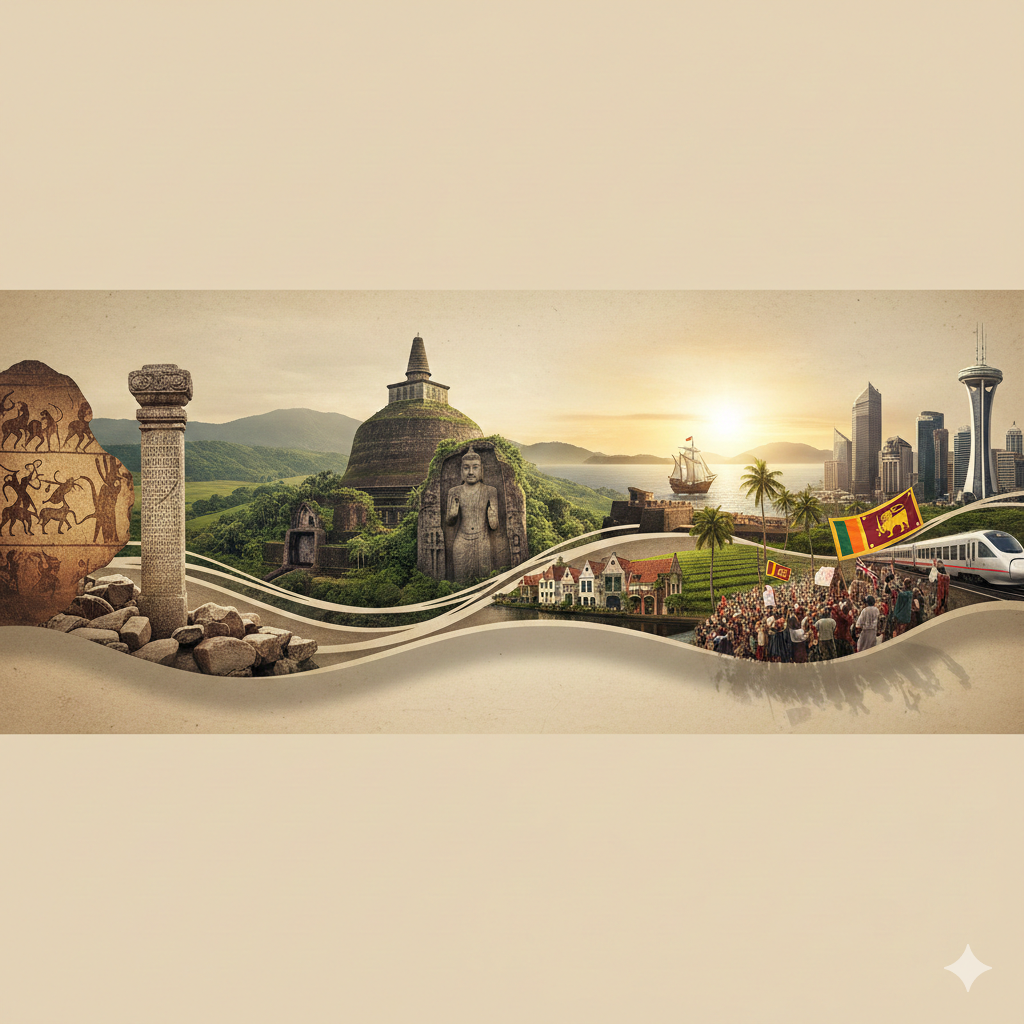
The history of Sri Lanka, known as the Pearl of the Indian Ocean, spans over 3,000 years, marked by glorious ancient kingdoms, the continuous flourishing of Buddhism, significant foreign invasions, and the transformative impact of colonial rule. This history is crucial not only to the island’s identity but also to the broader cultural and political history of South Asia.
 Prehistoric and Protohistoric Eras
While modern historical accounts typically begin with written records, the island’s human story stretches back much further.
-
- Prehistoric Evidence: Archaeological evidence points to human habitation as early as 300,000 years ago. The most notable prehistoric resident is the Balangoda Man (Homo sapiens balangodensis), whose skeletal remains and tools suggest a Mesolithic culture that thrived from about 34,000 BP (Before Present). These early inhabitants were hunter-gatherers and were highly adaptable, utilizing rock shelters and caves throughout the island.
-
- The Iron Age: Around 1000 BCE, the use of iron technology emerged, marking the transition to the Protohistoric period. The burial sites at Ibbankatuwa provide evidence of early agricultural and metal-working communities, suggesting a sophisticated social structure prior to the arrival of the legendary founders of the Sinhalese kingdoms.
 The Rise of the Sinhalese Civilization (c. 543 BCE – 1017 CE)
The foundational era of Sri Lankan history is chronicled in the Mahavamsa (Great Chronicle), a historical poem written in Pāli in the 6th century CE, which details the lineage of Sri Lankan kings and the establishment of Buddhism.
The Vijaya Legend and Early Settlements
The traditional starting point for the Sinhalese dynasty is 543 BCE, with the arrival of Prince Vijaya and his 700 followers.
-
- The Arrival: The Mahavamsa recounts that Vijaya, an exiled prince from northern India (specifically, the Vanga/Lala region), landed near Tammanna on the northwestern coast. He is said to have subdued the indigenous inhabitants, the Yakkhas, and established the first kingdom. This legend is highly symbolic, representing the migration of Indo-Aryan speakers and the fusion of new settlers with the existing populations.
-
- Early Centers: Vijaya’s followers settled in several locations, eventually consolidating their power. The most important early centers were on the northern dry zone, where irrigation technology was vital.
 The Anuradhapura Kingdom (c. 377 BCE – 1017 CE)
The Anuradhapura Kingdom is considered the longest-reigning continuous dynasty in South Asia, spanning over a millennium. It was the golden age of Sri Lankan civilization, characterized by grand hydraulic engineering and the deep establishment of Buddhism.
The Zenith of Power and Engineering
-
- Foundation: The city of Anuradhapura was officially established as the capital by King Pandukabhaya in the 4th century BCE. The city’s layout and sophisticated urban planning were unparalleled for its time.
-
- The Hydraulic Civilization: The kings of Anuradhapura oversaw the construction of massive reservoirs (tanks or wewas) and intricate canal networks. These sophisticated hydraulic systems were essential for large-scale rice cultivation in the dry zone. Notable examples include the Basawakkulama Tank and the Tissa Wewa. This technological prowess was the backbone of the kingdom’s economy and stability.
-
- King Devanampiya Tissa (c. 250-210 BCE): This king’s reign is epochal. According to tradition, he was converted to Buddhism by Mahinda, the son of the Mauryan Emperor Ashoka, who arrived in Sri Lanka. This conversion marked the official adoption of Theravada Buddhism as the state religion. The sapling of the Sri Maha Bodhi, the sacred fig tree under which Buddha attained enlightenment, was brought to Anuradhapura by the nun Sanghamitta and planted there, becoming one of the most sacred relics.
-
- Religious Architecture (Stupas/Dagobas): The era saw the construction of colossal stupas, magnificent domes housing Buddhist relics. The Ruwanwelisaya, Abhayagiri, and Jetavanarama are spectacular examples. The Jetavanarama stupa, in particular, was one of the tallest structures in the ancient world, showcasing the architectural and engineering skills of the time.
Tamil Influences and Conflicts
The geographical proximity to South India led to frequent cultural exchange and, often, military conflict.
-
- Elara and Duttagamani (c. 2nd Century BCE): The Mahavamsa vividly narrates the story of Elara, a Chola prince from South India who ruled Anuradhapura for 44 years. He was defeated in a famous battle by Duttagamani (Dutugemunu), a Sinhalese prince from Ruhuna (the south of the island). While Duttagamani’s victory is celebrated as a moment of national unity and the re-establishment of Sinhalese-Buddhist rule, the Mahavamsa notably praises Elara as a just and noble king, highlighting a complex history of coexistence and conflict.
-
- The Pallava and Pandyan Invasions: Throughout the Anuradhapura period, the kingdom faced periodic invasions from various South Indian powers, including the Pandyas and Pallavas. These invasions often resulted in the temporary overthrow of the Sinhalese monarchy, necessitating the payment of tribute or the retreat of the Sinhalese kings to the southern or central parts of the island.
The Shift of Power
By the end of the 10th century, the pressure from South Indian empires, particularly the resurgent Chola Empire, became overwhelming.
-
- Chola Conquest: In 993 CE, the powerful Chola emperor Rajaraja I invaded and effectively annexed the northern part of Sri Lanka. His son, Rajendra I, completed the conquest, and in 1017 CE, the capital of Anuradhapura was abandoned. The Cholas moved the capital to Polonnaruwa, a strategically important location further east. This marked the definitive end of the Anuradhapura Kingdom.
The Polonnaruwa Kingdom (c. 1055 – 1232 CE)
The Polonnaruwa Kingdom, though shorter-lived, represents a dynamic period of reunification, expansion, and sophisticated administration, particularly after the expulsion of the Cholas.
-
- Reunification by Vijayabahu I (1055-1110 CE): The period of Chola rule was ended by King Vijayabahu I, who led a protracted campaign to drive out the invaders and unite the island under Sinhalese rule once again. He formally moved the capital to Polonnaruwa, initiating a second golden age.
-
- Parakramabahu the Great (1153-1186 CE): Polonnaruwa reached its zenith under King Parakramabahu I, arguably the most ambitious and powerful monarch in Sri Lankan history.
-
- “Not even a drop of water that comes from the rain is to flow into the ocean without being made useful to man.” This famous quote encapsulates his dedication to hydraulic engineering. He is credited with the construction of the colossal Parakrama Samudra (Sea of Parakrama), an artificial reservoir that significantly expanded agricultural output.
-
- Military Campaigns: Parakramabahu not only fully unified the island but also launched ambitious foreign campaigns, notably a retaliatory expedition to South India and an invasion of Burma (Myanmar) to settle a trade dispute. This demonstrates the extent of the kingdom’s military and naval power.
-
- Religious and Architectural Patronage: His reign saw a revitalization of Buddhist monasticism and impressive construction, including the Vatadage (Circular Relic House) and the majestic rock-cut images of the Gal Vihara.
-
- Parakramabahu the Great (1153-1186 CE): Polonnaruwa reached its zenith under King Parakramabahu I, arguably the most ambitious and powerful monarch in Sri Lankan history.
-
- Decline: Following the death of Parakramabahu and later Nissanka Malla, the kingdom became unstable, plagued by internal power struggles, weak successors, and renewed invasions from South India (notably the Kalinga Magha invasion in 1215 CE). The central government collapsed, forcing the Sinhalese monarchy to move further south and west to defend itself.
 Transition and Fragmentation (c. 1232 – 1505 CE)
After Polonnaruwa, the island’s political center shifted continuously, moving between Dambadeniya, Yapahuwa, Kurunegala, Gampola, and finally, Kotte. This era is defined by the fragmentation of the central kingdom and the emergence of regional powers.
-
- The Moving Capitals: The shift was primarily driven by the need for better defense against invaders from South India and the increasing difficulty of maintaining the complex dry-zone irrigation systems after years of conflict. The capitals moved to the wet zone, where they were less dependent on massive tanks.
-
- The Jaffna Kingdom (c. 13th Century): In the north, the Jaffna Kingdom (also known as the Aryacakravarti Kingdom) emerged as a powerful, independent Tamil state. It was a sophisticated kingdom with its own administration, coinage, and cultural identity, fostering a rich tradition of Tamil literature and Saivite Hinduism. This period marks a clear political distinction between the Sinhalese kingdoms in the south/west and the Tamil kingdom in the north.
-
- The Kotte Kingdom (c. 1412 – 1597 CE): The last major Sinhalese kingdom before the colonial era was the Kotte Kingdom near modern-day Colombo. Under kings like Parakramabahu VI, the kingdom achieved a period of stability and cultural revival, briefly reuniting the whole island (excluding the Jaffna Kingdom). It became a prominent center for trade, interacting heavily with maritime traders from the Middle East and Southeast Asia.
-
- Economic and Cultural Shifts: This final period of indigenous rule witnessed increasing reliance on international trade, especially spices like cinnamon, which would soon attract European powers. The island was positioned perfectly along the maritime Silk Road.
The stage was thus set for the arrival of a new, global power that would fundamentally alter the course of Sri Lankan history: The Europeans.
Visit : www. dkbtech.com and allcircular.com