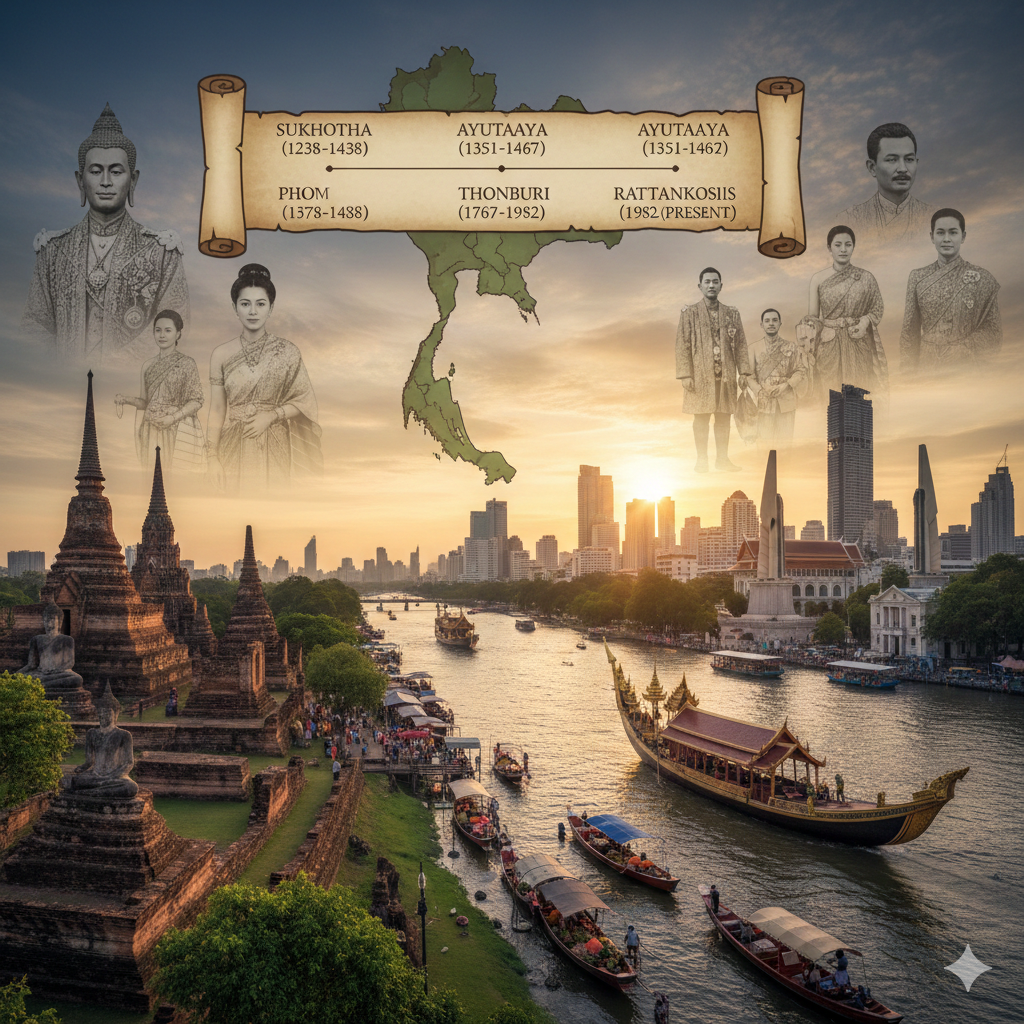
The History of Thailand, formerly known as Siam, is a rich and complex tapestry woven from indigenous civilizations, migrations, powerful kingdoms, religious devotion, and a unique national resilience in the face of global imperialism. It is the story of the only Southeast Asian nation to have successfully maintained its independence throughout the colonial era, charting a singular path from absolute monarchy to a modern constitutional state.
I. Pre-Thai Civilizations and the Tai Migration (Prehistory – c. 13th Century CE)
The landmass that is now Thailand has been inhabited for millennia. Archaeological evidence, most notably the Bronze Age settlements at Ban Chiang in the northeast, points to sophisticated early cultures with rice cultivation and bronze-casting as far back as 3,600 BCE.
The Indianized Kingdoms
Prior to the establishment of the first unified Tai kingdoms, the region was dominated by “Indianized” polities, which absorbed cultural, political, and religious influences from India.
-
- Dvaravati (c. 6th–11th Century CE): Centered in the Chao Phraya River valley, this Mon-speaking culture was a network of city-states that flourished as a center of Theravada Buddhism. Sites like Nakhon Pathom and Lopburi bear testament to its artistic and religious heritage.
-
- Srivijaya and Tambralinga (c. 8th–13th Century CE): In the south, the region came under the cultural and political influence of the Srivijaya maritime empire, based in Sumatra. Later, the independent kingdom of Tambralinga, centered in Nakhon Si Thammarat, emerged as a major Theravada Buddhist hub, maintaining vital maritime trade routes.
-
- The Khmer Empire (c. 9th–13th Century CE): For several centuries, the powerful Khmer Empire, with its capital at Angkor, held sway over large parts of Central and Northeastern Thailand. The grand Hindu-Buddhist temples at Phimai and Phanom Rung are enduring monuments to this period of Khmer political and cultural dominance, which heavily influenced later Tai political thought, particularly the concept of the god-king (devaraja).
The Tai People
The Tai peoples, the ancestral ethnic group of the modern Thai, are generally believed to have originated in what is now southern China and northern Vietnam. Over centuries, various Tai groups migrated southward into mainland Southeast Asia, establishing independent city-states, or mueang. As the Khmer Empire began to weaken in the 13th century, these independent Tai principalities rose to prominence, eventually forming the core of the Thai nation. Notable early Tai polities included Lan Na in the north, centered around Chiang Mai, and the small state that would evolve into the first major Thai kingdom.
II. The Classical Thai Kingdoms (c. 1238–1767)
The classical era of History of Thailand is defined by two powerful kingdoms: Sukhothai and Ayutthaya. These periods established the foundational elements of Thai culture, religion, and political structure.
The Sukhothai Kingdom (1238–1438)
The Kingdom of Sukhothai is traditionally heralded as the first independent Thai kingdom. Its founding in 1238 is often seen as a symbolic declaration of independence from Khmer suzerainty, when two Tai chieftains, Khun Bang Klang Hao and Khun Pha Muang, overthrew the Khmer outpost at Sukhothai.
-
- The Golden Age under Ramkhamhaeng (c. 1279–1298): Sukhothai reached its zenith under the third king, Ramkhamhaeng the Great. He is credited with the creation of the Thai script and the expansion of the kingdom’s influence across the Malay Peninsula. Crucially, Ramkhamhaeng introduced the concept of “Paternal Rule” (Phokhun), wherein the king was seen as a benevolent father figure, accessible to his people. This was a significant shift from the esoteric, Hindu-influenced devaraja concept of the Khmers. The king also actively promoted Theravada Buddhism from Sri Lanka (through Nakhon Si Thammarat), making it the unifying religion of the kingdom.
-
- Decline: Following Ramkhamhaeng’s death, Sukhothai began a gradual decline, its vassal states asserting independence. By the 15th century, it had been overshadowed and eventually absorbed as a vassal state by its more powerful southern neighbor, Ayutthaya. Despite its relatively short lifespan, Sukhothai is regarded as the “Golden Age” of Thai culture, leaving an indelible legacy in art, architecture, and political ideology.
The Ayutthaya Kingdom (1351–1767)
Founded in 1351 by King Ramathibodi I (Uthong) on an island in the Chao Phraya River, the Kingdom of Ayutthaya rapidly surpassed Sukhothai, becoming the dominant power in mainland Southeast Asia for over four centuries.
-
- Political and Social Structure: Ayutthaya’s political system was a fusion of Sukhothai’s Theravada Buddhist ideals and the powerful, ritualized court practices of the Khmer. The king returned to a more absolute, semi-divine status, incorporating the Hindu concept of the devaraja with the Buddhist Dhammaraja (Righteous King). This was formalized under King Trailokanat (r. 1448–1488) with the Sakdina System, a highly stratified social hierarchy based on a system of land entitlements and rank.
-
- Economic Power and International Trade: Ayutthaya was a thriving cosmopolitan port, strategically located to exploit the maritime trade routes connecting India, the Middle East, and China. Foreign communities—including Chinese, Japanese, Portuguese, Dutch, French, and British—established trading posts. This trade brought enormous wealth to the kingdom, funding its elaborate court and vast military.
-
- Golden Age and Foreign Relations: The 17th century, particularly the reign of King Narai the Great (r. 1656–1688), is considered a golden age for Ayutthayan diplomacy and culture. Narai maintained extensive contact with European powers, notably the French, whom he treated as valuable but controllable allies, skillfully balancing their influence against other powers like the Dutch.
-
- Conflict and Collapse: Throughout its history, Ayutthaya was engaged in frequent warfare with its neighbors, particularly the Burmese and the kingdoms of Lan Na and Laos. A series of devastating wars with the Konbaung dynasty of Burma led to the kingdom’s ultimate destruction. The Burmese laid siege to Ayutthaya, and in 1767, they captured, sacked, and utterly destroyed the capital city, effectively ending the Ayutthaya period.
III. The Thonburi and Rattanakosin Periods (1767–Present)
The immediate aftermath of Ayutthaya’s fall saw the country fragmented and occupied. The restoration of national unity and the founding of the current dynasty mark the final two periods of pre-modern Thai history.
The Thonburi Kingdom (1767–1782)
Following the destruction of Ayutthaya, a capable military leader of Chinese descent, General Phraya Taksin, rallied the scattered Thai forces. He successfully expelled the Burmese, reunified the central provinces, and established a new capital at Thonburi, a small river port closer to the sea.
-
- King Taksin the Great: Crowned King in 1769, Taksin spent his short reign fighting to consolidate his new kingdom, subjugating the principalities in the north and west, and retrieving the revered Emerald Buddha from Vientiane. However, his rule ended abruptly in 1782 when he was deposed and executed following an alleged descent into madness and a coup led by his trusted general.
The Rattanakosin Kingdom (1782–1932)
In 1782, General Chao Phraya Chakri ascended the throne as King Phutthayotfa Chulalok (Rama I), founding the Chakri Dynasty, which rules Thailand to this day. He moved the capital across the Chao Phraya River to the village of Bangkok (Krung Thep), founding the city that became the administrative and cultural heart of the modern nation.
-
- Restoration and Early Reigns (Rama I, II, III): The early Chakri kings focused on national consolidation, restoring the institutions of the Ayutthaya state, and defending against renewed Burmese invasions and conflicts with Vietnam. Rama I commissioned the compilation of the Three Seals Law and the restoration of Buddhist texts and art, essentially recreating the cultural glories of Ayutthaya in the new capital.
-
- The Great Reform Kings and the Threat of Imperialism (Rama IV and V): The 19th century was dominated by the rising tide of Western colonialism, which engulfed all of Thailand’s neighbors. Siam’s survival as the only independent Southeast Asian nation is a testament to the diplomatic skill and modernizing reforms of two great monarchs:
-
- King Mongkut (Rama IV, r. 1851–1868): A former monk well-versed in Western sciences and languages, he was a pragmatic modernizer. He opened Siam to Western trade and began the process of modernization to prove Siam was not a “barbaric” state deserving of colonization. His signing of the Bowring Treaty with Britain in 1855 significantly liberalized foreign trade but curtailed Siamese sovereignty.
-
- King Chulalongkorn (Rama V, r. 1868–1910): Considered the greatest of the Chakri reformers, Rama V systematically modernized the country’s administration, military, law, and infrastructure. He abolished slavery, reorganized the bureaucracy into Western-style ministries, built railways, and introduced a national education system. His reforms transformed Siam into a centralized nation-state. However, to preserve independence, Siam was forced to cede its suzerainty over Laos and Cambodia to the French and parts of the Malay Peninsula to the British.
-
- The Great Reform Kings and the Threat of Imperialism (Rama IV and V): The 19th century was dominated by the rising tide of Western colonialism, which engulfed all of Thailand’s neighbors. Siam’s survival as the only independent Southeast Asian nation is a testament to the diplomatic skill and modernizing reforms of two great monarchs:
-
- Towards Constitutionalism (Rama VI and VII): King Vajiravudh (Rama VI, r. 1910–1925) furthered nationalism and modernized the military, even leading Siam to join the Allied forces in World War I. His brother, King Prajadhipok (Rama VII, r. 1925–1935), inherited a country facing economic strain from the Great Depression and a growing sense among the educated elite that the absolute monarchy was outdated.
IV. The Constitutional Era (1932–Present)
The 20th century brought a seismic shift to Thai politics, moving the country from absolute rule to a constitutional system, though often one heavily influenced by the military.
The Siamese Revolution of 1932
On June 24, 1932, a bloodless coup d’état by a group of Western-educated military officers and civil servants known as the Khana Ratsadon (People’s Party) ended 700 years of absolute monarchy. King Prajadhipok (Rama VII) accepted the new reality, signing the first constitution and transforming Siam into a constitutional monarchy.
Military Dominance and World War II (1932–1945)
The new constitutional era quickly became one of military and civilian factionalism. Plaek Phibunsongkhram (Phibun), a strong military leader, rose to prominence, ushering in an era of intense Thai nationalism.
-
- The Name Change: In 1939, Siam was officially renamed Thailand (Prathet Thai), meaning “Land of the Free,” a symbolic act reflecting the ultra-nationalist ideology of the time.
-
- World War II: Phibun’s government was initially pro-Japanese. After a brief resistance, Thailand allowed Japan to use the country as a base for its invasion of Malaya and Burma, formally allying with the Axis powers and declaring war on the US and UK. Simultaneously, an anti-Japanese underground resistance, the Free Thai Movement, was active, supported by the Allies. This duality allowed Thailand to avoid the fate of a defeated nation.
The Cold War and the American Era (1945–1970s)
In the post-war period, Thailand aligned firmly with the United States to counter the spread of Communism in Southeast Asia. This anti-communist stance made Thailand a key strategic ally of the US, receiving substantial military and economic aid.
-
- Military Juntas: The period from 1947 to 1973 was dominated by a series of powerful military leaders, most notably Sarit Thanarat (r. 1958–1963), who centralized state power and aggressively promoted economic development and the institution of the monarchy as a symbol of national unity. This era, though autocratic, was marked by significant economic growth.
Political Turbulence and the Rise of People Power (1970s–2000)
The 1970s brought an end to prolonged military dictatorship, though instability remained the norm.
-
- The October 1973 Uprising: A massive student-led protest brought down the military regime of Thanom Kittikachorn, ushering in a brief and fragile period of democracy.
-
- The Coup of 1976: The civilian government collapsed due to internal divisions and fear of communist expansion from neighboring Vietnam, Laos, and Cambodia. This culminated in the brutal October 6, 1976 massacre of students at Thammasat University and a return to military rule.
-
- The 1992 Bloody May: After another period of military control, massive pro-democracy protests in May 1992, violently suppressed by the army, ultimately led to a return to a civilian-led government and a greater emphasis on democratic institutions. The 1997 Constitution, often called the “People’s Constitution,” was a major step towards greater transparency and democracy.
-
- The Asian Financial Crisis (1997): The crisis severely impacted the Thai economy, exposing deep-seated problems in its financial sector and shaking public confidence.
The Shinawatra Era and Deepening Political Divisions (2001–Present)
The early 21st century has been characterized by profound political polarization centered around the populist politician Thaksin Shinawatra, who served as Prime Minister from 2001 to 2006.
-
- Thaksin’s Premiership: Thaksin’s government introduced popular policies like universal healthcare and micro-loans, winning him massive support among the rural poor (“Red Shirts”). His style of governance and perceived conflicts of interest, however, alienated the traditional Bangkok elite, the military, and royalists (“Yellow Shirts”).
-
- The 2006 Coup: Thaksin was overthrown in a bloodless military coup, triggering a decade-long cycle of street protests by pro- and anti-Thaksin forces, interspersed with short-lived civilian governments and further military interventions.
-
- The 2014 Coup: Following years of political deadlock and mounting protests, the military, led by General Prayut Chan-o-cha, staged its most recent coup in May 2014, establishing a National Council for Peace and Order (NCPO) junta. This military government promised to restore order and enact reforms before returning to democracy.
-
- The Reign of Rama X: The nation entered a new era with the passing of the revered King Bhumibol Adulyadej (Rama IX) in 2016 and the accession of his son, King Maha Vajiralongkorn (Rama X), marking a new phase in the relationship between the monarchy, the military, and the public.
-
- Recent Developments: Elections were finally held in 2019, returning General Prayut as Prime Minister under a new constitution heavily influenced by the military. This led to mass pro-democracy youth protests in 2020, which, for the first time in modern Thai history, openly challenged the role of the monarchy, ushering in a period of unprecedented social and political tension that continues to define contemporary Thailand.
 Conclusion
The History of Thailand is a narrative of continuity and transformation. It is a story of powerful ancient kingdoms, a deeply ingrained Buddhist culture, and a legacy of national independence secured through shrewd diplomacy. The modern era is one of a nation grappling with the legacy of its absolute past, seeking to balance the power of its monarchy and military with the aspirations for a fully realized, stable democracy. Thailand’s enduring national identity, defined by its people, its religion, and the institution of the monarchy, remains the central force shaping its tumultuous but resilient journey into the future.
Visit : www.dkbtech.com and allcircular.com