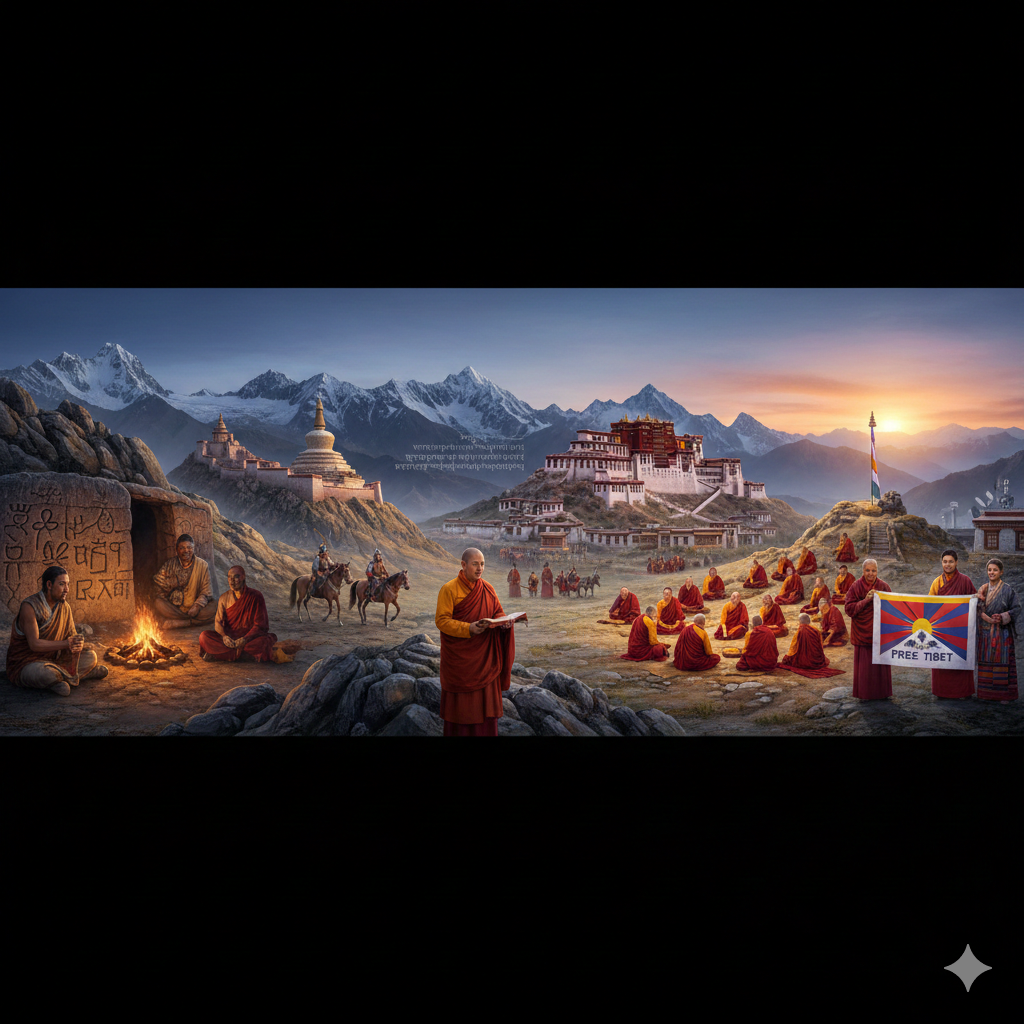
The history of Tibet is a profound saga spanning millennia, marked by periods of immense imperial power, a unique evolution into a theocratic state centered on a distinctive form of Buddhism, and a final, turbulent encounter with modern geopolitics.
I. Early History and the Imperial Age (Pre-7th Century – 842 CE)
Mythological Origins and the Yarlung Dynasty
Early Tibetan history is rooted in myth and the high-altitude landscape of the plateau. Tradition holds that the Tibetan people originated from the union of a monkey and a rock ogress, representing the compassion of the Bodhisattva Avalokiteśvara. The first kings belonged to the Yarlung Dynasty, which began in the Yarlung Valley, a fertile area southeast of Lhasa. The first king, Nyatri Tsenpo (traditionally c. 127 BCE), is a semi-mythical figure said to have descended from the heavens.
The Tibetan Empire and the Three Dharma Kings
The true historical era began in the 7th century CE with Songtsen Gampo (c. 604–650 CE), the 33rd King of the Yarlung Dynasty. He consolidated various tribes, unified the Tibetan Plateau, and established a powerful military empire.
-
- Political Expansion: The Tibetan Empire (Tubo) became a formidable power in Central Asia, challenging the Tang Dynasty of China and various Turkish groups. At its zenith, its influence stretched into parts of modern-day Nepal, India, Pakistan, and Central Asia.
-
- Cultural Foundations: Songtsen Gampo is credited with introducing the Tibetan script, developed by his minister Thonmi Sambhota after studying Indian scripts. This allowed for the first translation of Buddhist texts and the codification of laws.
-
- Introduction of Buddhism: Songtsen Gampo married Princess Bhrikuti of Nepal and Princess Wencheng of the Tang Dynasty. Both were Buddhists, and their influence is credited with the initial introduction of Buddhism, marked by the construction of the Jokhang and Ramoche temples in Lhasa.
-
- The “Three Dharma Kings”: Songtsen Gampo, along with Trisong Detsen (r. 755–797) and Ralpacan (r. 815–838), are revered as the “Three Dharma Kings” for their role in establishing Buddhism. Trisong Detsen formally declared Buddhism the state religion and invited the Indian master Padmasambhava (Guru Rinpoche) and the scholar Śāntarakṣita, leading to the founding of Samye Monastery, Tibet’s first monastic institution.
Decline and Fragmentation
The imperial period ended violently. King Langdarma (r. 841–842), a figure reviled in Buddhist histories, is said to have persecuted Buddhist monks and destroyed monasteries in an effort to revive the indigenous Bön religion. His assassination in 842 CE led to the collapse of centralized rule. The once-great empire fragmented into a dozen or more separate principalities and lordships, ushering in a long period known as the Era of Fragmentation.
II. The Second Dissemination of Buddhism and The Rise of Monastic Schools (9th Century – 17th Century)
The Renaissance of Buddhism
Beginning in the late 10th and 11th centuries, Buddhism was re-established, largely through figures from the Western Tibetan kingdoms and the arrival of Indian masters like Atiśa (982–1054). This era, the Second Dissemination, led to the formation of the distinct schools of Tibetan Buddhism:
-
- Nyingma (Ancient)
-
- Kagyu (Oral Lineage)
-
- Sakya (Grey Earth, named after its founding monastery)
-
- Kadam (later absorbed into Gelug)
The Mongol Patron-Priest Relationship (Yuan Dynasty)
In the History of Tibet the 13th century brought the threat of the Mongol Empire. Instead of outright conquest, Tibet developed a unique political and religious relationship.
-
- In 1244, the Mongol Prince Godan Khan invited Sakya Paṇḍita, the head of the Sakya school, to a meeting.
-
- This culminated in the Patron-Priest (Tibetan: Chöyön) relationship, where the Sakya Lama became the spiritual preceptor (Lama) of the Mongol Khans, and the Khans served as the temporal protector (Patron) of the Buddhist faith.
-
- When Kublai Khan established the Yuan Dynasty in China, he appointed the Sakya Lama Phagpa as his Imperial Preceptor, giving the Sakya school political control over Tibet. This administrative link, while providing a degree of autonomy, also brought Tibet under Mongol influence for the first time.
The Rise of the Gelug School and the Dalai Lamas
In the 14th and 15th centuries, Tibet reasserted its independence from the weakening Mongols. This period saw the emergence of Je Tsongkhapa (1357–1419), a reformer who founded the Gelug (or “Yellow Hat”) school, emphasizing strict monastic discipline and rigorous scholarship.
-
- The Dalai Lama Title: The title Dalai Lama was first conferred in 1578 by the Mongol leader Altan Khan upon Sonam Gyatso, who was subsequently recognized as the Third Dalai Lama (the two previous incarnations were recognized posthumously). The title means “Ocean Teacher” (Dalai is the Mongolian word for “ocean”).
-
- The Great Fifth: In the 17th century, the Gelug school faced political rivals. In 1642, with the military support of the Mongol warlord Güshri Khan, the Fifth Dalai Lama, Lobsang Gyatso (1617–1682), was established as the supreme spiritual and temporal ruler of all Tibet. This government, known as the Ganden Phodrang, ruled Central Tibet for over 300 years. The Fifth Dalai Lama initiated the construction of the magnificent Potala Palace in Lhasa.
III. Qing Dynasty and the Great Game (18th Century – 1912)
The Manchu Qing Influence
The 18th century saw the ascendancy of the Manchu-led Qing Dynasty in China. In 1720, Qing forces entered Lhasa to expel the invading Dzungar Mongols, marking the beginning of significant Qing administrative involvement.
-
- Appointment of Ambans: The Qing emperors appointed two resident high commissioners, or Ambans, in Lhasa. The Qing asserted a status of suzerainty (a relationship where the Chinese Emperor provided protection but Tibet retained internal autonomy), though the degree of actual Chinese authority fluctuated wildly depending on the strength of the Qing central government.
-
- The Golden Urn: Following a Gurkha invasion from Nepal (1788–1792), the Qing sent a massive army into Tibet. In 1793, they imposed the Twenty-Nine Article Ordinance, which included the Golden Urn system for selecting high lamas (though this system was frequently bypassed by the Tibetans).
The Great Game
By the late 19th and early 20th centuries, Tibet became a remote pawn in the geopolitical rivalry between the British Empire (in India) and the Russian Empire (the “Great Game”).
-
- Fearing Russian influence through the 13th Dalai Lama’s advisor, the British launched the Younghusband Expedition in 1904. A British Indian military force fought its way to Lhasa, forcing the Tibetan government to sign the Convention of Lhasa, which opened up trade routes and granted Britain influence. China subsequently signed conventions with Britain to reassert its theoretical authority.
-
- In response, the weak Qing government sent a large army to Lhasa in 1910 to assert direct control, forcing the 13th Dalai Lama, Thubten Gyatso, to flee to British India.
IV. The Period of De Facto Independence (1912 – 1951)
The Declaration of Independence
The collapse of the Qing Dynasty in the Xinhai Revolution of 1911 created a power vacuum.
-
- The 13th Dalai Lama returned to Lhasa in 1912 and, in 1913, issued a proclamation re-asserting Tibet’s independence, expelling the remaining Chinese troops.
-
- For the next 39 years, from 1912 to 1951, Central Tibet functioned as a de facto independent state. It issued its own currency and stamps, maintained a small army, and conducted foreign relations, though its independence was never formally recognized by most major world powers.
Attempts at Modernization
The 13th Dalai Lama attempted cautious modernization, including establishing a modern army and a post office, but his efforts were hampered by the conservative monastic establishment and powerful aristocratic families. After his death in 1933, a series of regents ruled while the 14th Dalai Lama, Tenzin Gyatso (born 1935), was located and trained.
V. Invasion and the Communist Era (1950 – Present)
The Chinese Invasion and the 17-Point Agreement
In 1949, the People’s Republic of China (PRC), under Mao Zedong, was established and immediately laid claim to Tibet as an inalienable part of Chinese territory.
-
- In October 1950, the People’s Liberation Army (PLA) crossed the border and defeated the small Tibetan army at Chamdo.
-
- In May 1951, Tibetan representatives, under duress, signed the “Agreement of the Central People’s Government and the Local Government of Tibet on Measures for the Peaceful Liberation of Tibet,” commonly known as the 17-Point Agreement. This accord affirmed China’s sovereignty but promised Tibet autonomy, respect for the status of the Dalai Lama, and non-interference in the existing political and religious systems.
Uprising, Flight, and Exile
For several years, the PRC generally honored the autonomy clause in Central Tibet (U-Tsang), but it aggressively implemented land reform and collectivization in the eastern Tibetan provinces of Kham and Amdo, which were incorporated into neighboring Chinese provinces (Sichuan, Qinghai, etc.). This led to widespread resistance and guerrilla warfare, which gradually spread to Central Tibet.
-
- 1959 Uprising: Fear that the Chinese were planning to abduct the young 14th Dalai Lama led to a massive popular uprising in Lhasa in March 1959. The PLA suppressed the revolt with brutal force.
-
- Flight to India: On March 17, 1959, the Dalai Lama fled Lhasa and successfully crossed the Himalayas into India, establishing the Tibetan Government in Exile (now the Central Tibetan Administration) in Dharamsala.
The Cultural Revolution and Modern Tibet
The years following the 1959 uprising were catastrophic.
-
- Destruction: During the Cultural Revolution (1966–1976), the Chinese government destroyed the vast majority of Tibet’s more than 6,000 monasteries, temples, and religious institutions. Monks and nuns were killed, imprisoned, or forced to disrobe, and the religious and cultural life of Tibet was nearly obliterated.
-
- Tibet Autonomous Region (TAR): In 1965, the Chinese government formally established the Tibet Autonomous Region (TAR), which covers only the western half of historical Tibet.
-
- Reform and Economic Development: Since the 1980s, Tibet has seen limited religious liberalization, allowing for the reconstruction of some monasteries. Simultaneously, the PRC has heavily invested in infrastructure, including the Qinghai–Tibet railway, promoting economic development, tourism, and resource extraction.
-
- Present Day: The Tibetan Plateau remains under tight control by the PRC. The government-in-exile, led by the 14th Dalai Lama, advocates for a “Middle Way Approach”—genuine autonomy for all Tibetan areas within the framework of the PRC Constitution. The issues of human rights, religious freedom, and the preservation of Tibetan culture continue to draw international attention.
Visit : www.dkbtech.com and allcircular.com