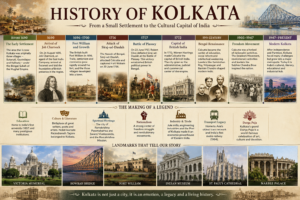
History of Kolkata: From a Riverside Settlement to the Cultural Capital of India
Introduction
Kolkata, formerly known as Calcutta, is one of India’s most historic and culturally significant cities. Situated on the eastern bank of the Hooghly River in the state of West Bengal, Kolkata has played a central role in shaping the political, economic, intellectual, and cultural history of modern India. Once the capital of British India and later a major center of the Indian independence movement, the city has witnessed centuries of transformation, from a cluster of small villages to a bustling metropolitan hub.
Known today as the “Cultural Capital of India,” Kolkata has produced some of the country’s greatest thinkers, writers, artists, scientists, and freedom fighters. The city’s history reflects the broader history of colonialism, industrialization, nationalism, and modernization in South Asia.
This article explores the rich and fascinating history of Kolkata, tracing its origins, growth under British rule, role in India’s renaissance and freedom struggle, and evolution into the modern metropolis it is today.
Early History and Ancient Background
The region where Kolkata stands today has been inhabited for centuries. Archaeological evidence suggests that human settlements existed in the lower Ganges delta long before the emergence of the city itself. The fertile lands surrounding the Hooghly River supported agriculture, fishing, and trade, making the area attractive for settlement.
Before the arrival of the British, the area consisted primarily of three villages:
-
Sutanuti
-
Govindapur
-
Kalikata
These villages were part of the Bengal Subah under the Mughal Empire. The local economy was based on agriculture, weaving, fishing, and river trade. The Hooghly River served as a vital transportation route connecting inland Bengal with the Bay of Bengal and international trade networks.
The region was also influenced by various Hindu and Buddhist traditions. Nearby temples and religious sites indicate that the area held spiritual significance long before the establishment of modern Kolkata.
Origin of the Name “Kolkata”
The origin of the name “Kolkata” remains a subject of debate among historians.
One popular theory suggests that the name derives from “Kalikata,” one of the three original villages. Some scholars believe Kalikata was named after the Hindu goddess Kali, whose famous temple at Kalighat became an important pilgrimage site.
Another theory connects the name to the Bengali words “khal” (canal) and “kata” (dug), referring to the canal systems that once characterized the region.
Some historians propose that the name may have originated from local practices related to lime production, while others suggest linguistic roots dating back to ancient Bengali settlements.
Regardless of its exact origin, “Kalikata” gradually evolved into “Calcutta” during British rule and officially became “Kolkata” again in 2001, reflecting the city’s Bengali heritage.
Bengal Before British Rule
Prior to British dominance, Bengal was one of the wealthiest regions in the world. During the Mughal period, Bengal was renowned for its textile industry, particularly muslin and silk production. European merchants from Portugal, the Netherlands, France, and England were drawn to Bengal’s prosperity.
The Mughal administration maintained political stability, encouraging trade and economic growth. Ports along the Hooghly River became important commercial centers. European trading companies established factories and warehouses throughout the region.
The English East India Company, founded in 1600, gradually increased its presence in Bengal. Initially focused on trade, the company sought favorable conditions for expanding its commercial operations.
The Arrival of the East India Company
The decisive chapter in Kolkata’s history began with the arrival of the British East India Company.
In the late seventeenth century, the Company sought a permanent trading base in Bengal. Job Charnock, an English administrator and Company official, is traditionally associated with the founding of Kolkata.
On August 24, 1690, Charnock arrived in Sutanuti and established a trading settlement. Although modern historians argue that Kolkata was not “founded” by a single individual because the villages already existed, Charnock played a crucial role in initiating British development of the area.
The East India Company subsequently acquired rights over the villages of Sutanuti, Govindapur, and Kalikata from local landlords. These villages were merged into a growing colonial settlement that would eventually become Calcutta.
Construction of Fort William
As British commercial interests expanded, security became a major concern.
In 1696, the East India Company began constructing Fort William. The fort served as both a military stronghold and an administrative center. Its presence symbolized the growing influence of the Company in Bengal.
Around the fort, warehouses, markets, offices, and residential areas developed rapidly. European merchants, soldiers, and administrators settled in increasing numbers.
The construction of roads, docks, and trading facilities transformed the once-rural villages into an emerging urban center.
Conflict with Siraj-ud-Daulah
The expansion of British power alarmed the rulers of Bengal.
In 1756, Siraj-ud-Daulah, the Nawab of Bengal, attacked Calcutta after becoming concerned about British fortifications and political ambitions. He successfully captured Fort William and temporarily drove the British out of the city.
This conflict marked a turning point in Indian history. The British quickly regrouped and launched a military campaign to regain control.
The Battle of Plassey and British Ascendancy
In 1757, the Battle of Plassey dramatically altered the future of Bengal and India.
Led by Robert Clive, the East India Company defeated Siraj-ud-Daulah. The victory was achieved through military strategy as well as political alliances with disaffected local elites.
The Battle of Plassey is often regarded as the beginning of British political dominance in India. Following the victory, Calcutta emerged as the principal center of British power in Bengal.
Over the following decades, the East India Company expanded its authority across large parts of the Indian subcontinent.
Calcutta Becomes the Capital of British India
In 1772, Governor-General Warren Hastings designated Calcutta as the capital of British India.
This decision transformed the city into the administrative heart of the British Empire in South Asia. Government offices, courts, military headquarters, and commercial institutions were concentrated in the city.
Calcutta became a showcase of colonial architecture and urban planning. Grand buildings, churches, educational institutions, and public spaces were constructed throughout the city.
Important landmarks from this period included:
-
Government House
-
St. John’s Church
-
Writers’ Building
-
Town Hall
-
Supreme Court
By the nineteenth century, Calcutta had become one of the largest and most important cities in the British Empire.
Economic Growth and Commercial Expansion
The nineteenth century witnessed rapid economic growth in Calcutta.
The city’s strategic location on the Hooghly River facilitated domestic and international trade. The port became one of the busiest in Asia, handling exports of jute, tea, coal, textiles, and other goods.
Industrialization accelerated during this period. Jute mills, engineering works, shipyards, and manufacturing industries emerged across the region.
The development of railways further strengthened Calcutta’s position as a commercial hub. The city became the gateway to eastern and northeastern India.
Banks, insurance companies, and trading firms established headquarters in Calcutta, making it one of the financial centers of the British Empire.
The Bengal Renaissance
One of the most significant chapters in Kolkata’s history is the Bengal Renaissance.
Beginning in the early nineteenth century, Calcutta became the center of intellectual, social, and cultural reform. Exposure to Western education and ideas encouraged critical thinking and social change.
This movement produced a remarkable generation of scholars, reformers, writers, and educators.
Among the leading figures were:
Raja Rammohan Roy
Often called the “Father of Modern India,” Roy advocated social reforms, women’s rights, and educational modernization. He campaigned against practices such as sati and promoted rational thought.
Ishwar Chandra Vidyasagar
A pioneering educator and reformer, Vidyasagar worked tirelessly for women’s education and widow remarriage.
Bankim Chandra Chattopadhyay
A celebrated novelist and thinker, Bankim wrote “Vande Mataram,” which later became a powerful symbol of Indian nationalism.
Michael Madhusudan Dutt
A literary innovator who introduced new styles and forms into Bengali literature.
The Bengal Renaissance transformed not only Bengal but also the intellectual landscape of modern India.
Education and Academic Excellence
Calcutta emerged as the educational capital of India during the nineteenth century.
The establishment of institutions such as:
-
Hindu College (1817)
-
University of Calcutta (1857)
-
Presidency College
-
Scottish Church College
created opportunities for higher learning and research.
These institutions produced generations of scholars, scientists, lawyers, administrators, and political leaders.
Western science, philosophy, literature, and law became accessible to Indian students, contributing to the rise of a modern educated middle class.
Literature, Art, and Culture
Kolkata’s cultural influence extends far beyond its geographical boundaries.
The city became the center of Bengali literature, theater, music, and visual arts.
The most famous cultural figure associated with Kolkata is Rabindranath Tagore. Poet, novelist, philosopher, composer, and educator, Tagore became the first Asian recipient of the Nobel Prize in Literature in 1913.
His contributions revolutionized Bengali literature and influenced generations of writers worldwide.
The city also nurtured:
-
Sarat Chandra Chattopadhyay
-
Kazi Nazrul Islam
-
Jibanananda Das
-
Satyajit Ray
Kolkata’s theaters, publishing houses, and literary societies created a vibrant cultural environment that continues to thrive today.
Spiritual and Religious Heritage
Kolkata has long been an important center of spiritual thought.
The nineteenth century witnessed the rise of Ramakrishna Paramahansa, whose teachings emphasized religious harmony and direct spiritual experience.
His disciple, Swami Vivekananda, carried these ideas to the global stage, especially through his famous speech at the Parliament of Religions in Chicago in 1893.
The Ramakrishna Mission, founded by Vivekananda, became one of India’s most influential spiritual and humanitarian organizations.
Temples, churches, mosques, synagogues, and monasteries throughout the city reflect Kolkata’s rich religious diversity.
Nationalism and the Freedom Movement
Calcutta played a central role in India’s struggle for independence.
As the capital of British India and a center of intellectual activity, the city became a breeding ground for nationalist ideas.
The partition of Bengal in 1905 triggered widespread protests and gave rise to the Swadeshi Movement. Indians boycotted British goods and promoted indigenous industries.
Many revolutionary organizations emerged in Calcutta during this period.
Prominent freedom fighters associated with the city included:
-
Subhas Chandra Bose
-
Aurobindo Ghosh
-
Khudiram Bose
-
Surya Sen
Political activism, journalism, public meetings, and revolutionary movements made Calcutta one of the strongest centers of anti-colonial resistance.
Transfer of the Capital to Delhi
In 1911, the British government announced the transfer of the capital of India from Calcutta to Delhi.
Several factors influenced this decision:
-
Delhi’s central location
-
Political unrest in Bengal
-
Strategic administrative considerations
Although Calcutta lost its status as the imperial capital, it remained a major commercial, cultural, and intellectual center.
The city’s influence continued to shape Indian politics and society.
The Impact of World Wars
Both World War I and World War II significantly affected Kolkata.
During World War II, the city became a crucial military and logistical center for Allied operations in Southeast Asia.
The war years brought economic disruption, inflation, and shortages.
One of the darkest episodes in Kolkata’s history was the Bengal Famine of 1943, which caused immense suffering and resulted in millions of deaths across Bengal.
The city also experienced Japanese air raids during the war, highlighting its strategic importance.
Independence and Partition
India achieved independence in 1947, but freedom came with the trauma of Partition.
The division of British India created East Pakistan (now Bangladesh) and triggered one of the largest migrations in human history.
Millions of refugees crossed into West Bengal, many settling in Kolkata.
The sudden population increase placed enormous pressure on housing, infrastructure, employment, and public services.
Despite these challenges, the city absorbed refugees and adapted to changing social realities.
Post-Independence Industrial Development
After independence, Kolkata remained one of India’s leading industrial cities.
Key industries included:
-
Jute manufacturing
-
Engineering
-
Steel production
-
Chemicals
-
Textiles
-
Shipping
The Kolkata Port continued to serve as a major gateway for trade in eastern India.
However, from the 1960s onward, industrial decline, labor disputes, and changing economic patterns reduced the city’s dominance.
Many businesses relocated to other parts of India.
Political Developments
West Bengal experienced significant political transformations after independence.
The city became a center of labor movements, student activism, and political debate.
In 1977, the Left Front government came to power and remained in office for more than three decades.
Kolkata developed a reputation for political engagement and intellectual discourse. Public debates, literary discussions, and social activism became integral parts of urban life.
Transportation and Urban Infrastructure
Kolkata pioneered many transportation innovations in India.
The city is famous for its tram system, which began operations in the nineteenth century and remains the oldest operating tram network in Asia.
Other milestones include:
-
India’s first metro railway (1984)
-
Extensive suburban rail networks
-
Ferry services across the Hooghly River
-
Modern highways and flyovers
The iconic Howrah Bridge, completed in 1943, became one of the city’s most recognizable symbols.
Durga Puja and Cultural Identity
No discussion of Kolkata’s history is complete without mentioning Durga Puja.
The festival evolved from private aristocratic celebrations into a massive public cultural event. Today it is one of the world’s largest religious festivals.
Durga Puja showcases:
-
Artistic creativity
-
Community participation
-
Traditional craftsmanship
-
Cultural performances
The festival has become a defining feature of Kolkata’s identity and attracts millions of visitors every year.
Kolkata in Contemporary India
In the twenty-first century, Kolkata continues to evolve.
The city has diversified its economy through investments in:
-
Information technology
-
Education
-
Healthcare
-
Financial services
-
Tourism
-
Creative industries
Major infrastructure projects, new business districts, and urban renewal initiatives have modernized parts of the city while preserving its historic character.
Kolkata remains home to prestigious institutions, museums, libraries, theaters, and research centers.
Major Historical Landmarks
Several landmarks symbolize Kolkata’s rich past:
Victoria Memorial
Built in memory of Queen Victoria, it remains one of India’s most famous monuments.
Howrah Bridge
An engineering marvel and a symbol of Kolkata.
Indian Museum
The oldest and largest museum in India.
Marble Palace
A historic mansion showcasing art and architecture.
St. Paul’s Cathedral
A prominent example of Gothic Revival architecture.
Fort William
The military stronghold that played a key role in colonial history.
Legacy and Significance
Kolkata’s significance extends beyond politics and economics.
The city has shaped modern Indian thought through:
-
Literature
-
Journalism
-
Science
-
Education
-
Nationalism
-
Spirituality
-
Cinema
Few cities have contributed as profoundly to the intellectual and cultural development of India.
The traditions of debate, creativity, scholarship, and social consciousness remain deeply embedded in Kolkata’s identity.
Conclusion
The history of Kolkata is a story of transformation, resilience, and cultural brilliance. From three small villages on the banks of the Hooghly River, it grew into the capital of British India, the center of the Bengal Renaissance, a stronghold of the freedom movement, and one of the most influential cities in South Asia.
Its streets preserve memories of colonial rule, revolutionary struggles, literary achievements, and spiritual awakening. The city’s unique blend of tradition and modernity continues to inspire millions.
Today, Kolkata stands not only as the capital of West Bengal but also as a living monument to India’s historical journey. Its legacy as a center of culture, education, and intellectual life ensures that it remains one of the most important and fascinating cities in the world.