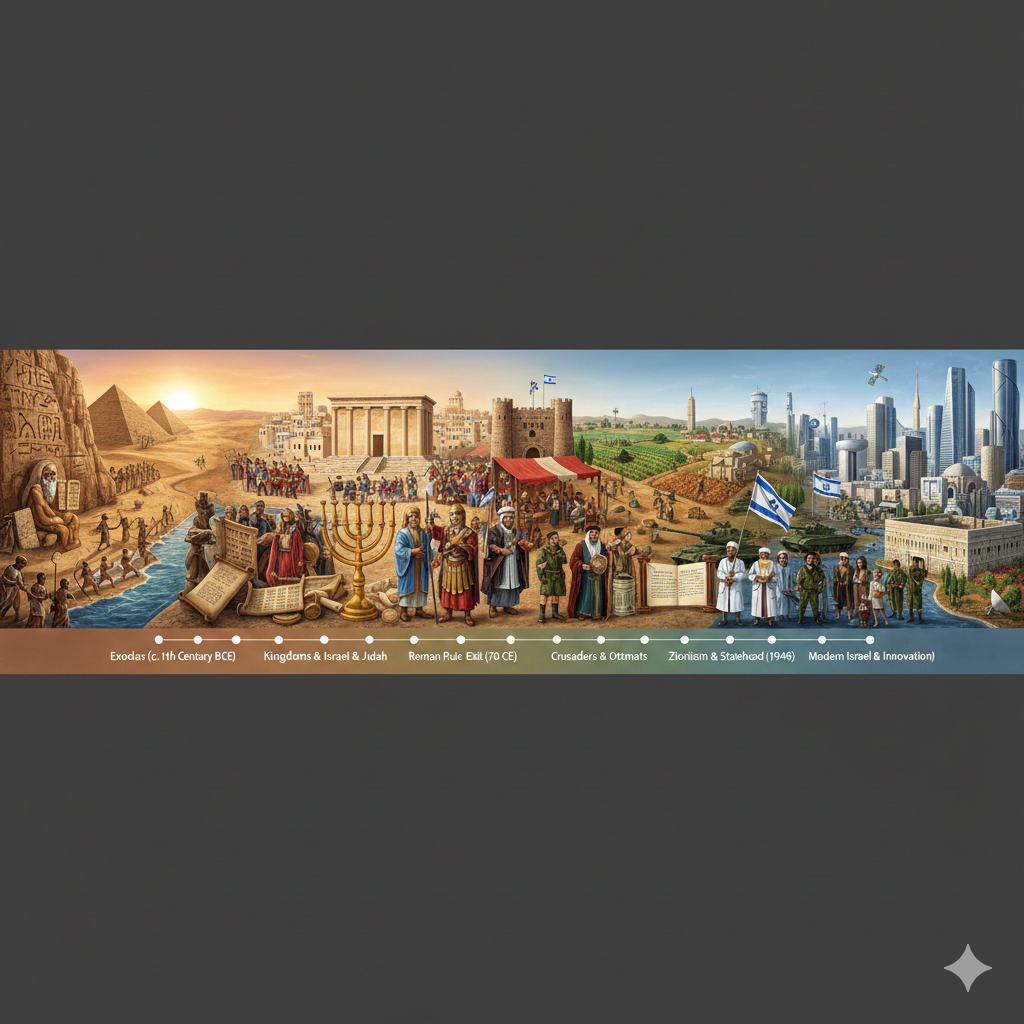
The history of Israel is one of the longest and most complex narratives in human civilization, spanning over three millennia. It is a story of monotheistic faith, national identity, conflict, exile, and renewal. The land, often referred to as Canaan, Judea, Palestine, or the Holy Land, has been the epicenter of three major monotheistic religions—Judaism, Christianity, and Islam—making its history critically important to a vast portion of the global population.
 I. Ancient Israel (c. 2000 BCE – 586 BCE)
The history of Israel begins with the foundational narrative of the Hebrews, as recorded in the Hebrew Bible (Tanakh).
The Patriarchal Age and Exodus
The traditional history starts with Abraham, around the 2nd millennium BCE, who is called to migrate from Mesopotamia to Canaan, the “Promised Land.” His descendants, Isaac and Jacob (later called Israel, from which the name of the people and land derives), are the progenitors of the Twelve Tribes of Israel. A period of famine eventually led the Israelites to migrate to Egypt, where they were ultimately enslaved. The definitive moment of formation for the Israelite people is the Exodus (c. 13th century BCE), where Moses leads them out of Egyptian bondage, receives the Ten Commandments (the foundation of the covenant and legal code) at Mount Sinai, and wanders for 40 years before entering Canaan.
The Period of the Judges
After the settlement of Canaan, the tribes existed in a loose confederacy governed by charismatic military and spiritual leaders known as the Judges (e.g., Deborah, Gideon, Samson). This was a time of frequent conflict with surrounding peoples, such as the Philistines.
The United Monarchy (c. 1050 – 931 BCE)
Facing external threats, the tribes united under a single king.
-
- Saul (c. 1050 BCE) was the first king, establishing the monarchy.
-
- David (c. 1000 BCE) succeeded Saul, conquered Jerusalem and made it the political and religious capital (“City of David”), and expanded the kingdom’s borders. He is revered as the greatest king of ancient Israel.
-
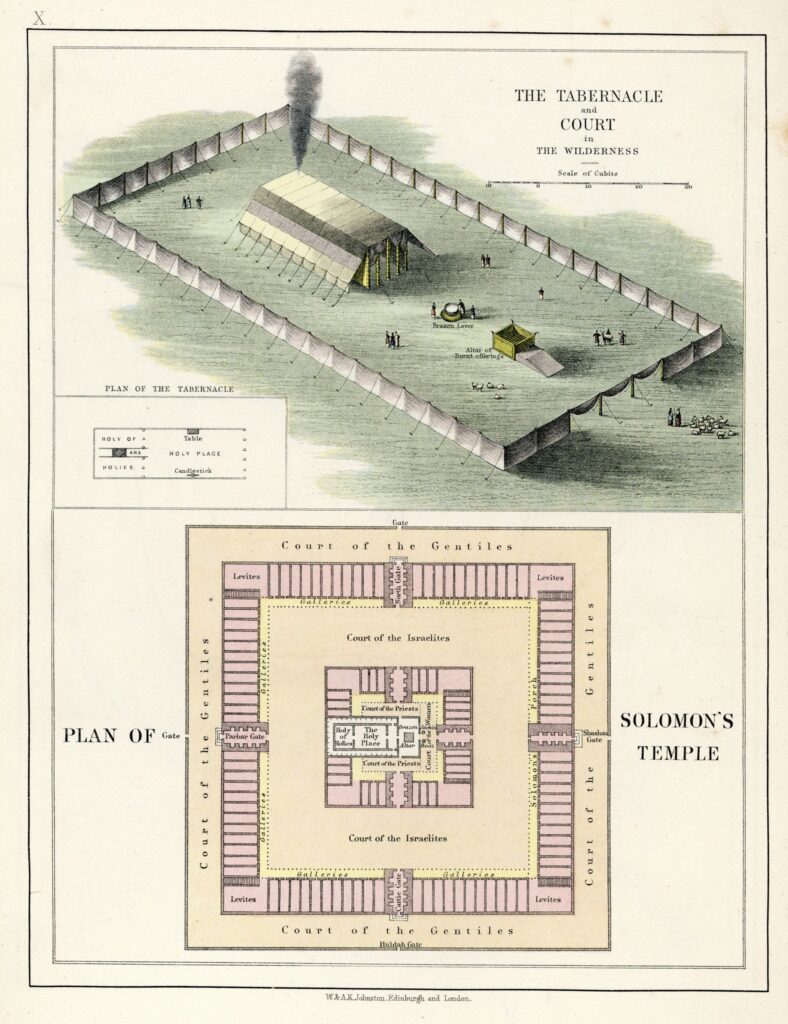
- Solomon (c. 970 BCE), David’s son, presided over a golden age of peace and prosperity. He built the First Temple in Jerusalem, centralizing the worship of Yahweh and solidifying Jerusalem’s status as the holy city.
The Divided Kingdom
Following Solomon’s death (931 BCE), the kingdom split into two:
-
- Kingdom of Israel (North): Comprised of ten tribes, with its capital first at Shechem, then Samaria.
-
- Kingdom of Judah (South): Comprised of the tribes of Judah and Benjamin, with its capital at Jerusalem.
The northern kingdom of Israel fell to the Assyrian Empire in 722 BCE, and its people became the “Lost Ten Tribes.” Judah survived longer until it was conquered by the Babylonian Empire.
 II. Exile, Return, and Roman Rule (586 BCE – 70 CE)
This era marks the transition from the Israelite to the Jewish people, as the focus narrowed to the tribe of Judah and the spiritual discipline developed in exile.
The Babylonian Exile and Return
In 586 BCE, Babylonian King Nebuchadnezzar II destroyed the First Temple, exiled the elite of Judah to Babylon, and ended the political sovereignty of the Davidic dynasty. This event, known as the Babylonian Exile, was a profound crisis but also a spiritual turning point. Jewish identity began to focus on the Torah (scripture) and synagogue (communal prayer and study), ensuring survival without a Temple or homeland.
The exile ended in 539 BCE when the Persian King Cyrus the Great conquered Babylon and allowed the Jews to return and rebuild. The Second Temple was dedicated in 516 BCE. This period is known as the Second Temple Period.
Hellenistic and Hasmonean Periods
The region came under the control of Hellenistic empires after the conquests of Alexander the Great. Following attempts to forcibly Hellenize the Jewish people, which included desecrating the Temple, the Maccabees led a successful revolt (167–160 BCE). They established the Hasmonean Dynasty, an independent Jewish state that lasted until the Roman conquest. This victory is celebrated in the festival of Hanukkah.
Roman Rule and the Destruction of the Second Temple
The Roman Empire conquered Judea in 63 BCE. Though the Jews were initially allowed some autonomy, Roman governors were often oppressive.
-
- Herod the Great (client king under Rome) famously renovated the Second Temple, creating one of the ancient world’s most magnificent structures.
-
- Growing tensions culminated in the First Jewish-Roman War (66–73 CE). In 70 CE, the Roman army, led by Titus, besieged and destroyed Jerusalem and the Second Temple.
The destruction of the Temple was a catastrophic event that fundamentally reshaped Judaism, leading to the Rabbinic period, where the focus shifted entirely to the study of the Torah, prayer, and good deeds.
 III. Diaspora and Medieval Periods (70 CE – Late 19th Century)
The vast majority of Jews lived in Diaspora (dispersion) outside the ancestral land, though a small continuous presence remained in Judea.
Jewish Life under Succeeding Empires
-
- Bar Kokhba Revolt (132–135 CE): A final, desperate revolt against Rome was crushed, leading to the Romans renaming the province Syria Palaestina (Palestine) and banning Jews from Jerusalem (Aelia Capitolina). This marked the definitive end of ancient Jewish sovereignty.
-
- Byzantine Rule: Under the Christian Byzantine Empire, Jews faced increasing restrictions and persecution.
-
- Early Arab/Islamic Rule (7th Century CE): Following the Muslim conquest (637 CE), Jerusalem became the third holiest site in Islam. Jews and Christians were considered dhimmis (protected people) and were generally allowed to practice their religion, though with social and legal disadvantages.
-
- The Crusades (1099–1291): The Christian Crusader Kingdoms ruled for about two centuries, bringing immense violence to the region and massacres of both Jewish and Muslim populations.
Throughout these eras, the Jewish community in the land, known as the Yishuv, persisted, maintaining religious centers, especially in Jerusalem, Tiberias, Safed, and Hebron.
The Ottoman Empire
From 1517 to 1917, the land was part of the vast Ottoman Empire. Jewish life in the Diaspora flourished in various centers—Spain (until 1492), Eastern Europe, and the Islamic world—always maintaining a deep, religious connection to the Land of Israel, expressed through daily prayers and pilgrimage.
 IV. Zionism and the Road to Statehood (Late 19th Century – 1948)
The late 19th and early 20th centuries witnessed the birth of the political movement that would fundamentally change the course of Jewish history.
The Rise of Zionism
-
- Background: The rise of anti-Semitism in Europe (especially pogroms in Russia) and the failure of Jewish assimilation in Western Europe fueled a desire for a national home.
-
- Founding: Theodor Herzl, an Austro-Hungarian journalist, is considered the founder of political Zionism. His book, Der Judenstaat (The Jewish State, 1896), argued for the establishment of a sovereign Jewish state in the ancient homeland.
-
- First Aliyah (1881–1903): Organized Jewish immigration (Aliyah) began, driven by religious and nationalist motivations, focusing on agricultural settlement. The Hebrew language was revived as a spoken tongue.
The British Mandate
-
- World War I: The Ottoman Empire was defeated. In 1917, the British issued the Balfour Declaration, publicly declaring support for “the establishment in Palestine of a national home for the Jewish people.”
-
- League of Nations Mandate (1920): Britain was granted a mandate over Palestine to prepare the territory for self-governance, incorporating the terms of the Balfour Declaration.
-
- Growing Tensions: Jewish immigration increased significantly, particularly during the 1920s and 1930s to escape the rise of Nazism in Europe. This led to escalating tensions and conflict with the local Arab population, who also sought national independence.
The Holocaust and the UN Partition
The Holocaust (1941–1945), in which six million Jews were systematically murdered by the Nazis, underscored the existential need for a sovereign Jewish state to act as a refuge. In 1947, Britain, unable to resolve the conflict, handed the problem to the United Nations (UN).
-
- UN Resolution 181 (November 29, 1947): The UN General Assembly voted to partition Palestine into separate Arab and Jewish states, with Jerusalem under international administration. The Jewish leadership accepted the plan, while the Arab leadership rejected it, viewing it as an infringement on their rights.
 V. The Modern State of Israel (1948 – Present)
This final period marks the realization of the Zionist dream and the subsequent decades of nation-building, conflict, and economic development.
The War of Independence and Founding (1948)
On May 14, 1948, as the British Mandate expired, David Ben-Gurion, the head of the Jewish Agency, declared the establishment of the State of Israel. The very next day, a coalition of Arab states (Egypt, Transjordan, Syria, Lebanon, and Iraq) invaded the new state.
-
- Outcome: Israel successfully defended its independence in the 1948 Arab-Israeli War (War of Independence). The war resulted in the state controlling significantly more territory than the UN partition plan had allocated.
-
- Consequences: The war created the Palestinian refugee problem (Nakba), as hundreds of thousands of Palestinians fled or were expelled from their homes. It also led to the expulsion or flight of most Jewish communities from Arab and Muslim countries to Israel.
Wars and Territorial Changes
Israel’s history has been continuously defined by security concerns and regional conflict:
-
- Suez Crisis (1956): Israel, allied with Britain and France, invaded the Sinai Peninsula after Egypt nationalized the Suez Canal.
-
- Six-Day War (June 1967): Surrounded by mobilizing Arab armies, Israel launched a preemptive strike. In six days, it defeated the combined forces and captured:
-
- The Sinai Peninsula and Gaza Strip (from Egypt)
-
- The West Bank and East Jerusalem (from Jordan)
-
- The Golan Heights (from Syria) The capture of the Old City of Jerusalem and the Western Wall was considered a monumental historical and religious event for the Jewish people.
-
- Six-Day War (June 1967): Surrounded by mobilizing Arab armies, Israel launched a preemptive strike. In six days, it defeated the combined forces and captured:
-
- Yom Kippur War (October 1973): Egypt and Syria launched a surprise attack on the holiest day of the Jewish year. Israel successfully counter-attacked, but the war demonstrated the need for peace.
The Peace Process and Ongoing Conflict
-
- Camp David Accords (1979): The first major peace treaty between Israel and an Arab nation, leading to the return of the Sinai to Egypt. Egyptian President Anwar Sadat and Israeli Prime Minister Menachem Begin shared the Nobel Peace Prize.
-
- First and Second Intifadas: Palestinian uprisings (Intifadas) against Israeli occupation and control in the West Bank and Gaza Strip marked periods of intense violence (1987-1993 and 2000-2005).
-
- Oslo Accords (1993): A landmark agreement between Israel and the Palestine Liberation Organization (PLO), leading to the creation of the Palestinian Authority (PA) and outlining a path toward a two-state solution.
-
- Peace with Jordan (1994): Israel signed a peace treaty with the Kingdom of Jordan.
-
- Disengagement from Gaza (2005): Israel unilaterally withdrew all military forces and civilian settlements from the Gaza Strip.
A Modern Nation
Today, Israel is a parliamentary democracy with a robust economy, globally renowned for its high-tech industry (“Startup Nation”). The central, ongoing challenge remains the resolution of the Israeli-Palestinian conflict—a dispute over land, security, and national rights that has yet to be settled.
Visit : www.dkbtech.com. and allcircular.com