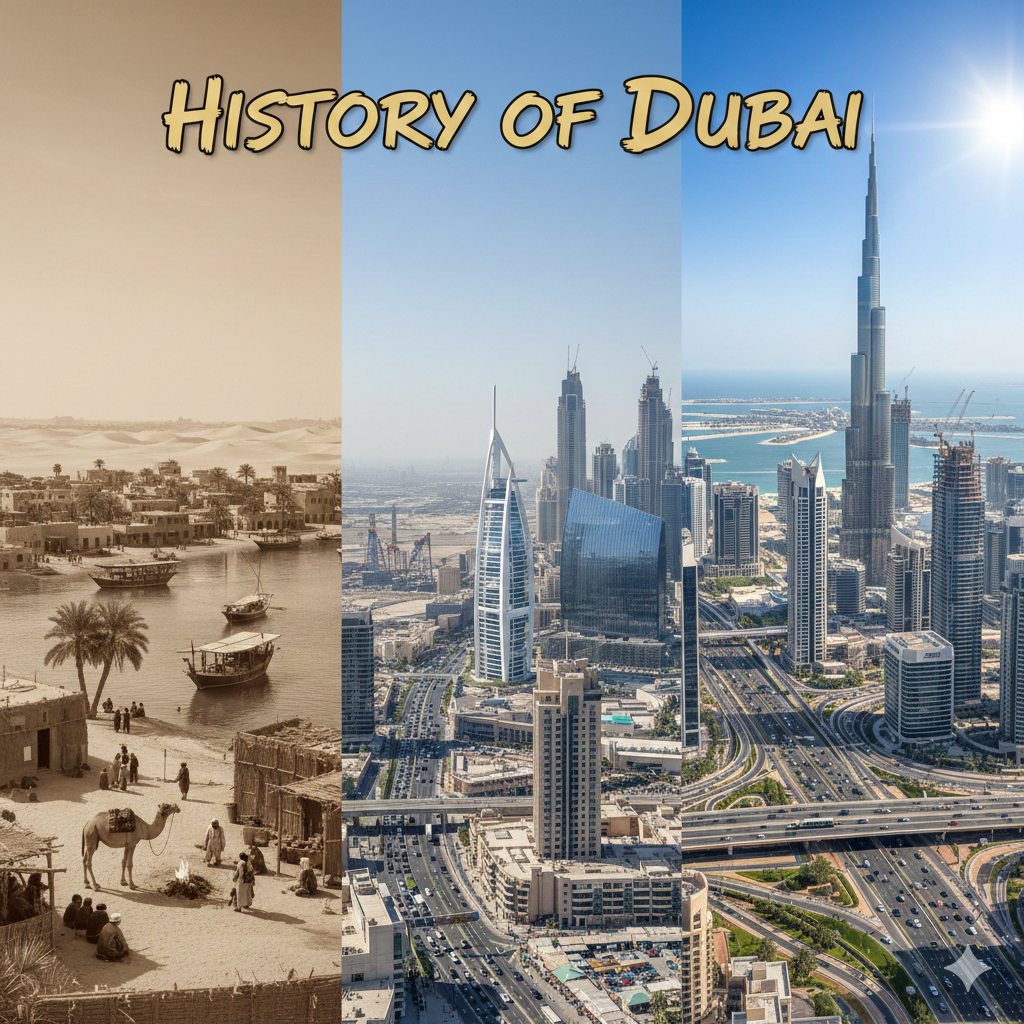
The History of Dubai: From Fishing Village to Global Hub:
The history of Dubai is a dramatic narrative of transformation, spanning millennia from a simple fishing settlement to one of the world’s most recognizable, modern cities.
Ancient Origins and Early Settlements (Pre-18th Century)
Archaeological findings in the area, such as those at Saruq Al Hadid, suggest human habitation in the region dates back to the Umm Al Nar period (c. 2600-2000 BCE). For centuries, the area was a key stop on the trade routes connecting Mesopotamia and the Indus Valley. By the time of the Abbasid Caliphate, the marshy region was known for its fishing and seasonal settlements. The most significant early economic activity was pearl diving, which sustained coastal communities for centuries. The natural, sheltered inlet of the Dubai Creek was a crucial factor, providing a safe harbor.
The Rise of the Al Maktoum Dynasty (18th – Early 20th Century)
The modern history of Dubai begins in 1833 when a branch of the Bani Yas tribe, led by Sheikh Maktoum bin Butti, migrated from the Liwa Oasis and settled at the Dubai Creek. This event established the Al Maktoum dynasty, which continues to rule Dubai today.
-
- Early Focus on Trade: Under the Al Maktoum leadership, Dubai quickly distinguished itself from neighboring settlements by cultivating a pro-trade environment. The Sheikhs encouraged merchants by offering zero taxation.
-
- The Pearl Era: The early 20th century marked the peak of Dubai’s pearling industry. Thousands of men were employed on dhows, and the trade created substantial wealth, fueling the construction of early commercial buildings and the Al Fahidi Historical Neighbourhood (Bastakiya).
-
- British Influence: Like the rest of the Trucial States (as the UAE was then known), Dubai signed a series of maritime and protective treaties with the United Kingdom, which governed foreign affairs and defense, ensuring regional stability.
 Economic Challenges and Resilience (1930s – 1960s)
The economic engine of Dubai faced a severe crisis in the 1930s.
-
- The Collapse of Pearling: The introduction of cultured pearls from Japan devastated Dubai’s primary industry.
-
- The Great Depression: Global economic downturn further stifled the remaining trade.
In response, Dubai’s leaders demonstrated an early aptitude for strategic diversification. To attract international merchants and ensure its status as the regional trading capital, rulers like Sheikh Saeed bin Maktoum Al Maktoum maintained the open-port, no-tax policy. They deepened and widened the Dubai Creek, allowing larger ships to dock, solidifying its position as the premier port on the coast.
 The Dawn of the Oil Era (1966 – 1971)
The discovery of oil fundamentally changed the trajectory of the emirate.
-
- Oil Discovery: In 1966, oil was discovered in Dubai’s offshore Fateh field.
-
- Strategic Investment: Crucially, Dubai’s leaders, primarily Sheikh Rashid bin Saeed Al Maktoum (father of the current ruler), adopted an unprecedented strategy: they did not hoard the oil wealth. Instead, they immediately used the revenue to invest heavily in large-scale infrastructure projects aimed at creating a post-oil economy. Key projects included the establishment of Port Rashid (1972) and the construction of the Dubai World Trade Centre (1979), a bold signal of Dubai’s international ambitions.
Formation of the United Arab Emirates (1971)
On December 2, 1971, Sheikh Rashid, alongside Sheikh Zayed bin Sultan Al Nahyan of Abu Dhabi and the rulers of the other Trucial States, played a pivotal role in establishing the United Arab Emirates (UAE). This union provided political and economic stability, allowing Dubai to focus on its development vision.
 The Modern Metropolis and Global Vision (1980s – Present)
Under the leadership of Sheikh Mohammed bin Rashid Al Maktoum, who assumed the role of Crown Prince in 1995 and Ruler in 2006, Dubai accelerated its transformation into a global city focused on tourism, finance, and logistics.
-
- The Tourism and Logistics Push: Building on its infrastructure, Dubai launched iconic projects designed to place it on the world map. The establishment of Emirates Airlines (1985) and the creation of Jebel Ali Port and Free Zone (JAFZA) transformed Dubai into a major international logistics hub.
-
- Architectural Icons: A series of ambitious projects cemented Dubai’s reputation for futuristic architecture and engineering marvels:
-
- Burj Al Arab (1999)
-
- The Palm Jumeirah (completed 2006)
-
- Burj Khalifa (2010), the world’s tallest building.
-
- Architectural Icons: A series of ambitious projects cemented Dubai’s reputation for futuristic architecture and engineering marvels:
Today, Dubai’s economy is less than 5% dependent on oil revenue, standing as a testament to its successful, decades-long strategy of diversification, driven by trade, services, finance, and tourism. It continues to pursue ambitious goals, such as the Dubai Plan 2030, to further enhance its quality of life and global competitiveness.
Visit : www.dkbtech.com and www.allcircular.com